"This is really the calling of our time — that is, to defeat these extremists and radicals,... an important part of laying the foundation for peace," the president said Monday. Bush: Look in the Mirror.
This, coming from someone who...
+ Started a war of Aggression
+ Misrepresentation of Intelligence to Justify War in Iraq
+ Abused War Powers to Justify Erosion of Civil Liberties
+ Initiated Warrantless Domestic Spying
+ Claims Common Article III of the Geneva Convention is Obsolete
+ Detains People Indefinitely without Due Process
+ Renditions People to Secret CIA Prisons
+ Renditions People to Countries Known to Conduct Torture
+ Used False Testimony Secured by Torture for Propaganda (Colin Powell UN Testimony)
+ Has Advocated and Conducted Torture
+ Withdrew from the Anti-ballistic Missile Treaty
+ Nominates Extreme Judges
+ Signing Statements indicating he won't follow laws.
+ Considers the Extreme Regligious Right to be his Base
+ Uses Harsh Retribution Against Countries & People that Oppose Bush Actions
+ Exposed a CIA Asset (Valarie Plame)
+ Surrounds himself with Extreme Advisors
+ Maintains Power through Election Fraud
+ Silences Government Scientists
+ Preventing Disclosure of White House Visitor Log
December 11, 2006
December 10, 2006
Richard Hugo Rorschach Approach to Writing
So, I'm reading The Trigger Town, by Richard Hugo. "Lectures and Essays on Poetry and Writing," said with a British accent and head thrown back. And I'm thinking this guy seems a bit forced in the way he advocates writing in a way that's not forced. He asks his "reader" to imagine a town and to pretend they know nothing of town but what they see. He implies we need to get into that mode when writing on subjects with which we ARE familiar. OK.
But he goes on with an example:
"That silo, filled with chorus girls and grain"
OK. I'm thinking, it's ... a bit forced. Then, I read his words, "I just said that line (Reader: Don't get smart. I actually did just write this down in the first darft of this.)" OK. don't get defensive...
Call me a skeptic. But I'm thinking, "He might do better to advise keeping one's ego out of their writing." He advises a "bare your soul" approach to writing.
I can't help but think his blurting phrase above reads like a Rorschach test. "So Dick, got "silos" and "chorus girls" on your mind? Sit down. Maybe you'd like to talk about this."
Yea, you can see the analyst now. I guess that's one approach to writing. I's sure the CIA would love it if everyone would indulge in that activity.... might keep the Secret Service working on overtime given the angst people feel inside about our current president.
Enough said. I suppose, sometimes, it's helpful to engage in Rorschach writing; particularly if suffering writer's block.
* In World War II, Richard Hugo served as a bombardier in the Mediterranean. Hugo flew thirty-five combat missions and reached the rank of first lieutenant before leaving the service in 1945. Gotta give him credit for that.
But he goes on with an example:
"That silo, filled with chorus girls and grain"
OK. I'm thinking, it's ... a bit forced. Then, I read his words, "I just said that line (Reader: Don't get smart. I actually did just write this down in the first darft of this.)" OK. don't get defensive...
Call me a skeptic. But I'm thinking, "He might do better to advise keeping one's ego out of their writing." He advises a "bare your soul" approach to writing.
I can't help but think his blurting phrase above reads like a Rorschach test. "So Dick, got "silos" and "chorus girls" on your mind? Sit down. Maybe you'd like to talk about this."
Yea, you can see the analyst now. I guess that's one approach to writing. I's sure the CIA would love it if everyone would indulge in that activity.... might keep the Secret Service working on overtime given the angst people feel inside about our current president.
Enough said. I suppose, sometimes, it's helpful to engage in Rorschach writing; particularly if suffering writer's block.
* In World War II, Richard Hugo served as a bombardier in the Mediterranean. Hugo flew thirty-five combat missions and reached the rank of first lieutenant before leaving the service in 1945. Gotta give him credit for that.
December 9, 2006
Bush and Conspirators Should be Investigated for Crimes Against Peace
 The principles of the London agreement of August 8, 1945, for the trial of major European war criminals, and the accompanying charter of the International Military Tribunal (Nuremberg Principles) should be applied to George W. Bush, the signatories of the Project for a New American Century, and others who conspired to commit fraud in marketing the Iraq war to the US Congress and general public.
Crimes Against Peace*:
i) Planning, preparation, initiation or waging of a war of aggression or a war in violation of international treaties, agreements or assurances;
(ii) Participation in a common plan or conspiracy for the accomplishment of any of the acts mentioned under (i).
Other Nuremberg Principles:
The charter enacts the principle that individuals rather than states are responsible for criminal violations of international law and applies to such lawbreakers the principle of conspiracy by which one who joins in a common plan to commit crime becomes responsible for the acts of any other conspirator in executing the plan.
It also prohibits the plea of "acts of state" as freeing defendants from legal responsibility, the charter refuses to recognize the immunity once enjoyed by criminal statesmanship.
Soldiers and officers who are refusing to serve in Iraq are supported by the charter principle, which provides that orders of a superior authority shall not free a defendant from responsibility. [1]
During the Nuremberg trials, the chief American prosecutor, Robert H. Jackson, stated:
"To initiate a war of aggression, therefore, is not only an international crime; it is the supreme international crime differing only from other war crimes in that it contains within itself the accumulated evil of the whole." [2]
In this view, despite statements by both Democrats and Republicans that much of the violence in Iraq is the blame of the Iraqis themselves, the ultimate responsibility for these accumulated evils are those who conspired to start the war of aggression against Iraq.
A former federal prosecutor named Elizabeth de la Vega has drafted a hypothetical indictment of President Bush, Vice President Cheney and other top officials for tricking the nation into war and for conspiracy to defraud the United States. The evidence and arguments are laid out in a new book entitled United States v. George W. Bush, et al.. [3][4]
But George W. Bush and his immediate conspirators may not be the only people who are exposed to legal action. Some British citizens are probably also culpable. In addition, some U.S. members of Congress could be legally exposed.
The U.S. Congress passed the 2006 Military Commissions Act, which among other things revises the 1996 US War Crimes Act to provide retroactive protection to George W. Bush and his conspirators. The War Crimes Act establishes serious punishments for people in the Executive Branch who violate the Geneva Conventions, including the death penalty for grave breaches. This recent action by Congress exposes their concern that certain people in the Executive Branch may be guilty of such crimes. Some have argued that Congress members who voted for this Act could be tried as accomplices under principles of obstruction of justice.
The Iraq War is Illegal
"The UN charter states that only the Security Council can authorise the use of force (except in cases of self-defence). ...[I]t is clear that in terms of the resolutions presented by the UK itself, the subsequent invasion was not authorised by the Security Council and was thus illegal. The clearest evidence of this is the fact that the UK sought an authorising resolution and failed to get it."
-- Carne Ross [5]
Sources, Notes and More Links:
* The definition of "crimes against peace" was first incorporated into the Nuremberg Principles and later included in the United Nations Charter. The United States has adopted the UN Charter as a treaty, ratified by the US Senate. Treaties form part of the "supreme law of the land" under the Constitution, Article VI, Clause 2.
[1] Much of the material preceding this reference number is taken directly from Yale University's Avalon Project.
[2] Wikipedia. Crimes against Peace, Nuremberg Principles.
[3] DemocracyNow! December 8, 2006.
[4] Text of the IndictmentCommondreams November 29, 2006, from TomDispatch.com
[5] Transcript of Carne Ross Testimony to Butler Inquiry
Who is Carne Ross: Ross was First Secretary in the UK Mission to the United Nations in New York from December 1997 until June 2002. He was responsible for Iraq policy in the mission, including policy on sanctions, weapons inspections and liaison with UNSCOM and later UNMOVIC.
During that time, he helped negotiate several UN Security Council resolutions on Iraq, including resolution 1284 which, inter alia, established UNMOVIC (an acronym Ross coined late one New York night during the year-long negotiation). He took part in policy debates within HMG and in particular with the US government. He attended many policy discussions on Iraq with the US State Department in Washington, New York and London.
British Diplomat's suppressed document lays bare the lies behind Iraq war
The Crime of War: From Nuremberg to Fallujah, a review of current international law regarding wars of aggression, Nicholas J.S. Davies.
December 8, 2006
Foley Panel: "It's OK to Lie"
The House Ethics Committee panel on Rep. Mark Foley's (R FL) sexual advances on under-aged pages rejected Hastert's contention that he couldn't recall separate warnings from two House Republican leaders. But the pane said Hastert, nor other GOP House members, broke no rules and should not be punished.
Hastert said he was pleased the committee found "there was no violation of any House rules by any member or staff."
The panel's most important "finding" is that House rules allow members of Congress to lie. Granted, the panel didn't state that finding, but we can read between the lines.
My message to Democratic wing of the plutocrats: You better tighten your rules before the unwashed masses tighten them for you.
Hastert said he was pleased the committee found "there was no violation of any House rules by any member or staff."
The panel's most important "finding" is that House rules allow members of Congress to lie. Granted, the panel didn't state that finding, but we can read between the lines.
My message to Democratic wing of the plutocrats: You better tighten your rules before the unwashed masses tighten them for you.
December 5, 2006
The Iraq Study Group Report: Plutocratic Damage Control
I'm not alone in feeling that the very need for the Iraq Study Group (ISG) exposes a flaw in our democracy. This need exposes the incapacity of Congress to exercise its oversight role. This incapacity is due, in part, to the Congress running in fear of the superficial corporate media, which can ruin a political career with a single ill-founded feeding frenzy.
The need for an ISG also exposes great weakness of Bush's Executive Branch, which suffers greatly from group think. Watching the ISG process feels like watching the "grown-ups" step in and clean up after the adolecents have been given a chance and have failed. More than that, it feels like the grown-ups are trying to talk down a suicidal teen who is standing on the brink.
Because George Bush and his cadre hold power, the ISG grown-ups are forced to negotiate with his administration. These negotiations are in addition to the international negotiations, and an implicit negotiation with the general public. A key principle of any negotiation is that all sides must "save face." The ISG report is, in great degree, a face-saving framework (withdrawl with honor). There are a lot of faces in the US that need to be saved, including some in the Democratic Party.
Iraq war oponents, like myself and others who saw through the false claims of "weapons of mass destruction," are critical of the ISG report. We read lines like one in the "Politics" section, "Iraq is a sovereign state...," as more face-saving fluff. We know the US is occupying Iraq, even if the story line says otherwise; we can read Brzezinski.
I appreciate the delicacy of the Baker-Bush negotiations. Perhaps we need to save Bush's face, as a practical matter, while extricating him from his historic mess. However, we cannot allow Bush's actions to be swept under the rug. We, the opponents of the Iraq war, are part of the negotiation. We want Bush and his conspirators to be punished for what they have done. Some might view the harsh Baker-Hamilton "Assessment" section of the report as part of that punishment; the embarassment of having Daddy's people come in and clean up his son's mess is noted. But we ultimately want George W. Bush and his conspirators formally investigated for crimes against peace. This is necessary as a lesson for future presidents that the public will not accept such behavior.
Bush continues to say the mission will not change, we must "win" the war. This is part of the face-saving dance we are watching. It's also part of another negotiation taking place; this is the unstated negotiation between the plutocrats (political elite) and the general public. It's as if George Bush is playing the bad cop for the plutocrats, and the ISG is playing the good cop for the plutocrats. The general public is not of one mind, but to the plutocrats we are the unwashed masses that they need to divide and conquer. Baker-Hamilton's rare honesty of the "Assessment" section works toward this end by striving to appease some of the public. I'm duely divided from anyone who is appeased by this "refreshing honesty;" I expect this level of honesty in public discourse as a routine matter.
The ISG report also perpetuates an attitued of "blame the victim." Both Democrats and Republicans are guilty of this when they say the Iraqis must solve their own problems. When I hear this I'm reminded of a quote by the chief American prosecutor during the Nuremberg trials, Robert H. Jackson. He said,
"To initiate a war of aggression, therefore, is not only an international crime; it is the supreme international crime differing only from other war crimes in that it contains within itself the accumulated evil of the whole."
In other words, George Bush is responsible for causing the "problems" the Iraqis "must solve on their own." The chaos in Iraq that didn't exist before the US invasion, including bombings of mosques, friendly fire deaths and injuries, psychological traumas on all sides, damages from looting including the loss of antiquities, even the sectarian killing are part of the "accumulated evil of the whole," for which Bush and his conspirators are ultimately responsible. Furthermore, the US is financially liable for damages in Iraq. Middle-class US tax payers will bear the burden if we don't secure a redistribution of the war profits, which includes oil windfalls.
I could go on. To some degree, the ISG report is just one step in a long process, like the turnover of "sovereignty," like the Iraq elections (like the 2006 US elections), like the killing of Al-Zarqawi. Yet, on another level the ISG phenomenon is a historic display of plutocratic damage control, which will be studied for generations. Those of us seeking deeper social change, in part to prevent such wars of aggression in the future, need to view the ISG report as an opening.
Further Reading:
ISG Report
Baker vs. “The Lobby”, Mike Whitney, December 9, 2006.
plutocracy, aristocracy, elite, monarch
The need for an ISG also exposes great weakness of Bush's Executive Branch, which suffers greatly from group think. Watching the ISG process feels like watching the "grown-ups" step in and clean up after the adolecents have been given a chance and have failed. More than that, it feels like the grown-ups are trying to talk down a suicidal teen who is standing on the brink.
Because George Bush and his cadre hold power, the ISG grown-ups are forced to negotiate with his administration. These negotiations are in addition to the international negotiations, and an implicit negotiation with the general public. A key principle of any negotiation is that all sides must "save face." The ISG report is, in great degree, a face-saving framework (withdrawl with honor). There are a lot of faces in the US that need to be saved, including some in the Democratic Party.
Iraq war oponents, like myself and others who saw through the false claims of "weapons of mass destruction," are critical of the ISG report. We read lines like one in the "Politics" section, "Iraq is a sovereign state...," as more face-saving fluff. We know the US is occupying Iraq, even if the story line says otherwise; we can read Brzezinski.
I appreciate the delicacy of the Baker-Bush negotiations. Perhaps we need to save Bush's face, as a practical matter, while extricating him from his historic mess. However, we cannot allow Bush's actions to be swept under the rug. We, the opponents of the Iraq war, are part of the negotiation. We want Bush and his conspirators to be punished for what they have done. Some might view the harsh Baker-Hamilton "Assessment" section of the report as part of that punishment; the embarassment of having Daddy's people come in and clean up his son's mess is noted. But we ultimately want George W. Bush and his conspirators formally investigated for crimes against peace. This is necessary as a lesson for future presidents that the public will not accept such behavior.
Bush continues to say the mission will not change, we must "win" the war. This is part of the face-saving dance we are watching. It's also part of another negotiation taking place; this is the unstated negotiation between the plutocrats (political elite) and the general public. It's as if George Bush is playing the bad cop for the plutocrats, and the ISG is playing the good cop for the plutocrats. The general public is not of one mind, but to the plutocrats we are the unwashed masses that they need to divide and conquer. Baker-Hamilton's rare honesty of the "Assessment" section works toward this end by striving to appease some of the public. I'm duely divided from anyone who is appeased by this "refreshing honesty;" I expect this level of honesty in public discourse as a routine matter.
The ISG report also perpetuates an attitued of "blame the victim." Both Democrats and Republicans are guilty of this when they say the Iraqis must solve their own problems. When I hear this I'm reminded of a quote by the chief American prosecutor during the Nuremberg trials, Robert H. Jackson. He said,
"To initiate a war of aggression, therefore, is not only an international crime; it is the supreme international crime differing only from other war crimes in that it contains within itself the accumulated evil of the whole."
In other words, George Bush is responsible for causing the "problems" the Iraqis "must solve on their own." The chaos in Iraq that didn't exist before the US invasion, including bombings of mosques, friendly fire deaths and injuries, psychological traumas on all sides, damages from looting including the loss of antiquities, even the sectarian killing are part of the "accumulated evil of the whole," for which Bush and his conspirators are ultimately responsible. Furthermore, the US is financially liable for damages in Iraq. Middle-class US tax payers will bear the burden if we don't secure a redistribution of the war profits, which includes oil windfalls.
I could go on. To some degree, the ISG report is just one step in a long process, like the turnover of "sovereignty," like the Iraq elections (like the 2006 US elections), like the killing of Al-Zarqawi. Yet, on another level the ISG phenomenon is a historic display of plutocratic damage control, which will be studied for generations. Those of us seeking deeper social change, in part to prevent such wars of aggression in the future, need to view the ISG report as an opening.
Further Reading:
ISG Report
Baker vs. “The Lobby”, Mike Whitney, December 9, 2006.
plutocracy, aristocracy, elite, monarch
December 4, 2006
Senator Brownback is a Joke
In case Senator Brownback didn't notice, his extreme, fundamentalist brand or politician is on the outs. Who is he trying to kid? Apparently, he has kidded himself as he announces a bid for Republican presidential nomination in 2008.
IMMIGRATION: Brownback voted for fencing off Mexico, a loosning position given the huge turn-out of the Latino vote for Democrats in 2006.
CIVIL LIBERTIES: Brownback voted for the Military Commission's Act, which revokes the right of Habeas Corpus and allows secret evidence to be used, contrary to the very foundation that makes America ... America.
Domino's Pizza founder, Tom Monaghan, has joined Brownback's exploratory committee, a good reason to boycott Domino's Pizza.
No offense to Kansas, I have family roots there, but Brownback continues to believe the earth is flat. Not one to need evidence, because he's all about "faith," he cites the topology of Kansas as evidence.
There is so much more to say about why Brownback should not be president, but frankly, he doesn't have a chance, so I can't see wasting any more of my time on it.
IMMIGRATION: Brownback voted for fencing off Mexico, a loosning position given the huge turn-out of the Latino vote for Democrats in 2006.
CIVIL LIBERTIES: Brownback voted for the Military Commission's Act, which revokes the right of Habeas Corpus and allows secret evidence to be used, contrary to the very foundation that makes America ... America.
Domino's Pizza founder, Tom Monaghan, has joined Brownback's exploratory committee, a good reason to boycott Domino's Pizza.
No offense to Kansas, I have family roots there, but Brownback continues to believe the earth is flat. Not one to need evidence, because he's all about "faith," he cites the topology of Kansas as evidence.
There is so much more to say about why Brownback should not be president, but frankly, he doesn't have a chance, so I can't see wasting any more of my time on it.
December 3, 2006
Why the 109th Congress Could Not be Bipartisan
It was impossible for the recent* Congresses, under Republican control, work in a bipartisan manner. This was the fault of the Majority leadership. Because they sought to destroy our government, Democrats could not work with them in a constructive way. That is, it was impossible for Democrates negotiate "compromises" on the fundamental dismanetling of our governing institutions.
The Republican leadership took a fundamentalist view toward the notion of "less government," leading to a view that could be summed up as "no government."** This was epressed in terms of extreme legislative proposals representing steps toward dismanteling institutions like social security. This leadership includes the White House under George W. Bush. This view is verbalized by Grover Norquist, key Bush advisor and founder of Americans for Tax Reform, who says, "My goal is to cut government in half in twenty-five years.." "..to get it down to the size where we can drown it in the bathtub."
This isn't just rehtoric from someone who likes to say pithy things on TV. Wall Street eononomist and former Treasury Secretry, Robert Rubin, wrote*** that he believed the Bush administration sought to force the government into such deep debt that it would be impossible to fund medicare and social security. Rather than structure legislation to "reform" these institutions, the goal was to kill them. It isn't possible for Democrats to "be bipartasin," and "go half-way" when the goal was death. The Repbulicans understood this, so they chose differet means to the same end; spend the US into such deep debt that their goals of destroying government becomes a foregone conclusion, regardless of what the Democrats would want to do if they regained control of Congress.
* Since 1994.
** Ironically, "no government" is also the anarchist goal.
*** I need to track down that article.
The Republican leadership took a fundamentalist view toward the notion of "less government," leading to a view that could be summed up as "no government."** This was epressed in terms of extreme legislative proposals representing steps toward dismanteling institutions like social security. This leadership includes the White House under George W. Bush. This view is verbalized by Grover Norquist, key Bush advisor and founder of Americans for Tax Reform, who says, "My goal is to cut government in half in twenty-five years.." "..to get it down to the size where we can drown it in the bathtub."
This isn't just rehtoric from someone who likes to say pithy things on TV. Wall Street eononomist and former Treasury Secretry, Robert Rubin, wrote*** that he believed the Bush administration sought to force the government into such deep debt that it would be impossible to fund medicare and social security. Rather than structure legislation to "reform" these institutions, the goal was to kill them. It isn't possible for Democrats to "be bipartasin," and "go half-way" when the goal was death. The Repbulicans understood this, so they chose differet means to the same end; spend the US into such deep debt that their goals of destroying government becomes a foregone conclusion, regardless of what the Democrats would want to do if they regained control of Congress.
* Since 1994.
** Ironically, "no government" is also the anarchist goal.
*** I need to track down that article.
December 2, 2006
Leahy to Probe Dangerous Government Traveler Screening Program
How would you feel if the U.S. Government shared some or all of their information about you with state, local, foreign governments, courts, Congress and even private contractors for use in hiring decisions and in granting licenses, security clearances, contracts or other benefits?
It's already being done, since 2002, if you fly internationally or go on cruises or cross into Canada on Am Trak. The Government's Automated Targeting System, or ATS, is operating in addition to existing watch lists. The travelers are not allowed to see or directly challenge these risk assessments. The cases of falsely jailed attorney Brandon Mayfield is one of a growing list of examples of why this type of dragnet screening of American citizens is dangerous. Fortunately, incoming Democratic Senator Patrick Leahy promises to conduct oversight.
The fact that Democrats are going to probe this excessive abuse of Government power is an example of why many people shifted their support to Democrats during the recent mid-term elections. As our Government becomes increasingly authoritarian, it is vital that we challenge such intrusions into our civil liberties and privacy.
Source:
MICHAEL J. SNIFFEN, Associated Press Writer, December 1, 2006 12/1/06Web LINK
It's already being done, since 2002, if you fly internationally or go on cruises or cross into Canada on Am Trak. The Government's Automated Targeting System, or ATS, is operating in addition to existing watch lists. The travelers are not allowed to see or directly challenge these risk assessments. The cases of falsely jailed attorney Brandon Mayfield is one of a growing list of examples of why this type of dragnet screening of American citizens is dangerous. Fortunately, incoming Democratic Senator Patrick Leahy promises to conduct oversight.
The fact that Democrats are going to probe this excessive abuse of Government power is an example of why many people shifted their support to Democrats during the recent mid-term elections. As our Government becomes increasingly authoritarian, it is vital that we challenge such intrusions into our civil liberties and privacy.
Source:
MICHAEL J. SNIFFEN, Associated Press Writer, December 1, 2006 12/1/06Web LINK
December 1, 2006
Lindsay Lohan and Robert Altman's Death
Mainstream media, including the Drudge Report, trashed Lindsay Lohan's condolence letter to Robert Altman's family, calling it an "illiterate, odd tribute." Yes. It is odd when someone opens their heart and speaks truth about power.
The Independent of London wrote, "the letter was also spectacular in its incoherence and disregard of basic grammar and spelling." Web LINK
Granted Lohan should have invested more time in refining the letter. But, one has to ask if she was struggling to express some deeper concerns. Imagine being a 20-year-old subjected to the world of the plutocrats? She's surely seen ugly abuse of raw power; she's probably practiced it herself and felt guilt about hurting others.
It sounds like Robert Altman shared with her his personal concerns about the direction of the World, concentration of wealth in the hands of a few, exploitation of natural resources and obliteration of people who dare stand in the way of the exploiters (think villagers killed in the Niger delta for Chevron profits). Clearly, Lohan was touched by Altman. Maybe a tiny bit of his spirit lives on in her letter.
What does Lohan mean when she writes, "Life comes once, doesn't 'keep coming back' and we all take such advantage of what we have. When we shouldn't..... '
'Make a searching and fearless moral inventory of yourselves' (12st book) -everytime there's a triumph in the world a million souls hafta be trampled on." ?
She seems to be refering to the 4th step in the 12-step Alcoholics Anonymous program or some variant. Web LINK She also seems to be refering to "we" the rich and powerful.
She seems to recognize that her privilaged status in society sets her apart. She seems to recognize that actions of the powerful elite minority can result in "collatoral damage" to the meek, the "millions of souls trampled on." Perhaps she is expressing a sense of moral responsibility. Perhaps, instead of heaping derision on this young person, the grown-ups of the mass media world should take notice. Perhaps people like Patt Morrison, a columnist with the Los Angeles Times, should spend more time looking at themselves in the mirror than they do writing pithy comentary on people like Lindsay Lohan.
Full Text of Lohan's Letter:
I feel as if I've just had the wind knocked out of me and my heart aches," Lohan said in a statement released Tuesday on Robert Altman's death.
Lindsay Lohan released a statement Tuesday extending her condolences to Robert Altman's family:
I would like to send my condolences out to Catherine Altman, Robert Altmans wife, as well as all of his immediate family, close friends, co-workers, and all of his inner circle.
I feel as if I've just had the wind knocked out of me and my heart aches.
If not only my heart but the heart of Mr. Altman's wife and family and many fellow actors/artists that admire him for his work and love him for making people laugh whenever and however he could..
Robert altman made dreams possible for many independent aspiring filmmakers, as well as creating roles for countless actors.
I am lucky enough to of been able to work with Robert Altman amongst the other greats on a film that I can genuinely say created a turning point in my career.
I learned so much from Altman and he was the closest thing to my father and grandfather that I really do believe I've had in several years.
The point is, he made a difference.
He left us with a legend that all of us have the ability to do.
So every day when you wake up.
Look in the mirror and thank god for every second you have and cherish all moments.
The fighting, the anger, the drama is tedious.
Please just take each moment day by day and consider yourself lucky to breathe and feel at all and smile. Be thankful.
Life comes once, doesn't 'keep coming back' and we all take such advantage of what we have.
When we shouldn't..... '
Make a searching and fearless moral inventory of yourselves' (12st book) -everytime there's a triumph in the world a million souls hafta be trampled on.-altman Its true. But treasure each triumph as they come.
If I can do anything for those who are in a very hard time right now, as I'm one of them with hearing this news, please take advantage of the fact that I'm just a phone call away.
God Bless, peace and love always.
Thank You,
"BE ADEQUITE"
Lindsay Lohan
The Independent of London wrote, "the letter was also spectacular in its incoherence and disregard of basic grammar and spelling." Web LINK
Granted Lohan should have invested more time in refining the letter. But, one has to ask if she was struggling to express some deeper concerns. Imagine being a 20-year-old subjected to the world of the plutocrats? She's surely seen ugly abuse of raw power; she's probably practiced it herself and felt guilt about hurting others.
It sounds like Robert Altman shared with her his personal concerns about the direction of the World, concentration of wealth in the hands of a few, exploitation of natural resources and obliteration of people who dare stand in the way of the exploiters (think villagers killed in the Niger delta for Chevron profits). Clearly, Lohan was touched by Altman. Maybe a tiny bit of his spirit lives on in her letter.
What does Lohan mean when she writes, "Life comes once, doesn't 'keep coming back' and we all take such advantage of what we have. When we shouldn't..... '
'Make a searching and fearless moral inventory of yourselves' (12st book) -everytime there's a triumph in the world a million souls hafta be trampled on." ?
She seems to be refering to the 4th step in the 12-step Alcoholics Anonymous program or some variant. Web LINK She also seems to be refering to "we" the rich and powerful.
She seems to recognize that her privilaged status in society sets her apart. She seems to recognize that actions of the powerful elite minority can result in "collatoral damage" to the meek, the "millions of souls trampled on." Perhaps she is expressing a sense of moral responsibility. Perhaps, instead of heaping derision on this young person, the grown-ups of the mass media world should take notice. Perhaps people like Patt Morrison, a columnist with the Los Angeles Times, should spend more time looking at themselves in the mirror than they do writing pithy comentary on people like Lindsay Lohan.
Full Text of Lohan's Letter:
I feel as if I've just had the wind knocked out of me and my heart aches," Lohan said in a statement released Tuesday on Robert Altman's death.
Lindsay Lohan released a statement Tuesday extending her condolences to Robert Altman's family:
I would like to send my condolences out to Catherine Altman, Robert Altmans wife, as well as all of his immediate family, close friends, co-workers, and all of his inner circle.
I feel as if I've just had the wind knocked out of me and my heart aches.
If not only my heart but the heart of Mr. Altman's wife and family and many fellow actors/artists that admire him for his work and love him for making people laugh whenever and however he could..
Robert altman made dreams possible for many independent aspiring filmmakers, as well as creating roles for countless actors.
I am lucky enough to of been able to work with Robert Altman amongst the other greats on a film that I can genuinely say created a turning point in my career.
I learned so much from Altman and he was the closest thing to my father and grandfather that I really do believe I've had in several years.
The point is, he made a difference.
He left us with a legend that all of us have the ability to do.
So every day when you wake up.
Look in the mirror and thank god for every second you have and cherish all moments.
The fighting, the anger, the drama is tedious.
Please just take each moment day by day and consider yourself lucky to breathe and feel at all and smile. Be thankful.
Life comes once, doesn't 'keep coming back' and we all take such advantage of what we have.
When we shouldn't..... '
Make a searching and fearless moral inventory of yourselves' (12st book) -everytime there's a triumph in the world a million souls hafta be trampled on.-altman Its true. But treasure each triumph as they come.
If I can do anything for those who are in a very hard time right now, as I'm one of them with hearing this news, please take advantage of the fact that I'm just a phone call away.
God Bless, peace and love always.
Thank You,
"BE ADEQUITE"
Lindsay Lohan
Chavez Buying Votes
In Caracas, a reporter "met with a reporter for the TV station whose owner is generally credited with having backed the failed 2002 coup [of Hugo Chavez]. She pointed to the "ranchos," the slums, above Caracas where shacks, most made of cardboard and tin, were quickly transforming into homes of cinder blocks and cement. "He gives them bread and bricks, so they vote for him, of course." She was disgusted. By "them," she meant 80% of the Venezuela that is "negro e indio" (Black and Indian). This poor, dark 80% had, until Chavez ran for President, left the running of the government, and the spending of the nation's wealth, to the minority white 20%."
We shouldn't fool ourselves. When the elite minority praises "democracy" they are coopting the term. Hugo Chavez is patriotic. The problem that the powerful minority in the US has with this is that Chavez's patriotism is directed toward Venezuela, not the United States of America. Go figure.
Source:
Palast, Greg, "Armed Madhouse," page 179, 2006, Dutton, Penguin Group, Inc.
Related Links:
Hands Off Hugo Chavez
Venezuela Analysis Web Site
We shouldn't fool ourselves. When the elite minority praises "democracy" they are coopting the term. Hugo Chavez is patriotic. The problem that the powerful minority in the US has with this is that Chavez's patriotism is directed toward Venezuela, not the United States of America. Go figure.
Source:
Palast, Greg, "Armed Madhouse," page 179, 2006, Dutton, Penguin Group, Inc.
Related Links:
Hands Off Hugo Chavez
Venezuela Analysis Web Site
November 30, 2006
Bush Blames al_Qaida for Iraq Debacle
Bush Blames al-Qaida for the mess he created in Iraq. He also said "Anytime you murder somebody, you're a criminal," which is an ironic foreshadowing of his future.
AP Article Link
AP Article Link
November 28, 2006
Huge Ineffective US Military
"The military budget is starting to bankrupt the country. It's got so much in it that's well beyond any rational military purpose. It equals just less than half of total global military spending. And yet here we are, stymied by two of the smallest, poorest countries on Earth. Iraq before we invaded had a GDP the size of the state of Louisiana and Afghanistan was certainly one of the poorest places on the planet. And yet these two places have stopped us."
- Chalmers Johnson
Johnson is the author of Blowback: The Costs and Consequences of American Empire and "The Sorrows of Empire: Militarism, Secrecy, and the End of the Republic."
- Chalmers Johnson
Johnson is the author of Blowback: The Costs and Consequences of American Empire and "The Sorrows of Empire: Militarism, Secrecy, and the End of the Republic."
November 26, 2006
Krauthammer's Pay Should Be Docked
An Open Letter to the Washington Post:
The editors of the Post should give Charles Krauthammer more time for fact-checking by reducing the frequency of his column for two months (and thus reducing his pay by half over that period). This would be an appropriate way to discipline Krauthammer for sloppy work, while giving other aspiring columnists an opportunity to appear in his place.
I'm referring to Krauthammer's piece of November 24, 2006 in the Washington Post., "Just an Anti-Semitic Laugh? Hardly." It's easy to produce pithy prose, but takes more time to produce well researched commentaries worthy of the Washington Post.
Krauthammer commits a factual error by selectively quoting Hugo Chavez, in a way that mischaracterizes Chavez's point, by writing:
In Venezuela, Hugo Chavez says that the "descendants of the same ones that crucified Christ" have "taken possession of all the wealth in the world."
Common mischaracterizations of Chavez's quotation in the US were exposed back in January, 2006 after bouncing around in the mainstream media echo chamber. Apparently Krauthammer didn't do his homework. So, here's the full quotation translated into english:
"The world is for all of us, then, but it so happens that a minority, the descendants of the same ones that crucified Christ, the descendants of the same ones that kicked Bolivar out of here and also crucified him in their own way over there in Santa Marta, in Colombia -- a minority has taken possession of all the wealth of the world, a minority has taken ownership of all of the gold of the planet, of the silver, of the minerals, the waters, the good lands, oil, of the wealth, and have concentrated the wealth in a few hands: Less than 10 percent of the population of the world owns more than half of the wealth of the world and … more than the population of the planet is poor, and each day there are more poor people in the whole world."
Given the proper context, it's clear that Chavez was referring the wealthy plutocracy. At the time, American Rabbi Arthur Waskow, told the Associated Press "it was the Roman Empire, and Roman soldiers, who crucified Jesus." (AP 1/5/06). Further, the American Jewish Committee and the American Jewish Congress joined the Confederation of Jewish Associations of Venezuela in pointing out, in a letter to the Simon Wiesenthal Center, that Chavez was not referring to Jews in his speech. (AP, 1/14/06) and (Inter Press Service, 1/13/06).
According to a VoltairNet.org article, which did extensive analysis of the issue, "The Liberation theologians who run the Centre of Human Endogenous Integral Development, where President Chávez made the comments on Christmas Eve, do not blame the Jews from Christ’s death but the Roman Empire and they develop a spirituality according to which Christ showed the way for inner and political liberation in front of imperialism."
According to the VoltairNet.org article, "In Argentina and Venezuela, journals of the extreme right retake the communiqué of the Wiesenthal Centre but, due to the exact quote transmitted by Reuters, most of the newspapers abstain and the controversy declines." But the non-issue bounced around in the US mainstream media echo chamber for a long time, including again on November 24, 2006 in the Washington Post.
This is and example of why Reporters Without Boarders ranks the United States as 44th on it's annual worldwide press freedom index. (The US was ranked 17th in 2002). For those who are perplexed by this, think about how strongly profit influences the US press. The influence of profit is so strong that competition is eroding the basic journalistic requirement of fact-checking. In other words, the US press is not "free" from corrupting commercial influences.
The editors of the Post should give Charles Krauthammer more time for fact-checking by reducing the frequency of his column for two months (and thus reducing his pay by half over that period). This would be an appropriate way to discipline Krauthammer for sloppy work, while giving other aspiring columnists an opportunity to appear in his place.
I'm referring to Krauthammer's piece of November 24, 2006 in the Washington Post., "Just an Anti-Semitic Laugh? Hardly." It's easy to produce pithy prose, but takes more time to produce well researched commentaries worthy of the Washington Post.
Krauthammer commits a factual error by selectively quoting Hugo Chavez, in a way that mischaracterizes Chavez's point, by writing:
In Venezuela, Hugo Chavez says that the "descendants of the same ones that crucified Christ" have "taken possession of all the wealth in the world."
Common mischaracterizations of Chavez's quotation in the US were exposed back in January, 2006 after bouncing around in the mainstream media echo chamber. Apparently Krauthammer didn't do his homework. So, here's the full quotation translated into english:
"The world is for all of us, then, but it so happens that a minority, the descendants of the same ones that crucified Christ, the descendants of the same ones that kicked Bolivar out of here and also crucified him in their own way over there in Santa Marta, in Colombia -- a minority has taken possession of all the wealth of the world, a minority has taken ownership of all of the gold of the planet, of the silver, of the minerals, the waters, the good lands, oil, of the wealth, and have concentrated the wealth in a few hands: Less than 10 percent of the population of the world owns more than half of the wealth of the world and … more than the population of the planet is poor, and each day there are more poor people in the whole world."
Given the proper context, it's clear that Chavez was referring the wealthy plutocracy. At the time, American Rabbi Arthur Waskow, told the Associated Press "it was the Roman Empire, and Roman soldiers, who crucified Jesus." (AP 1/5/06). Further, the American Jewish Committee and the American Jewish Congress joined the Confederation of Jewish Associations of Venezuela in pointing out, in a letter to the Simon Wiesenthal Center, that Chavez was not referring to Jews in his speech. (AP, 1/14/06) and (Inter Press Service, 1/13/06).
According to a VoltairNet.org article, which did extensive analysis of the issue, "The Liberation theologians who run the Centre of Human Endogenous Integral Development, where President Chávez made the comments on Christmas Eve, do not blame the Jews from Christ’s death but the Roman Empire and they develop a spirituality according to which Christ showed the way for inner and political liberation in front of imperialism."
According to the VoltairNet.org article, "In Argentina and Venezuela, journals of the extreme right retake the communiqué of the Wiesenthal Centre but, due to the exact quote transmitted by Reuters, most of the newspapers abstain and the controversy declines." But the non-issue bounced around in the US mainstream media echo chamber for a long time, including again on November 24, 2006 in the Washington Post.
This is and example of why Reporters Without Boarders ranks the United States as 44th on it's annual worldwide press freedom index. (The US was ranked 17th in 2002). For those who are perplexed by this, think about how strongly profit influences the US press. The influence of profit is so strong that competition is eroding the basic journalistic requirement of fact-checking. In other words, the US press is not "free" from corrupting commercial influences.
November 19, 2006
War in Iran = Spreading of the Iraq War
One of the greatest fears of war is that it will expand, uncontrollably, across neighboring boarders. Although the US media makes it sound like a war with Iran would be a separate "war of choice", there are indications that the situation is more like a war that is spreading of its own accord. This is dangerous, because a war of choice could be stopped by garnering enough public pressure against it. Unfortunately, the US is loosing the Iraq war, and Iran stands to be the unintended winner. Pressure will be intense on both political parties to prevent this from happening. The pressures for the Iraq war to spread into Iran have taken on a life of their own.
It might be going too far to say that the Bush administration was duped into war with Iraq by Iran, but it's not too far off the mark. According to one private intelligence source, Iran supported the US invasion of Iraq with intelligence: "It can be argued that Iran provided exactly the intelligence that would provoke the U.S. attack in a way most advantageous to Iran -- by indicating that the occupation of Iraq would not be as difficult as migt be imagined, particularly if the United States destroyed the Baath Party and all of its institutions. U.S. leaders were hearing what they wanted to hear anyway, but Iran made certin they heard this much more clearly." [1]
Two side-bar notes: 1) The Bush neo-cons, and Judith Miller of the New York Times, portreyed Ahmed Chalabi of the US-based Iraqi National Congress (INC) as solid sources. However, Chalabi and his sources were deeply distrusted by the CIA. David Corn notes, "the CIA, starting in the mid-’90s... They worried that Iranian intelligence was working through the INC, and there was one INC official in particular, a man named Aras Habib, who they intercepted communications about and came to believe that he was working quite actively with Iranian intelligence." [2] This is in addition to the widely discussed issue of Chalabi tipping the Iranians off to US's breaking of some of their codes. Web LINK
2) It is widely felt that when the head of the Coalition Provisional Authority, L. Paul Bremer, disbanded the Iraqi military and government bureaucracy, he sealed the disasterous fate of Iraq that we are witnessing today. This point is made eloquently in an interview with a U.S. soldier responsible for civil affairs documented by Trish Wood. This was the wish of Iran, and the U.S. seemed to fall into the trap. [3]
The Shia are the majority in Iraq, and to a great degree are allied with Iran. George Friedman provides more details, but the bottom line is that Iran is well-positioned to take advantage of the U.S. being stuck in a quagmire, which we call the Iraq war. When stuck in a quagmire, the only way out is.... out. However, now that the U.S. is succeeded in creating a climate in Iraq in which the Shia, and Iran, are likely to come out on top if the U.S. extracts itself, that's not an acceptable option either.
So, since staying in the quagmire, and pulling out of the muck are not acceptable options, the third option becomes the logical one; hammer Iran while pulling out of the quagmire. A fourth option might be negotiating a deal with Iran: "We won't hammer you, if you let us get out of this mess in Iraq without taking advantage of the situation."
It's all in the hands of the Iranian leaders. They might think that allowing the U.S. to bomb them will win popular support across the middle-east; people in that reagion know what's going on, even if the U.S. corporate media is keeping Americans in the dark. It would be a risky gamble, but if the U.S. bombs Iran, then we'll know that Iran has decided to see if it can bring down the U.S. by further self-inflicted wounds.
For related reading, See: Bush Drawn into Iraq-Trap by Iran
Sources:
[1] Friedman, George, Stratfor "Break Point: What Went Wrong"
[2] DemocracyNow interview with David Corn and MICHAEL ISIKOFF, September 12, 2006 regarding their book "Hubris: The Inside Story of Spin, Scandal, and the Selling of the Iraq War." Web LINK
[3] "What Was Asked of Us: An Oral History of the Iraq War by the Soldiers Who Fought It" by Trish Wood. Also, C-SPAN Book TV Interview with Trish Wood, which includes this soldier's interview Web LINK
Additional Information:
Former Bush National Security Council staff, Flynt Leverett, says, "We’ve put ourselves in a situation in Iraq where at this point we need them (the Iranians) more than they need us."
out of control, war spilling over, spreading, expanding
It might be going too far to say that the Bush administration was duped into war with Iraq by Iran, but it's not too far off the mark. According to one private intelligence source, Iran supported the US invasion of Iraq with intelligence: "It can be argued that Iran provided exactly the intelligence that would provoke the U.S. attack in a way most advantageous to Iran -- by indicating that the occupation of Iraq would not be as difficult as migt be imagined, particularly if the United States destroyed the Baath Party and all of its institutions. U.S. leaders were hearing what they wanted to hear anyway, but Iran made certin they heard this much more clearly." [1]
Two side-bar notes: 1) The Bush neo-cons, and Judith Miller of the New York Times, portreyed Ahmed Chalabi of the US-based Iraqi National Congress (INC) as solid sources. However, Chalabi and his sources were deeply distrusted by the CIA. David Corn notes, "the CIA, starting in the mid-’90s... They worried that Iranian intelligence was working through the INC, and there was one INC official in particular, a man named Aras Habib, who they intercepted communications about and came to believe that he was working quite actively with Iranian intelligence." [2] This is in addition to the widely discussed issue of Chalabi tipping the Iranians off to US's breaking of some of their codes. Web LINK
2) It is widely felt that when the head of the Coalition Provisional Authority, L. Paul Bremer, disbanded the Iraqi military and government bureaucracy, he sealed the disasterous fate of Iraq that we are witnessing today. This point is made eloquently in an interview with a U.S. soldier responsible for civil affairs documented by Trish Wood. This was the wish of Iran, and the U.S. seemed to fall into the trap. [3]
The Shia are the majority in Iraq, and to a great degree are allied with Iran. George Friedman provides more details, but the bottom line is that Iran is well-positioned to take advantage of the U.S. being stuck in a quagmire, which we call the Iraq war. When stuck in a quagmire, the only way out is.... out. However, now that the U.S. is succeeded in creating a climate in Iraq in which the Shia, and Iran, are likely to come out on top if the U.S. extracts itself, that's not an acceptable option either.
So, since staying in the quagmire, and pulling out of the muck are not acceptable options, the third option becomes the logical one; hammer Iran while pulling out of the quagmire. A fourth option might be negotiating a deal with Iran: "We won't hammer you, if you let us get out of this mess in Iraq without taking advantage of the situation."
It's all in the hands of the Iranian leaders. They might think that allowing the U.S. to bomb them will win popular support across the middle-east; people in that reagion know what's going on, even if the U.S. corporate media is keeping Americans in the dark. It would be a risky gamble, but if the U.S. bombs Iran, then we'll know that Iran has decided to see if it can bring down the U.S. by further self-inflicted wounds.
For related reading, See: Bush Drawn into Iraq-Trap by Iran
Sources:
[1] Friedman, George, Stratfor "Break Point: What Went Wrong"
[2] DemocracyNow interview with David Corn and MICHAEL ISIKOFF, September 12, 2006 regarding their book "Hubris: The Inside Story of Spin, Scandal, and the Selling of the Iraq War." Web LINK
[3] "What Was Asked of Us: An Oral History of the Iraq War by the Soldiers Who Fought It" by Trish Wood. Also, C-SPAN Book TV Interview with Trish Wood, which includes this soldier's interview Web LINK
Additional Information:
Former Bush National Security Council staff, Flynt Leverett, says, "We’ve put ourselves in a situation in Iraq where at this point we need them (the Iranians) more than they need us."
out of control, war spilling over, spreading, expanding
November 18, 2006
Gaza Human Shield
While Yahoo News is highlighting OJ Simpson, Tom Cruise & Katie Holmes, and Foley crying at his father's funeral, "real" news from the Gaza strip is being pushed off their list of headlines.
The Isreali Army calls the homes where militants or their families live and warn them that an air strike is about to happen. Israel's form of benevolence. This time, the recipiant of the phone call pulled a page from Martin Luther King, Jr.'s play book. He urged hundreds of relatives and supporters to gather at his house, and on his roof. As they chanted anti-US and Israelis slogans, the Isreali's called off the air strike. "An Israeli military spokesman confirmed to Reuters news agency that the raid had been called off because of the Palestinian action," according to a BBC Story.
How much do you wanna bet the Israeli's will be back to destroy this house?
Reuters, November 19, 2006, by Nidal al-Mughrabi
The Isreali Army calls the homes where militants or their families live and warn them that an air strike is about to happen. Israel's form of benevolence. This time, the recipiant of the phone call pulled a page from Martin Luther King, Jr.'s play book. He urged hundreds of relatives and supporters to gather at his house, and on his roof. As they chanted anti-US and Israelis slogans, the Isreali's called off the air strike. "An Israeli military spokesman confirmed to Reuters news agency that the raid had been called off because of the Palestinian action," according to a BBC Story.
How much do you wanna bet the Israeli's will be back to destroy this house?
Reuters, November 19, 2006, by Nidal al-Mughrabi
November 13, 2006
20% of Republicans Support Bush Impeachment
Of "all Americans" polled by Newsweek in October 2006, 51% are in favor of impeaching President George W. Bush. 20% of Republicans support impeachment.[1]
You'd have a hard time figuring that out from the way it was reported by Newsweek:
"Other parts of a potential Democratic agenda receive less support, especially calls to impeach Bush: 47 percent of Democrats say that should be a “top priority,” but only 28 percent of all Americans say it should be, 23 percent say it should be a lower priority and nearly half, 44 percent, say it should not be done. (Five percent of Republicans say it should be a top priority and 15 percent of Republicans say it should be a lower priority; 78 percent oppose impeachment.)"
Yep. "only" 28 percent say impeachment is a "top priority." That plus 23 percent will get you 51 percent that support impeaching Bush. How does that compare to the issues that voters felt were "most important" in the Newsweek poll?
Iraq (31 percent),
Economy (18 percent),
Health care (16 percent),
Terrorism (13 percent).
OK, so that's a false comparison, but clearly Newsweek is biased when it says "only 28 percent" in this context. Then they say "nearly half, 44 percent, say it [impeachment] should not be done." That's nice. But more interesting is the fact that their own poll says OVER HALF, 51 percent, say it SHOULD be done.
We have to read Democratic statements of "Impeachment is off the Table," with a "for now" tagged on the end. The Democrats are trying to demonstrate statesmanship, and are afraid of a corporate media that reports facts in the twisted way Newsweek does. The Democrats are not going to move on impeachment until there is a popular ground-swell. Like the elections, the populace needs to lead the way.
Source:
[1] Newseek Article, by Marcus Mabry, "Are the Faithful Losing Faith?" October 21, 2006
You'd have a hard time figuring that out from the way it was reported by Newsweek:
"Other parts of a potential Democratic agenda receive less support, especially calls to impeach Bush: 47 percent of Democrats say that should be a “top priority,” but only 28 percent of all Americans say it should be, 23 percent say it should be a lower priority and nearly half, 44 percent, say it should not be done. (Five percent of Republicans say it should be a top priority and 15 percent of Republicans say it should be a lower priority; 78 percent oppose impeachment.)"
Yep. "only" 28 percent say impeachment is a "top priority." That plus 23 percent will get you 51 percent that support impeaching Bush. How does that compare to the issues that voters felt were "most important" in the Newsweek poll?
Iraq (31 percent),
Economy (18 percent),
Health care (16 percent),
Terrorism (13 percent).
OK, so that's a false comparison, but clearly Newsweek is biased when it says "only 28 percent" in this context. Then they say "nearly half, 44 percent, say it [impeachment] should not be done." That's nice. But more interesting is the fact that their own poll says OVER HALF, 51 percent, say it SHOULD be done.
We have to read Democratic statements of "Impeachment is off the Table," with a "for now" tagged on the end. The Democrats are trying to demonstrate statesmanship, and are afraid of a corporate media that reports facts in the twisted way Newsweek does. The Democrats are not going to move on impeachment until there is a popular ground-swell. Like the elections, the populace needs to lead the way.
Source:
[1] Newseek Article, by Marcus Mabry, "Are the Faithful Losing Faith?" October 21, 2006
November 12, 2006
List of US Corporations with Offshore Tax-Havens
25 Fortune 500 Corporations With the Most Offshore Tax-Haven Subsidiaries
El Paso (2002)
AES (2002)
Morgan Stanley (2003) (was Dean Witter)
Citigroup (2003) (was Traveler's Group)
Aon (2002)
Marsh & McLennan (2002)
Mirant (2002) (Southern was the parent company/
Halliburton (2002)
Bank of America Corp. (2003)
Marriott International (2003)
BellSouth (2003)
Boeing (2003)
Williams (2002)
Pfizer (2002)
PepsiCo (2003)
Viacom (2002)
Interpublic Group (2002)
J.P. Morgan Chase (2003) (was Chase Manhattan)
Fluor (2002)
Sara Lee (2002)
American Express (2002)
Lehman Brothers Holdings (2003)
Xerox (2002)
Prudential Financial (2003)
Enron (2001)
Note: Enron is no longer a member of the Fortune 500. Below are their numbers from 2001. These numbers do not include many Special Purpose Entities (SPE's) Enron did not report to the SEC.
Data compiled by Citizen Works from corporate 10-K's. For more information, please Details See:Web LINK
Countries considered to be tax havens include: Aguilla Andorra Antigua Bahrain Barbados Belize Bermuda British Virgin Islands Canary Islands Cayman Islands Channel Islands Commonwealth of Bahamas Commonwealth of Dominica Cook Island Gibraltar Grenada Guernesey Isle of Man Jersey Liberia Liechtenstein, The Principality of Maldives, The Republic of Marshall Islands, The Republic of Mauritius Monaco, The Principality of Montserrat Nauru, The Republic of Netherlands Antilles Niue Panama Samoa Seychelles, The Republic of St. Christopher and Nevis St. Lucia St. Vincent Tonga Turks and Caicos US Virgin Islands Vanuatu, The Republic of
El Paso (2002)
AES (2002)
Morgan Stanley (2003) (was Dean Witter)
Citigroup (2003) (was Traveler's Group)
Aon (2002)
Marsh & McLennan (2002)
Mirant (2002) (Southern was the parent company/
Halliburton (2002)
Bank of America Corp. (2003)
Marriott International (2003)
BellSouth (2003)
Boeing (2003)
Williams (2002)
Pfizer (2002)
PepsiCo (2003)
Viacom (2002)
Interpublic Group (2002)
J.P. Morgan Chase (2003) (was Chase Manhattan)
Fluor (2002)
Sara Lee (2002)
American Express (2002)
Lehman Brothers Holdings (2003)
Xerox (2002)
Prudential Financial (2003)
Enron (2001)
Note: Enron is no longer a member of the Fortune 500. Below are their numbers from 2001. These numbers do not include many Special Purpose Entities (SPE's) Enron did not report to the SEC.
Data compiled by Citizen Works from corporate 10-K's. For more information, please Details See:Web LINK
Countries considered to be tax havens include: Aguilla Andorra Antigua Bahrain Barbados Belize Bermuda British Virgin Islands Canary Islands Cayman Islands Channel Islands Commonwealth of Bahamas Commonwealth of Dominica Cook Island Gibraltar Grenada Guernesey Isle of Man Jersey Liberia Liechtenstein, The Principality of Maldives, The Republic of Marshall Islands, The Republic of Mauritius Monaco, The Principality of Montserrat Nauru, The Republic of Netherlands Antilles Niue Panama Samoa Seychelles, The Republic of St. Christopher and Nevis St. Lucia St. Vincent Tonga Turks and Caicos US Virgin Islands Vanuatu, The Republic of
1913 Massacre
by Woody Guthrie
Take a trip with me in nineteen thirteen
To Calumet, Michigan in the copper country
I'll take you to a place called Italian Hall
And the miners are having their big Christmas ball
I'll take you in a door and up a high stairs
Singing and dancing is heard ev'rywhere
I'll let you shake hands with the people you see
And watch the kids dance 'round the big Christmas tree.
There's talking and laughing and songs in the air
And the spirit of Christmas is there ev'rywhere
Before you know it you're friends with us all
And you're dancing around and around in the hall
You ask about work and you ask about pay
They'll tell you they make less than a dollar a day
Working their copper claims, risking their lives
So it's fun to spend Christmas with children and wives.
A little girl sits down by the Christmas tree lights
To play the piano so you gotta keep quiet
To hear all this fun; you would not realize
That the copper boss thug men are milling outside
The copper boss thugs stuck their heads in the door
One of them yelled and he screamed, "There's a fire"
A lady she hollered, "There's no such a thing;
Keep on with your party, there's no such a thing."
A few people rushed and there's only a few
"It's just the thugs and the scabs fooling you."
A man grabbed his daughter and he carried her down
But the thugs held the door and he could not get out.
And then others followed, about a hundred or more
But most everybody remained on the floor
The gun thugs, they laughed at their murderous joke
And the children were smothered on the stairs by the door.
Such a terrible sight I never did see
We carried our children back up to their tree
The scabs outside still laughed at their spree
And the children that died there was seventy-three
The piano played a slow funeral tune,
And the town was lit up by a cold Christmas moon
The parents, they cried and the men, they moaned,
"See what your greed for money has done?"
©1961 (Renewed) by Fall River Music Inc.
All Rights Reserved.
Take a trip with me in nineteen thirteen
To Calumet, Michigan in the copper country
I'll take you to a place called Italian Hall
And the miners are having their big Christmas ball
I'll take you in a door and up a high stairs
Singing and dancing is heard ev'rywhere
I'll let you shake hands with the people you see
And watch the kids dance 'round the big Christmas tree.
There's talking and laughing and songs in the air
And the spirit of Christmas is there ev'rywhere
Before you know it you're friends with us all
And you're dancing around and around in the hall
You ask about work and you ask about pay
They'll tell you they make less than a dollar a day
Working their copper claims, risking their lives
So it's fun to spend Christmas with children and wives.
A little girl sits down by the Christmas tree lights
To play the piano so you gotta keep quiet
To hear all this fun; you would not realize
That the copper boss thug men are milling outside
The copper boss thugs stuck their heads in the door
One of them yelled and he screamed, "There's a fire"
A lady she hollered, "There's no such a thing;
Keep on with your party, there's no such a thing."
A few people rushed and there's only a few
"It's just the thugs and the scabs fooling you."
A man grabbed his daughter and he carried her down
But the thugs held the door and he could not get out.
And then others followed, about a hundred or more
But most everybody remained on the floor
The gun thugs, they laughed at their murderous joke
And the children were smothered on the stairs by the door.
Such a terrible sight I never did see
We carried our children back up to their tree
The scabs outside still laughed at their spree
And the children that died there was seventy-three
The piano played a slow funeral tune,
And the town was lit up by a cold Christmas moon
The parents, they cried and the men, they moaned,
"See what your greed for money has done?"
©1961 (Renewed) by Fall River Music Inc.
All Rights Reserved.
November 11, 2006
War is a Racket: Full Text by Smedley Butler
Major General Smedley Darlington Butler, USMC,
1881 - 1940
Two-time recipient of the Congressional Medal of Honor
"I spent 33 years and 4 months in active service as a member of our country's most agile military force--the Marine Corps. I served in all commissioned ranks from second lieutenant to Major General. And during that period I spent most of my time being a high-class muscle man for Big Business, for Wall Street and for the bankers. In short, I was a racketeer for capitalism. I suspected I was part of a racket all the time. Now I am sure of it." S. D. Butler
War is a racket!
Chapter One
WAR IS A RACKET
WAR is a racket. It always has been.
It is possibly the oldest, easily the most profitable, surely the most vicious. It is the only one international in scope. It is the only one in which the profits are reckoned in dollars and the losses in lives.
A racket is best described, I believe, as something that is not what it seems to the majority of the people. Only a small "inside" group knows what it is about. It is conducted for the benefit of the very few, at the expense of the very many. Out of war a few people make huge fortunes.
In the World War [I] a mere handful garnered the profits of the conflict. At least 21,000 new millionaires and billionaires were made in the United States during the World War. That many admitted their huge blood gains in their income tax returns. How many other war millionaires falsified their tax returns no one knows.
How many of these war millionaires shouldered a rifle? How many of them dug a trench? How many of them knew what it meant to go hungry in a rat-infested dug-out? How many of them spent sleepless, frightened nights, ducking shells and shrapnel and machine gun bullets? How many of them parried a bayonet thrust of an enemy? How many of them were wounded or killed in battle?
Out of war nations acquire additional territory, if they are victorious. They just take it. This newly acquired territory promptly is exploited by the few – the selfsame few who wrung dollars out of blood in the war. The general public shoulders the bill.
And what is this bill?
This bill renders a horrible accounting. Newly placed gravestones. Mangled bodies. Shattered minds. Broken hearts and homes. Economic instability. Depression and all its attendant miseries. Back-breaking taxation for generations and generations.
For a great many years, as a soldier, I had a suspicion that war was a racket; not until I retired to civil life did I fully realize it. Now that I see the international war clouds gathering, as they are today, I must face it and speak out.
Again they are choosing sides. France and Russia met and agreed to stand side by side. Italy and Austria hurried to make a similar agreement. Poland and Germany cast sheep's eyes at each other, forgetting for the nonce [one unique occasion], their dispute over the Polish Corridor.
The assassination of King Alexander of Jugoslavia [Yugoslavia] complicated matters. Jugoslavia and Hungary, long bitter enemies, were almost at each other's throats. Italy was ready to jump in. But France was waiting. So was Czechoslovakia. All of them are looking ahead to war. Not the people – not those who fight and pay and die – only those who foment wars and remain safely at home to profit.
There are 40,000,000 men under arms in the world today, and our statesmen and diplomats have the temerity to say that war is not in the making.
Hell's bells! Are these 40,000,000 men being trained to be dancers?
Not in Italy, to be sure. Premier Mussolini knows what they are being trained for. He, at least, is frank enough to speak out. Only the other day, Il Duce in "International Conciliation," the publication of the Carnegie Endowment for International Peace, said:
"And above all, Fascism, the more it considers and observes the future and the development of humanity quite apart from political considerations of the moment, believes neither in the possibility nor the utility of perpetual peace... War alone brings up to its highest tension all human energy and puts the stamp of nobility upon the people who have the courage to meet it."
Undoubtedly Mussolini means exactly what he says. His well-trained army, his great fleet of planes, and even his navy are ready for war – anxious for it, apparently. His recent stand at the side of Hungary in the latter's dispute with Jugoslavia showed that. And the hurried mobilization of his troops on the Austrian border after the assassination of Dollfuss showed it too. There are others in Europe too whose sabre rattling presages war, sooner or later.
Herr Hitler, with his rearming Germany and his constant demands for more and more arms, is an equal if not greater menace to peace. France only recently increased the term of military service for its youth from a year to eighteen months.
Yes, all over, nations are camping in their arms. The mad dogs of Europe are on the loose. In the Orient the maneuvering is more adroit. Back in 1904, when Russia and Japan fought, we kicked out our old friends the Russians and backed Japan. Then our very generous international bankers were financing Japan. Now the trend is to poison us against the Japanese. What does the "open door" policy to China mean to us? Our trade with China is about $90,000,000 a year. Or the Philippine Islands? We have spent about $600,000,000 in the Philippines in thirty-five years and we (our bankers and industrialists and speculators) have private investments there of less than $200,000,000.
Then, to save that China trade of about $90,000,000, or to protect these private investments of less than $200,000,000 in the Philippines, we would be all stirred up to hate Japan and go to war – a war that might well cost us tens of billions of dollars, hundreds of thousands of lives of Americans, and many more hundreds of thousands of physically maimed and mentally unbalanced men.
Of course, for this loss, there would be a compensating profit – fortunes would be made. Millions and billions of dollars would be piled up. By a few. Munitions makers. Bankers. Ship builders. Manufacturers. Meat packers. Speculators. They would fare well.
Yes, they are getting ready for another war. Why shouldn't they? It pays high dividends.
But what does it profit the men who are killed? What does it profit their mothers and sisters, their wives and their sweethearts? What does it profit their children?
What does it profit anyone except the very few to whom war means huge profits?
Yes, and what does it profit the nation?
Take our own case. Until 1898 we didn't own a bit of territory outside the mainland of North America. At that time our national debt was a little more than $1,000,000,000. Then we became "internationally minded." We forgot, or shunted aside, the advice of the Father of our country. We forgot George Washington's warning about "entangling alliances." We went to war. We acquired outside territory. At the end of the World War period, as a direct result of our fiddling in international affairs, our national debt had jumped to over $25,000,000,000. Our total favorable trade balance during the twenty-five-year period was about $24,000,000,000. Therefore, on a purely bookkeeping basis, we ran a little behind year for year, and that foreign trade might well have been ours without the wars.
It would have been far cheaper (not to say safer) for the average American who pays the bills to stay out of foreign entanglements. For a very few this racket, like bootlegging and other underworld rackets, brings fancy profits, but the cost of operations is always transferred to the people – who do not profit.
CHAPTER TWO
WHO MAKES THE PROFITS?
The World War, rather our brief participation in it, has cost the United States some $52,000,000,000. Figure it out. That means $400 to every American man, woman, and child. And we haven't paid the debt yet. We are paying it, our children will pay it, and our children's children probably still will be paying the cost of that war.
The normal profits of a business concern in the United States are six, eight, ten, and sometimes twelve percent. But war-time profits – ah! that is another matter – twenty, sixty, one hundred, three hundred, and even eighteen hundred per cent – the sky is the limit. All that traffic will bear. Uncle Sam has the money. Let's get it.
Of course, it isn't put that crudely in war time. It is dressed into speeches about patriotism, love of country, and "we must all put our shoulders to the wheel," but the profits jump and leap and skyrocket – and are safely pocketed. Let's just take a few examples:
Take our friends the du Ponts, the powder people – didn't one of them testify before a Senate committee recently that their powder won the war? Or saved the world for democracy? Or something? How did they do in the war? They were a patriotic corporation. Well, the average earnings of the du Ponts for the period 1910 to 1914 were $6,000,000 a year. It wasn't much, but the du Ponts managed to get along on it. Now let's look at their average yearly profit during the war years, 1914 to 1918. Fifty-eight million dollars a year profit we find! Nearly ten times that of normal times, and the profits of normal times were pretty good. An increase in profits of more than 950 per cent.
Take one of our little steel companies that patriotically shunted aside the making of rails and girders and bridges to manufacture war materials. Well, their 1910-1914 yearly earnings averaged $6,000,000. Then came the war. And, like loyal citizens, Bethlehem Steel promptly turned to munitions making. Did their profits jump – or did they let Uncle Sam in for a bargain? Well, their 1914-1918 average was $49,000,000 a year!
Or, let's take United States Steel. The normal earnings during the five-year period prior to the war were $105,000,000 a year. Not bad. Then along came the war and up went the profits. The average yearly profit for the period 1914-1918 was $240,000,000. Not bad.
There you have some of the steel and powder earnings. Let's look at something else. A little copper, perhaps. That always does well in war times.
Anaconda, for instance. Average yearly earnings during the pre-war years 1910-1914 of $10,000,000. During the war years 1914-1918 profits leaped to $34,000,000 per year.
Or Utah Copper. Average of $5,000,000 per year during the 1910-1914 period. Jumped to an average of $21,000,000 yearly profits for the war period.
Let's group these five, with three smaller companies. The total yearly average profits of the pre-war period 1910-1914 were $137,480,000. Then along came the war. The average yearly profits for this group skyrocketed to $408,300,000.
A little increase in profits of approximately 200 per cent.
Does war pay? It paid them. But they aren't the only ones. There are still others. Let's take leather.
For the three-year period before the war the total profits of Central Leather Company were $3,500,000. That was approximately $1,167,000 a year. Well, in 1916 Central Leather returned a profit of $15,000,000, a small increase of 1,100 per cent. That's all. The General Chemical Company averaged a profit for the three years before the war of a little over $800,000 a year. Came the war, and the profits jumped to $12,000,000. a leap of 1,400 per cent.
International Nickel Company – and you can't have a war without nickel – showed an increase in profits from a mere average of $4,000,000 a year to $73,000,000 yearly. Not bad? An increase of more than 1,700 per cent.
American Sugar Refining Company averaged $2,000,000 a year for the three years before the war. In 1916 a profit of $6,000,000 was recorded.
Listen to Senate Document No. 259. The Sixty-Fifth Congress, reporting on corporate earnings and government revenues. Considering the profits of 122 meat packers, 153 cotton manufacturers, 299 garment makers, 49 steel plants, and 340 coal producers during the war. Profits under 25 per cent were exceptional. For instance the coal companies made between 100 per cent and 7,856 per cent on their capital stock during the war. The Chicago packers doubled and tripled their earnings.
And let us not forget the bankers who financed the great war. If anyone had the cream of the profits it was the bankers. Being partnerships rather than incorporated organizations, they do not have to report to stockholders. And their profits were as secret as they were immense. How the bankers made their millions and their billions I do not know, because those little secrets never become public – even before a Senate investigatory body.
But here's how some of the other patriotic industrialists and speculators chiseled their way into war profits.
Take the shoe people. They like war. It brings business with abnormal profits. They made huge profits on sales abroad to our allies. Perhaps, like the munitions manufacturers and armament makers, they also sold to the enemy. For a dollar is a dollar whether it comes from Germany or from France. But they did well by Uncle Sam too. For instance, they sold Uncle Sam 35,000,000 pairs of hobnailed service shoes. There were 4,000,000 soldiers. Eight pairs, and more, to a soldier. My regiment during the war had only one pair to a soldier. Some of these shoes probably are still in existence. They were good shoes. But when the war was over Uncle Sam has a matter of 25,000,000 pairs left over. Bought – and paid for. Profits recorded and pocketed.
There was still lots of leather left. So the leather people sold your Uncle Sam hundreds of thousands of McClellan saddles for the cavalry. But there wasn't any American cavalry overseas! Somebody had to get rid of this leather, however. Somebody had to make a profit in it – so we had a lot of McClellan saddles. And we probably have those yet.
Also somebody had a lot of mosquito netting. They sold your Uncle Sam 20,000,000 mosquito nets for the use of the soldiers overseas. I suppose the boys were expected to put it over them as they tried to sleep in muddy trenches – one hand scratching cooties on their backs and the other making passes at scurrying rats. Well, not one of these mosquito nets ever got to France!
Anyhow, these thoughtful manufacturers wanted to make sure that no soldier would be without his mosquito net, so 40,000,000 additional yards of mosquito netting were sold to Uncle Sam.
There were pretty good profits in mosquito netting in those days, even if there were no mosquitoes in France. I suppose, if the war had lasted just a little longer, the enterprising mosquito netting manufacturers would have sold your Uncle Sam a couple of consignments of mosquitoes to plant in France so that more mosquito netting would be in order.
Airplane and engine manufacturers felt they, too, should get their just profits out of this war. Why not? Everybody else was getting theirs. So $1,000,000,000 – count them if you live long enough – was spent by Uncle Sam in building airplane engines that never left the ground! Not one plane, or motor, out of the billion dollars worth ordered, ever got into a battle in France. Just the same the manufacturers made their little profit of 30, 100, or perhaps 300 per cent.
Undershirts for soldiers cost 14¢ [cents] to make and uncle Sam paid 30¢ to 40¢ each for them – a nice little profit for the undershirt manufacturer. And the stocking manufacturer and the uniform manufacturers and the cap manufacturers and the steel helmet manufacturers – all got theirs.
Why, when the war was over some 4,000,000 sets of equipment – knapsacks and the things that go to fill them – crammed warehouses on this side. Now they are being scrapped because the regulations have changed the contents. But the manufacturers collected their wartime profits on them – and they will do it all over again the next time.
There were lots of brilliant ideas for profit making during the war.
One very versatile patriot sold Uncle Sam twelve dozen 48-inch wrenches. Oh, they were very nice wrenches. The only trouble was that there was only one nut ever made that was large enough for these wrenches. That is the one that holds the turbines at Niagara Falls. Well, after Uncle Sam had bought them and the manufacturer had pocketed the profit, the wrenches were put on freight cars and shunted all around the United States in an effort to find a use for them. When the Armistice was signed it was indeed a sad blow to the wrench manufacturer. He was just about to make some nuts to fit the wrenches. Then he planned to sell these, too, to your Uncle Sam.
Still another had the brilliant idea that colonels shouldn't ride in automobiles, nor should they even ride on horseback. One has probably seen a picture of Andy Jackson riding in a buckboard. Well, some 6,000 buckboards were sold to Uncle Sam for the use of colonels! Not one of them was used. But the buckboard manufacturer got his war profit.
The shipbuilders felt they should come in on some of it, too. They built a lot of ships that made a lot of profit. More than $3,000,000,000 worth. Some of the ships were all right. But $635,000,000 worth of them were made of wood and wouldn't float! The seams opened up – and they sank. We paid for them, though. And somebody pocketed the profits.
It has been estimated by statisticians and economists and researchers that the war cost your Uncle Sam $52,000,000,000. Of this sum, $39,000,000,000 was expended in the actual war itself. This expenditure yielded $16,000,000,000 in profits. That is how the 21,000 billionaires and millionaires got that way. This $16,000,000,000 profits is not to be sneezed at. It is quite a tidy sum. And it went to a very few.
The Senate (Nye) committee probe of the munitions industry and its wartime profits, despite its sensational disclosures, hardly has scratched the surface.
Even so, it has had some effect. The State Department has been studying "for some time" methods of keeping out of war. The War Department suddenly decides it has a wonderful plan to spring. The Administration names a committee – with the War and Navy Departments ably represented under the chairmanship of a Wall Street speculator – to limit profits in war time. To what extent isn't suggested. Hmmm. Possibly the profits of 300 and 600 and 1,600 per cent of those who turned blood into gold in the World War would be limited to some smaller figure.
Apparently, however, the plan does not call for any limitation of losses – that is, the losses of those who fight the war. As far as I have been able to ascertain there is nothing in the scheme to limit a soldier to the loss of but one eye, or one arm, or to limit his wounds to one or two or three. Or to limit the loss of life.
There is nothing in this scheme, apparently, that says not more than 12 per cent of a regiment shall be wounded in battle, or that not more than 7 per cent in a division shall be killed.
Of course, the committee cannot be bothered with such trifling matters.
CHAPTER THREE
WHO PAYS THE BILLS?
Who provides the profits – these nice little profits of 20, 100, 300, 1,500 and 1,800 per cent? We all pay them – in taxation. We paid the bankers their profits when we bought Liberty Bonds at $100.00 and sold them back at $84 or $86 to the bankers. These bankers collected $100 plus. It was a simple manipulation. The bankers control the security marts. It was easy for them to depress the price of these bonds. Then all of us – the people – got frightened and sold the bonds at $84 or $86. The bankers bought them. Then these same bankers stimulated a boom and government bonds went to par – and above. Then the bankers collected their profits.
But the soldier pays the biggest part of the bill.
If you don't believe this, visit the American cemeteries on the battlefields abroad. Or visit any of the veteran's hospitals in the United States. On a tour of the country, in the midst of which I am at the time of this writing, I have visited eighteen government hospitals for veterans. In them are a total of about 50,000 destroyed men – men who were the pick of the nation eighteen years ago. The very able chief surgeon at the government hospital; at Milwaukee, where there are 3,800 of the living dead, told me that mortality among veterans is three times as great as among those who stayed at home.
Boys with a normal viewpoint were taken out of the fields and offices and factories and classrooms and put into the ranks. There they were remolded; they were made over; they were made to "about face"; to regard murder as the order of the day. They were put shoulder to shoulder and, through mass psychology, they were entirely changed. We used them for a couple of years and trained them to think nothing at all of killing or of being killed.
Then, suddenly, we discharged them and told them to make another "about face" ! This time they had to do their own readjustment, sans [without] mass psychology, sans officers' aid and advice and sans nation-wide propaganda. We didn't need them any more. So we scattered them about without any "three-minute" or "Liberty Loan" speeches or parades. Many, too many, of these fine young boys are eventually destroyed, mentally, because they could not make that final "about face" alone.
In the government hospital in Marion, Indiana, 1,800 of these boys are in pens! Five hundred of them in a barracks with steel bars and wires all around outside the buildings and on the porches. These already have been mentally destroyed. These boys don't even look like human beings. Oh, the looks on their faces! Physically, they are in good shape; mentally, they are gone.
There are thousands and thousands of these cases, and more and more are coming in all the time. The tremendous excitement of the war, the sudden cutting off of that excitement – the young boys couldn't stand it.
That's a part of the bill. So much for the dead – they have paid their part of the war profits. So much for the mentally and physically wounded – they are paying now their share of the war profits. But the others paid, too – they paid with heartbreaks when they tore themselves away from their firesides and their families to don the uniform of Uncle Sam – on which a profit had been made. They paid another part in the training camps where they were regimented and drilled while others took their jobs and their places in the lives of their communities. The paid for it in the trenches where they shot and were shot; where they were hungry for days at a time; where they slept in the mud and the cold and in the rain – with the moans and shrieks of the dying for a horrible lullaby.
But don't forget – the soldier paid part of the dollars and cents bill too.
Up to and including the Spanish-American War, we had a prize system, and soldiers and sailors fought for money. During the Civil War they were paid bonuses, in many instances, before they went into service. The government, or states, paid as high as $1,200 for an enlistment. In the Spanish-American War they gave prize money. When we captured any vessels, the soldiers all got their share – at least, they were supposed to. Then it was found that we could reduce the cost of wars by taking all the prize money and keeping it, but conscripting [drafting] the soldier anyway. Then soldiers couldn't bargain for their labor, Everyone else could bargain, but the soldier couldn't.
Napoleon once said,
"All men are enamored of decorations...they positively hunger for them."
So by developing the Napoleonic system – the medal business – the government learned it could get soldiers for less money, because the boys liked to be decorated. Until the Civil War there were no medals. Then the Congressional Medal of Honor was handed out. It made enlistments easier. After the Civil War no new medals were issued until the Spanish-American War.
In the World War, we used propaganda to make the boys accept conscription. They were made to feel ashamed if they didn't join the army.
So vicious was this war propaganda that even God was brought into it. With few exceptions our clergymen joined in the clamor to kill, kill, kill. To kill the Germans. God is on our side...it is His will that the Germans be killed.
And in Germany, the good pastors called upon the Germans to kill the allies...to please the same God. That was a part of the general propaganda, built up to make people war conscious and murder conscious.
Beautiful ideals were painted for our boys who were sent out to die. This was the "war to end all wars." This was the "war to make the world safe for democracy." No one mentioned to them, as they marched away, that their going and their dying would mean huge war profits. No one told these American soldiers that they might be shot down by bullets made by their own brothers here. No one told them that the ships on which they were going to cross might be torpedoed by submarines built with United States patents. They were just told it was to be a "glorious adventure."
Thus, having stuffed patriotism down their throats, it was decided to make them help pay for the war, too. So, we gave them the large salary of $30 a month.
All they had to do for this munificent sum was to leave their dear ones behind, give up their jobs, lie in swampy trenches, eat canned willy (when they could get it) and kill and kill and kill...and be killed.
But wait!
Half of that wage (just a little more than a riveter in a shipyard or a laborer in a munitions factory safe at home made in a day) was promptly taken from him to support his dependents, so that they would not become a charge upon his community. Then we made him pay what amounted to accident insurance – something the employer pays for in an enlightened state – and that cost him $6 a month. He had less than $9 a month left.
Then, the most crowning insolence of all – he was virtually blackjacked into paying for his own ammunition, clothing, and food by being made to buy Liberty Bonds. Most soldiers got no money at all on pay days.
We made them buy Liberty Bonds at $100 and then we bought them back – when they came back from the war and couldn't find work – at $84 and $86. And the soldiers bought about $2,000,000,000 worth of these bonds!
Yes, the soldier pays the greater part of the bill. His family pays too. They pay it in the same heart-break that he does. As he suffers, they suffer. At nights, as he lay in the trenches and watched shrapnel burst about him, they lay home in their beds and tossed sleeplessly – his father, his mother, his wife, his sisters, his brothers, his sons, and his daughters.
When he returned home minus an eye, or minus a leg or with his mind broken, they suffered too – as much as and even sometimes more than he. Yes, and they, too, contributed their dollars to the profits of the munitions makers and bankers and shipbuilders and the manufacturers and the speculators made. They, too, bought Liberty Bonds and contributed to the profit of the bankers after the Armistice in the hocus-pocus of manipulated Liberty Bond prices.
And even now the families of the wounded men and of the mentally broken and those who never were able to readjust themselves are still suffering and still paying.
CHAPTER FOUR
HOW TO SMASH THIS RACKET!
WELL, it's a racket, all right.
A few profit – and the many pay. But there is a way to stop it. You can't end it by disarmament conferences. You can't eliminate it by peace parleys at Geneva. Well-meaning but impractical groups can't wipe it out by resolutions. It can be smashed effectively only by taking the profit out of war.
The only way to smash this racket is to conscript capital and industry and labor before the nations manhood can be conscripted. One month before the Government can conscript the young men of the nation – it must conscript capital and industry and labor. Let the officers and the directors and the high-powered executives of our armament factories and our munitions makers and our shipbuilders and our airplane builders and the manufacturers of all the other things that provide profit in war time as well as the bankers and the speculators, be conscripted – to get $30 a month, the same wage as the lads in the trenches get.
Let the workers in these plants get the same wages – all the workers, all presidents, all executives, all directors, all managers, all bankers –
yes, and all generals and all admirals and all officers and all politicians and all government office holders – everyone in the nation be restricted to a total monthly income not to exceed that paid to the soldier in the trenches!
Let all these kings and tycoons and masters of business and all those workers in industry and all our senators and governors and majors pay half of their monthly $30 wage to their families and pay war risk insurance and buy Liberty Bonds.
Why shouldn't they?
They aren't running any risk of being killed or of having their bodies mangled or their minds shattered. They aren't sleeping in muddy trenches. They aren't hungry. The soldiers are!
Give capital and industry and labor thirty days to think it over and you will find, by that time, there will be no war. That will smash the war racket – that and nothing else.
Maybe I am a little too optimistic. Capital still has some say. So capital won't permit the taking of the profit out of war until the people – those who do the suffering and still pay the price – make up their minds that those they elect to office shall do their bidding, and not that of the profiteers.
Another step necessary in this fight to smash the war racket is the limited plebiscite to determine whether a war should be declared. A plebiscite not of all the voters but merely of those who would be called upon to do the fighting and dying. There wouldn't be very much sense in having a 76-year-old president of a munitions factory or the flat-footed head of an international banking firm or the cross-eyed manager of a uniform manufacturing plant – all of whom see visions of tremendous profits in the event of war – voting on whether the nation should go to war or not. They never would be called upon to shoulder arms – to sleep in a trench and to be shot. Only those who would be called upon to risk their lives for their country should have the privilege of voting to determine whether the nation should go to war.
There is ample precedent for restricting the voting to those affected. Many of our states have restrictions on those permitted to vote. In most, it is necessary to be able to read and write before you may vote. In some, you must own property. It would be a simple matter each year for the men coming of military age to register in their communities as they did in the draft during the World War and be examined physically. Those who could pass and who would therefore be called upon to bear arms in the event of war would be eligible to vote in a limited plebiscite. They should be the ones to have the power to decide – and not a Congress few of whose members are within the age limit and fewer still of whom are in physical condition to bear arms. Only those who must suffer should have the right to vote.
A third step in this business of smashing the war racket is to make certain that our military forces are truly forces for defense only.
At each session of Congress the question of further naval appropriations comes up. The swivel-chair admirals of Washington (and there are always a lot of them) are very adroit lobbyists. And they are smart. They don't shout that "We need a lot of battleships to war on this nation or that nation." Oh no. First of all, they let it be known that America is menaced by a great naval power. Almost any day, these admirals will tell you, the great fleet of this supposed enemy will strike suddenly and annihilate 125,000,000 people. Just like that. Then they begin to cry for a larger navy. For what? To fight the enemy? Oh my, no. Oh, no. For defense purposes only.
Then, incidentally, they announce maneuvers in the Pacific. For defense. Uh, huh.
The Pacific is a great big ocean. We have a tremendous coastline on the Pacific. Will the maneuvers be off the coast, two or three hundred miles? Oh, no. The maneuvers will be two thousand, yes, perhaps even thirty-five hundred miles, off the coast.
The Japanese, a proud people, of course will be pleased beyond expression to see the united States fleet so close to Nippon's shores. Even as pleased as would be the residents of California were they to dimly discern through the morning mist, the Japanese fleet playing at war games off Los Angeles.
The ships of our navy, it can be seen, should be specifically limited, by law, to within 200 miles of our coastline. Had that been the law in 1898 the Maine would never have gone to Havana Harbor. She never would have been blown up. There would have been no war with Spain with its attendant loss of life. Two hundred miles is ample, in the opinion of experts, for defense purposes. Our nation cannot start an offensive war if its ships can't go further than 200 miles from the coastline. Planes might be permitted to go as far as 500 miles from the coast for purposes of reconnaissance. And the army should never leave the territorial limits of our nation.
To summarize: Three steps must be taken to smash the war racket.
We must take the profit out of war.
We must permit the youth of the land who would bear arms to decide whether or not there should be war.
We must limit our military forces to home defense purposes.
CHAPTER FIVE
TO HELL WITH WAR!
I am not a fool as to believe that war is a thing of the past. I know the people do not want war, but there is no use in saying we cannot be pushed into another war.
Looking back, Woodrow Wilson was re-elected president in 1916 on a platform that he had "kept us out of war" and on the implied promise that he would "keep us out of war." Yet, five months later he asked Congress to declare war on Germany.
In that five-month interval the people had not been asked whether they had changed their minds. The 4,000,000 young men who put on uniforms and marched or sailed away were not asked whether they wanted to go forth to suffer and die.
Then what caused our government to change its mind so suddenly?
Money.
An allied commission, it may be recalled, came over shortly before the war declaration and called on the President. The President summoned a group of advisers. The head of the commission spoke. Stripped of its diplomatic language, this is what he told the President and his group:
"There is no use kidding ourselves any longer. The cause of the allies is lost. We now owe you (American bankers, American munitions makers, American manufacturers, American speculators, American exporters) five or six billion dollars.
If we lose (and without the help of the United States we must lose) we, England, France and Italy, cannot pay back this money...and Germany won't.
So..."
Had secrecy been outlawed as far as war negotiations were concerned, and had the press been invited to be present at that conference, or had radio been available to broadcast the proceedings, America never would have entered the World War. But this conference, like all war discussions, was shrouded in utmost secrecy. When our boys were sent off to war they were told it was a "war to make the world safe for democracy" and a "war to end all wars."
Well, eighteen years after, the world has less of democracy than it had then. Besides, what business is it of ours whether Russia or Germany or England or France or Italy or Austria live under democracies or monarchies? Whether they are Fascists or Communists? Our problem is to preserve our own democracy.
And very little, if anything, has been accomplished to assure us that the World War was really the war to end all wars.
Yes, we have had disarmament conferences and limitations of arms conferences. They don't mean a thing. One has just failed; the results of another have been nullified. We send our professional soldiers and our sailors and our politicians and our diplomats to these conferences. And what happens?
The professional soldiers and sailors don't want to disarm. No admiral wants to be without a ship. No general wants to be without a command. Both mean men without jobs. They are not for disarmament. They cannot be for limitations of arms. And at all these conferences, lurking in the background but all-powerful, just the same, are the sinister agents of those who profit by war. They see to it that these conferences do not disarm or seriously limit armaments.
The chief aim of any power at any of these conferences has not been to achieve disarmament to prevent war but rather to get more armament for itself and less for any potential foe.
There is only one way to disarm with any semblance of practicability. That is for all nations to get together and scrap every ship, every gun, every rifle, every tank, every war plane. Even this, if it were possible, would not be enough.
The next war, according to experts, will be fought not with battleships, not by artillery, not with rifles and not with machine guns. It will be fought with deadly chemicals and gases.
Secretly each nation is studying and perfecting newer and ghastlier means of annihilating its foes wholesale. Yes, ships will continue to be built, for the shipbuilders must make their profits. And guns still will be manufactured and powder and rifles will be made, for the munitions makers must make their huge profits. And the soldiers, of course, must wear uniforms, for the manufacturer must make their war profits too.
But victory or defeat will be determined by the skill and ingenuity of our scientists.
If we put them to work making poison gas and more and more fiendish mechanical and explosive instruments of destruction, they will have no time for the constructive job of building greater prosperity for all peoples. By putting them to this useful job, we can all make more money out of peace than we can out of war – even the munitions makers.
So...I say,
TO HELL WITH WAR!
Official UM Marine Corps Biography on S.D. Butler
1881 - 1940
Two-time recipient of the Congressional Medal of Honor
"I spent 33 years and 4 months in active service as a member of our country's most agile military force--the Marine Corps. I served in all commissioned ranks from second lieutenant to Major General. And during that period I spent most of my time being a high-class muscle man for Big Business, for Wall Street and for the bankers. In short, I was a racketeer for capitalism. I suspected I was part of a racket all the time. Now I am sure of it." S. D. Butler
War is a racket!
Chapter One
WAR IS A RACKET
WAR is a racket. It always has been.
It is possibly the oldest, easily the most profitable, surely the most vicious. It is the only one international in scope. It is the only one in which the profits are reckoned in dollars and the losses in lives.
A racket is best described, I believe, as something that is not what it seems to the majority of the people. Only a small "inside" group knows what it is about. It is conducted for the benefit of the very few, at the expense of the very many. Out of war a few people make huge fortunes.
In the World War [I] a mere handful garnered the profits of the conflict. At least 21,000 new millionaires and billionaires were made in the United States during the World War. That many admitted their huge blood gains in their income tax returns. How many other war millionaires falsified their tax returns no one knows.
How many of these war millionaires shouldered a rifle? How many of them dug a trench? How many of them knew what it meant to go hungry in a rat-infested dug-out? How many of them spent sleepless, frightened nights, ducking shells and shrapnel and machine gun bullets? How many of them parried a bayonet thrust of an enemy? How many of them were wounded or killed in battle?
Out of war nations acquire additional territory, if they are victorious. They just take it. This newly acquired territory promptly is exploited by the few – the selfsame few who wrung dollars out of blood in the war. The general public shoulders the bill.
And what is this bill?
This bill renders a horrible accounting. Newly placed gravestones. Mangled bodies. Shattered minds. Broken hearts and homes. Economic instability. Depression and all its attendant miseries. Back-breaking taxation for generations and generations.
For a great many years, as a soldier, I had a suspicion that war was a racket; not until I retired to civil life did I fully realize it. Now that I see the international war clouds gathering, as they are today, I must face it and speak out.
Again they are choosing sides. France and Russia met and agreed to stand side by side. Italy and Austria hurried to make a similar agreement. Poland and Germany cast sheep's eyes at each other, forgetting for the nonce [one unique occasion], their dispute over the Polish Corridor.
The assassination of King Alexander of Jugoslavia [Yugoslavia] complicated matters. Jugoslavia and Hungary, long bitter enemies, were almost at each other's throats. Italy was ready to jump in. But France was waiting. So was Czechoslovakia. All of them are looking ahead to war. Not the people – not those who fight and pay and die – only those who foment wars and remain safely at home to profit.
There are 40,000,000 men under arms in the world today, and our statesmen and diplomats have the temerity to say that war is not in the making.
Hell's bells! Are these 40,000,000 men being trained to be dancers?
Not in Italy, to be sure. Premier Mussolini knows what they are being trained for. He, at least, is frank enough to speak out. Only the other day, Il Duce in "International Conciliation," the publication of the Carnegie Endowment for International Peace, said:
"And above all, Fascism, the more it considers and observes the future and the development of humanity quite apart from political considerations of the moment, believes neither in the possibility nor the utility of perpetual peace... War alone brings up to its highest tension all human energy and puts the stamp of nobility upon the people who have the courage to meet it."
Undoubtedly Mussolini means exactly what he says. His well-trained army, his great fleet of planes, and even his navy are ready for war – anxious for it, apparently. His recent stand at the side of Hungary in the latter's dispute with Jugoslavia showed that. And the hurried mobilization of his troops on the Austrian border after the assassination of Dollfuss showed it too. There are others in Europe too whose sabre rattling presages war, sooner or later.
Herr Hitler, with his rearming Germany and his constant demands for more and more arms, is an equal if not greater menace to peace. France only recently increased the term of military service for its youth from a year to eighteen months.
Yes, all over, nations are camping in their arms. The mad dogs of Europe are on the loose. In the Orient the maneuvering is more adroit. Back in 1904, when Russia and Japan fought, we kicked out our old friends the Russians and backed Japan. Then our very generous international bankers were financing Japan. Now the trend is to poison us against the Japanese. What does the "open door" policy to China mean to us? Our trade with China is about $90,000,000 a year. Or the Philippine Islands? We have spent about $600,000,000 in the Philippines in thirty-five years and we (our bankers and industrialists and speculators) have private investments there of less than $200,000,000.
Then, to save that China trade of about $90,000,000, or to protect these private investments of less than $200,000,000 in the Philippines, we would be all stirred up to hate Japan and go to war – a war that might well cost us tens of billions of dollars, hundreds of thousands of lives of Americans, and many more hundreds of thousands of physically maimed and mentally unbalanced men.
Of course, for this loss, there would be a compensating profit – fortunes would be made. Millions and billions of dollars would be piled up. By a few. Munitions makers. Bankers. Ship builders. Manufacturers. Meat packers. Speculators. They would fare well.
Yes, they are getting ready for another war. Why shouldn't they? It pays high dividends.
But what does it profit the men who are killed? What does it profit their mothers and sisters, their wives and their sweethearts? What does it profit their children?
What does it profit anyone except the very few to whom war means huge profits?
Yes, and what does it profit the nation?
Take our own case. Until 1898 we didn't own a bit of territory outside the mainland of North America. At that time our national debt was a little more than $1,000,000,000. Then we became "internationally minded." We forgot, or shunted aside, the advice of the Father of our country. We forgot George Washington's warning about "entangling alliances." We went to war. We acquired outside territory. At the end of the World War period, as a direct result of our fiddling in international affairs, our national debt had jumped to over $25,000,000,000. Our total favorable trade balance during the twenty-five-year period was about $24,000,000,000. Therefore, on a purely bookkeeping basis, we ran a little behind year for year, and that foreign trade might well have been ours without the wars.
It would have been far cheaper (not to say safer) for the average American who pays the bills to stay out of foreign entanglements. For a very few this racket, like bootlegging and other underworld rackets, brings fancy profits, but the cost of operations is always transferred to the people – who do not profit.
CHAPTER TWO
WHO MAKES THE PROFITS?
The World War, rather our brief participation in it, has cost the United States some $52,000,000,000. Figure it out. That means $400 to every American man, woman, and child. And we haven't paid the debt yet. We are paying it, our children will pay it, and our children's children probably still will be paying the cost of that war.
The normal profits of a business concern in the United States are six, eight, ten, and sometimes twelve percent. But war-time profits – ah! that is another matter – twenty, sixty, one hundred, three hundred, and even eighteen hundred per cent – the sky is the limit. All that traffic will bear. Uncle Sam has the money. Let's get it.
Of course, it isn't put that crudely in war time. It is dressed into speeches about patriotism, love of country, and "we must all put our shoulders to the wheel," but the profits jump and leap and skyrocket – and are safely pocketed. Let's just take a few examples:
Take our friends the du Ponts, the powder people – didn't one of them testify before a Senate committee recently that their powder won the war? Or saved the world for democracy? Or something? How did they do in the war? They were a patriotic corporation. Well, the average earnings of the du Ponts for the period 1910 to 1914 were $6,000,000 a year. It wasn't much, but the du Ponts managed to get along on it. Now let's look at their average yearly profit during the war years, 1914 to 1918. Fifty-eight million dollars a year profit we find! Nearly ten times that of normal times, and the profits of normal times were pretty good. An increase in profits of more than 950 per cent.
Take one of our little steel companies that patriotically shunted aside the making of rails and girders and bridges to manufacture war materials. Well, their 1910-1914 yearly earnings averaged $6,000,000. Then came the war. And, like loyal citizens, Bethlehem Steel promptly turned to munitions making. Did their profits jump – or did they let Uncle Sam in for a bargain? Well, their 1914-1918 average was $49,000,000 a year!
Or, let's take United States Steel. The normal earnings during the five-year period prior to the war were $105,000,000 a year. Not bad. Then along came the war and up went the profits. The average yearly profit for the period 1914-1918 was $240,000,000. Not bad.
There you have some of the steel and powder earnings. Let's look at something else. A little copper, perhaps. That always does well in war times.
Anaconda, for instance. Average yearly earnings during the pre-war years 1910-1914 of $10,000,000. During the war years 1914-1918 profits leaped to $34,000,000 per year.
Or Utah Copper. Average of $5,000,000 per year during the 1910-1914 period. Jumped to an average of $21,000,000 yearly profits for the war period.
Let's group these five, with three smaller companies. The total yearly average profits of the pre-war period 1910-1914 were $137,480,000. Then along came the war. The average yearly profits for this group skyrocketed to $408,300,000.
A little increase in profits of approximately 200 per cent.
Does war pay? It paid them. But they aren't the only ones. There are still others. Let's take leather.
For the three-year period before the war the total profits of Central Leather Company were $3,500,000. That was approximately $1,167,000 a year. Well, in 1916 Central Leather returned a profit of $15,000,000, a small increase of 1,100 per cent. That's all. The General Chemical Company averaged a profit for the three years before the war of a little over $800,000 a year. Came the war, and the profits jumped to $12,000,000. a leap of 1,400 per cent.
International Nickel Company – and you can't have a war without nickel – showed an increase in profits from a mere average of $4,000,000 a year to $73,000,000 yearly. Not bad? An increase of more than 1,700 per cent.
American Sugar Refining Company averaged $2,000,000 a year for the three years before the war. In 1916 a profit of $6,000,000 was recorded.
Listen to Senate Document No. 259. The Sixty-Fifth Congress, reporting on corporate earnings and government revenues. Considering the profits of 122 meat packers, 153 cotton manufacturers, 299 garment makers, 49 steel plants, and 340 coal producers during the war. Profits under 25 per cent were exceptional. For instance the coal companies made between 100 per cent and 7,856 per cent on their capital stock during the war. The Chicago packers doubled and tripled their earnings.
And let us not forget the bankers who financed the great war. If anyone had the cream of the profits it was the bankers. Being partnerships rather than incorporated organizations, they do not have to report to stockholders. And their profits were as secret as they were immense. How the bankers made their millions and their billions I do not know, because those little secrets never become public – even before a Senate investigatory body.
But here's how some of the other patriotic industrialists and speculators chiseled their way into war profits.
Take the shoe people. They like war. It brings business with abnormal profits. They made huge profits on sales abroad to our allies. Perhaps, like the munitions manufacturers and armament makers, they also sold to the enemy. For a dollar is a dollar whether it comes from Germany or from France. But they did well by Uncle Sam too. For instance, they sold Uncle Sam 35,000,000 pairs of hobnailed service shoes. There were 4,000,000 soldiers. Eight pairs, and more, to a soldier. My regiment during the war had only one pair to a soldier. Some of these shoes probably are still in existence. They were good shoes. But when the war was over Uncle Sam has a matter of 25,000,000 pairs left over. Bought – and paid for. Profits recorded and pocketed.
There was still lots of leather left. So the leather people sold your Uncle Sam hundreds of thousands of McClellan saddles for the cavalry. But there wasn't any American cavalry overseas! Somebody had to get rid of this leather, however. Somebody had to make a profit in it – so we had a lot of McClellan saddles. And we probably have those yet.
Also somebody had a lot of mosquito netting. They sold your Uncle Sam 20,000,000 mosquito nets for the use of the soldiers overseas. I suppose the boys were expected to put it over them as they tried to sleep in muddy trenches – one hand scratching cooties on their backs and the other making passes at scurrying rats. Well, not one of these mosquito nets ever got to France!
Anyhow, these thoughtful manufacturers wanted to make sure that no soldier would be without his mosquito net, so 40,000,000 additional yards of mosquito netting were sold to Uncle Sam.
There were pretty good profits in mosquito netting in those days, even if there were no mosquitoes in France. I suppose, if the war had lasted just a little longer, the enterprising mosquito netting manufacturers would have sold your Uncle Sam a couple of consignments of mosquitoes to plant in France so that more mosquito netting would be in order.
Airplane and engine manufacturers felt they, too, should get their just profits out of this war. Why not? Everybody else was getting theirs. So $1,000,000,000 – count them if you live long enough – was spent by Uncle Sam in building airplane engines that never left the ground! Not one plane, or motor, out of the billion dollars worth ordered, ever got into a battle in France. Just the same the manufacturers made their little profit of 30, 100, or perhaps 300 per cent.
Undershirts for soldiers cost 14¢ [cents] to make and uncle Sam paid 30¢ to 40¢ each for them – a nice little profit for the undershirt manufacturer. And the stocking manufacturer and the uniform manufacturers and the cap manufacturers and the steel helmet manufacturers – all got theirs.
Why, when the war was over some 4,000,000 sets of equipment – knapsacks and the things that go to fill them – crammed warehouses on this side. Now they are being scrapped because the regulations have changed the contents. But the manufacturers collected their wartime profits on them – and they will do it all over again the next time.
There were lots of brilliant ideas for profit making during the war.
One very versatile patriot sold Uncle Sam twelve dozen 48-inch wrenches. Oh, they were very nice wrenches. The only trouble was that there was only one nut ever made that was large enough for these wrenches. That is the one that holds the turbines at Niagara Falls. Well, after Uncle Sam had bought them and the manufacturer had pocketed the profit, the wrenches were put on freight cars and shunted all around the United States in an effort to find a use for them. When the Armistice was signed it was indeed a sad blow to the wrench manufacturer. He was just about to make some nuts to fit the wrenches. Then he planned to sell these, too, to your Uncle Sam.
Still another had the brilliant idea that colonels shouldn't ride in automobiles, nor should they even ride on horseback. One has probably seen a picture of Andy Jackson riding in a buckboard. Well, some 6,000 buckboards were sold to Uncle Sam for the use of colonels! Not one of them was used. But the buckboard manufacturer got his war profit.
The shipbuilders felt they should come in on some of it, too. They built a lot of ships that made a lot of profit. More than $3,000,000,000 worth. Some of the ships were all right. But $635,000,000 worth of them were made of wood and wouldn't float! The seams opened up – and they sank. We paid for them, though. And somebody pocketed the profits.
It has been estimated by statisticians and economists and researchers that the war cost your Uncle Sam $52,000,000,000. Of this sum, $39,000,000,000 was expended in the actual war itself. This expenditure yielded $16,000,000,000 in profits. That is how the 21,000 billionaires and millionaires got that way. This $16,000,000,000 profits is not to be sneezed at. It is quite a tidy sum. And it went to a very few.
The Senate (Nye) committee probe of the munitions industry and its wartime profits, despite its sensational disclosures, hardly has scratched the surface.
Even so, it has had some effect. The State Department has been studying "for some time" methods of keeping out of war. The War Department suddenly decides it has a wonderful plan to spring. The Administration names a committee – with the War and Navy Departments ably represented under the chairmanship of a Wall Street speculator – to limit profits in war time. To what extent isn't suggested. Hmmm. Possibly the profits of 300 and 600 and 1,600 per cent of those who turned blood into gold in the World War would be limited to some smaller figure.
Apparently, however, the plan does not call for any limitation of losses – that is, the losses of those who fight the war. As far as I have been able to ascertain there is nothing in the scheme to limit a soldier to the loss of but one eye, or one arm, or to limit his wounds to one or two or three. Or to limit the loss of life.
There is nothing in this scheme, apparently, that says not more than 12 per cent of a regiment shall be wounded in battle, or that not more than 7 per cent in a division shall be killed.
Of course, the committee cannot be bothered with such trifling matters.
CHAPTER THREE
WHO PAYS THE BILLS?
Who provides the profits – these nice little profits of 20, 100, 300, 1,500 and 1,800 per cent? We all pay them – in taxation. We paid the bankers their profits when we bought Liberty Bonds at $100.00 and sold them back at $84 or $86 to the bankers. These bankers collected $100 plus. It was a simple manipulation. The bankers control the security marts. It was easy for them to depress the price of these bonds. Then all of us – the people – got frightened and sold the bonds at $84 or $86. The bankers bought them. Then these same bankers stimulated a boom and government bonds went to par – and above. Then the bankers collected their profits.
But the soldier pays the biggest part of the bill.
If you don't believe this, visit the American cemeteries on the battlefields abroad. Or visit any of the veteran's hospitals in the United States. On a tour of the country, in the midst of which I am at the time of this writing, I have visited eighteen government hospitals for veterans. In them are a total of about 50,000 destroyed men – men who were the pick of the nation eighteen years ago. The very able chief surgeon at the government hospital; at Milwaukee, where there are 3,800 of the living dead, told me that mortality among veterans is three times as great as among those who stayed at home.
Boys with a normal viewpoint were taken out of the fields and offices and factories and classrooms and put into the ranks. There they were remolded; they were made over; they were made to "about face"; to regard murder as the order of the day. They were put shoulder to shoulder and, through mass psychology, they were entirely changed. We used them for a couple of years and trained them to think nothing at all of killing or of being killed.
Then, suddenly, we discharged them and told them to make another "about face" ! This time they had to do their own readjustment, sans [without] mass psychology, sans officers' aid and advice and sans nation-wide propaganda. We didn't need them any more. So we scattered them about without any "three-minute" or "Liberty Loan" speeches or parades. Many, too many, of these fine young boys are eventually destroyed, mentally, because they could not make that final "about face" alone.
In the government hospital in Marion, Indiana, 1,800 of these boys are in pens! Five hundred of them in a barracks with steel bars and wires all around outside the buildings and on the porches. These already have been mentally destroyed. These boys don't even look like human beings. Oh, the looks on their faces! Physically, they are in good shape; mentally, they are gone.
There are thousands and thousands of these cases, and more and more are coming in all the time. The tremendous excitement of the war, the sudden cutting off of that excitement – the young boys couldn't stand it.
That's a part of the bill. So much for the dead – they have paid their part of the war profits. So much for the mentally and physically wounded – they are paying now their share of the war profits. But the others paid, too – they paid with heartbreaks when they tore themselves away from their firesides and their families to don the uniform of Uncle Sam – on which a profit had been made. They paid another part in the training camps where they were regimented and drilled while others took their jobs and their places in the lives of their communities. The paid for it in the trenches where they shot and were shot; where they were hungry for days at a time; where they slept in the mud and the cold and in the rain – with the moans and shrieks of the dying for a horrible lullaby.
But don't forget – the soldier paid part of the dollars and cents bill too.
Up to and including the Spanish-American War, we had a prize system, and soldiers and sailors fought for money. During the Civil War they were paid bonuses, in many instances, before they went into service. The government, or states, paid as high as $1,200 for an enlistment. In the Spanish-American War they gave prize money. When we captured any vessels, the soldiers all got their share – at least, they were supposed to. Then it was found that we could reduce the cost of wars by taking all the prize money and keeping it, but conscripting [drafting] the soldier anyway. Then soldiers couldn't bargain for their labor, Everyone else could bargain, but the soldier couldn't.
Napoleon once said,
"All men are enamored of decorations...they positively hunger for them."
So by developing the Napoleonic system – the medal business – the government learned it could get soldiers for less money, because the boys liked to be decorated. Until the Civil War there were no medals. Then the Congressional Medal of Honor was handed out. It made enlistments easier. After the Civil War no new medals were issued until the Spanish-American War.
In the World War, we used propaganda to make the boys accept conscription. They were made to feel ashamed if they didn't join the army.
So vicious was this war propaganda that even God was brought into it. With few exceptions our clergymen joined in the clamor to kill, kill, kill. To kill the Germans. God is on our side...it is His will that the Germans be killed.
And in Germany, the good pastors called upon the Germans to kill the allies...to please the same God. That was a part of the general propaganda, built up to make people war conscious and murder conscious.
Beautiful ideals were painted for our boys who were sent out to die. This was the "war to end all wars." This was the "war to make the world safe for democracy." No one mentioned to them, as they marched away, that their going and their dying would mean huge war profits. No one told these American soldiers that they might be shot down by bullets made by their own brothers here. No one told them that the ships on which they were going to cross might be torpedoed by submarines built with United States patents. They were just told it was to be a "glorious adventure."
Thus, having stuffed patriotism down their throats, it was decided to make them help pay for the war, too. So, we gave them the large salary of $30 a month.
All they had to do for this munificent sum was to leave their dear ones behind, give up their jobs, lie in swampy trenches, eat canned willy (when they could get it) and kill and kill and kill...and be killed.
But wait!
Half of that wage (just a little more than a riveter in a shipyard or a laborer in a munitions factory safe at home made in a day) was promptly taken from him to support his dependents, so that they would not become a charge upon his community. Then we made him pay what amounted to accident insurance – something the employer pays for in an enlightened state – and that cost him $6 a month. He had less than $9 a month left.
Then, the most crowning insolence of all – he was virtually blackjacked into paying for his own ammunition, clothing, and food by being made to buy Liberty Bonds. Most soldiers got no money at all on pay days.
We made them buy Liberty Bonds at $100 and then we bought them back – when they came back from the war and couldn't find work – at $84 and $86. And the soldiers bought about $2,000,000,000 worth of these bonds!
Yes, the soldier pays the greater part of the bill. His family pays too. They pay it in the same heart-break that he does. As he suffers, they suffer. At nights, as he lay in the trenches and watched shrapnel burst about him, they lay home in their beds and tossed sleeplessly – his father, his mother, his wife, his sisters, his brothers, his sons, and his daughters.
When he returned home minus an eye, or minus a leg or with his mind broken, they suffered too – as much as and even sometimes more than he. Yes, and they, too, contributed their dollars to the profits of the munitions makers and bankers and shipbuilders and the manufacturers and the speculators made. They, too, bought Liberty Bonds and contributed to the profit of the bankers after the Armistice in the hocus-pocus of manipulated Liberty Bond prices.
And even now the families of the wounded men and of the mentally broken and those who never were able to readjust themselves are still suffering and still paying.
CHAPTER FOUR
HOW TO SMASH THIS RACKET!
WELL, it's a racket, all right.
A few profit – and the many pay. But there is a way to stop it. You can't end it by disarmament conferences. You can't eliminate it by peace parleys at Geneva. Well-meaning but impractical groups can't wipe it out by resolutions. It can be smashed effectively only by taking the profit out of war.
The only way to smash this racket is to conscript capital and industry and labor before the nations manhood can be conscripted. One month before the Government can conscript the young men of the nation – it must conscript capital and industry and labor. Let the officers and the directors and the high-powered executives of our armament factories and our munitions makers and our shipbuilders and our airplane builders and the manufacturers of all the other things that provide profit in war time as well as the bankers and the speculators, be conscripted – to get $30 a month, the same wage as the lads in the trenches get.
Let the workers in these plants get the same wages – all the workers, all presidents, all executives, all directors, all managers, all bankers –
yes, and all generals and all admirals and all officers and all politicians and all government office holders – everyone in the nation be restricted to a total monthly income not to exceed that paid to the soldier in the trenches!
Let all these kings and tycoons and masters of business and all those workers in industry and all our senators and governors and majors pay half of their monthly $30 wage to their families and pay war risk insurance and buy Liberty Bonds.
Why shouldn't they?
They aren't running any risk of being killed or of having their bodies mangled or their minds shattered. They aren't sleeping in muddy trenches. They aren't hungry. The soldiers are!
Give capital and industry and labor thirty days to think it over and you will find, by that time, there will be no war. That will smash the war racket – that and nothing else.
Maybe I am a little too optimistic. Capital still has some say. So capital won't permit the taking of the profit out of war until the people – those who do the suffering and still pay the price – make up their minds that those they elect to office shall do their bidding, and not that of the profiteers.
Another step necessary in this fight to smash the war racket is the limited plebiscite to determine whether a war should be declared. A plebiscite not of all the voters but merely of those who would be called upon to do the fighting and dying. There wouldn't be very much sense in having a 76-year-old president of a munitions factory or the flat-footed head of an international banking firm or the cross-eyed manager of a uniform manufacturing plant – all of whom see visions of tremendous profits in the event of war – voting on whether the nation should go to war or not. They never would be called upon to shoulder arms – to sleep in a trench and to be shot. Only those who would be called upon to risk their lives for their country should have the privilege of voting to determine whether the nation should go to war.
There is ample precedent for restricting the voting to those affected. Many of our states have restrictions on those permitted to vote. In most, it is necessary to be able to read and write before you may vote. In some, you must own property. It would be a simple matter each year for the men coming of military age to register in their communities as they did in the draft during the World War and be examined physically. Those who could pass and who would therefore be called upon to bear arms in the event of war would be eligible to vote in a limited plebiscite. They should be the ones to have the power to decide – and not a Congress few of whose members are within the age limit and fewer still of whom are in physical condition to bear arms. Only those who must suffer should have the right to vote.
A third step in this business of smashing the war racket is to make certain that our military forces are truly forces for defense only.
At each session of Congress the question of further naval appropriations comes up. The swivel-chair admirals of Washington (and there are always a lot of them) are very adroit lobbyists. And they are smart. They don't shout that "We need a lot of battleships to war on this nation or that nation." Oh no. First of all, they let it be known that America is menaced by a great naval power. Almost any day, these admirals will tell you, the great fleet of this supposed enemy will strike suddenly and annihilate 125,000,000 people. Just like that. Then they begin to cry for a larger navy. For what? To fight the enemy? Oh my, no. Oh, no. For defense purposes only.
Then, incidentally, they announce maneuvers in the Pacific. For defense. Uh, huh.
The Pacific is a great big ocean. We have a tremendous coastline on the Pacific. Will the maneuvers be off the coast, two or three hundred miles? Oh, no. The maneuvers will be two thousand, yes, perhaps even thirty-five hundred miles, off the coast.
The Japanese, a proud people, of course will be pleased beyond expression to see the united States fleet so close to Nippon's shores. Even as pleased as would be the residents of California were they to dimly discern through the morning mist, the Japanese fleet playing at war games off Los Angeles.
The ships of our navy, it can be seen, should be specifically limited, by law, to within 200 miles of our coastline. Had that been the law in 1898 the Maine would never have gone to Havana Harbor. She never would have been blown up. There would have been no war with Spain with its attendant loss of life. Two hundred miles is ample, in the opinion of experts, for defense purposes. Our nation cannot start an offensive war if its ships can't go further than 200 miles from the coastline. Planes might be permitted to go as far as 500 miles from the coast for purposes of reconnaissance. And the army should never leave the territorial limits of our nation.
To summarize: Three steps must be taken to smash the war racket.
We must take the profit out of war.
We must permit the youth of the land who would bear arms to decide whether or not there should be war.
We must limit our military forces to home defense purposes.
CHAPTER FIVE
TO HELL WITH WAR!
I am not a fool as to believe that war is a thing of the past. I know the people do not want war, but there is no use in saying we cannot be pushed into another war.
Looking back, Woodrow Wilson was re-elected president in 1916 on a platform that he had "kept us out of war" and on the implied promise that he would "keep us out of war." Yet, five months later he asked Congress to declare war on Germany.
In that five-month interval the people had not been asked whether they had changed their minds. The 4,000,000 young men who put on uniforms and marched or sailed away were not asked whether they wanted to go forth to suffer and die.
Then what caused our government to change its mind so suddenly?
Money.
An allied commission, it may be recalled, came over shortly before the war declaration and called on the President. The President summoned a group of advisers. The head of the commission spoke. Stripped of its diplomatic language, this is what he told the President and his group:
"There is no use kidding ourselves any longer. The cause of the allies is lost. We now owe you (American bankers, American munitions makers, American manufacturers, American speculators, American exporters) five or six billion dollars.
If we lose (and without the help of the United States we must lose) we, England, France and Italy, cannot pay back this money...and Germany won't.
So..."
Had secrecy been outlawed as far as war negotiations were concerned, and had the press been invited to be present at that conference, or had radio been available to broadcast the proceedings, America never would have entered the World War. But this conference, like all war discussions, was shrouded in utmost secrecy. When our boys were sent off to war they were told it was a "war to make the world safe for democracy" and a "war to end all wars."
Well, eighteen years after, the world has less of democracy than it had then. Besides, what business is it of ours whether Russia or Germany or England or France or Italy or Austria live under democracies or monarchies? Whether they are Fascists or Communists? Our problem is to preserve our own democracy.
And very little, if anything, has been accomplished to assure us that the World War was really the war to end all wars.
Yes, we have had disarmament conferences and limitations of arms conferences. They don't mean a thing. One has just failed; the results of another have been nullified. We send our professional soldiers and our sailors and our politicians and our diplomats to these conferences. And what happens?
The professional soldiers and sailors don't want to disarm. No admiral wants to be without a ship. No general wants to be without a command. Both mean men without jobs. They are not for disarmament. They cannot be for limitations of arms. And at all these conferences, lurking in the background but all-powerful, just the same, are the sinister agents of those who profit by war. They see to it that these conferences do not disarm or seriously limit armaments.
The chief aim of any power at any of these conferences has not been to achieve disarmament to prevent war but rather to get more armament for itself and less for any potential foe.
There is only one way to disarm with any semblance of practicability. That is for all nations to get together and scrap every ship, every gun, every rifle, every tank, every war plane. Even this, if it were possible, would not be enough.
The next war, according to experts, will be fought not with battleships, not by artillery, not with rifles and not with machine guns. It will be fought with deadly chemicals and gases.
Secretly each nation is studying and perfecting newer and ghastlier means of annihilating its foes wholesale. Yes, ships will continue to be built, for the shipbuilders must make their profits. And guns still will be manufactured and powder and rifles will be made, for the munitions makers must make their huge profits. And the soldiers, of course, must wear uniforms, for the manufacturer must make their war profits too.
But victory or defeat will be determined by the skill and ingenuity of our scientists.
If we put them to work making poison gas and more and more fiendish mechanical and explosive instruments of destruction, they will have no time for the constructive job of building greater prosperity for all peoples. By putting them to this useful job, we can all make more money out of peace than we can out of war – even the munitions makers.
So...I say,
TO HELL WITH WAR!
Official UM Marine Corps Biography on S.D. Butler
In Debt We Trust
 Subtitled, "America Before the Bubble Bursts," the documentary In Debt We Trust Web Site
by Danny Schechter can be approached at two levels. On the surface, it offers a rallying point that cuts across party lines. Just as newly-elected Senator Bernie Sanders of Vermont has discovered, both conservative and liberal working people have serious economic concerns. He recently observed, "conservative Republicans don’t have healthcare, conservative Republicans can't afford to send their kids to college, conservative Republicans are being thrown out of their jobs as our good-paying jobs move to China. And if you talk about those issues, you know what people say? “I need somebody to stand up to protect my economic well-being.” [1] Full Interview
On a deeper level, Schechter is joining a growing chorus questioning the very basis of our economic system. He is in good company, which includes former chief economist of the World Bank, Joseph Stiglitz. Stiglitz, Nobel Award winner in economics has said, "[corporate] globalization inherently increases the inequalities in developing countries." He'd probably say that it increases inequalities in developed countries too if asked.
True, the Democratic Party hasn't caught on to this new trend... OK, we know they're slow to catch on. Efforts are being made to push the Democrats in this direction, but some research indicates change isn't likely to come from within the USA [2], and if it does, it will come from the grassroots.
A final parting word. People who founded The Program on Corporations, Law and Democracy (POCLAD) have given a lot of thought to the deeper perspective. They make a very persuasive argument that "It's Exessive Corporate Power Stupid." Well, they don't say it that way, but they are quick to point out, it's not about the bad behavior of corporations, it's about raw power of the corporate form of business, which has been "legitimized" in Supreme Court decisons over the decades.
Bottom line: Going back to Schechter, society's great problems won't be solved by small fixes, we need to revamp the system.
Sources:
[1] DemocracyNow! November 8, 2006, Inteview with Bernie Sanders (I-VT)
[2] Foreign Affairs, Journal of the Council on Foreign Relations. (trying to track down the article).
[3] Flashpoints Interview with Danny Schechter
Danny Scheckter
.
November 10, 2006
Parting Shot at Rumsfeld
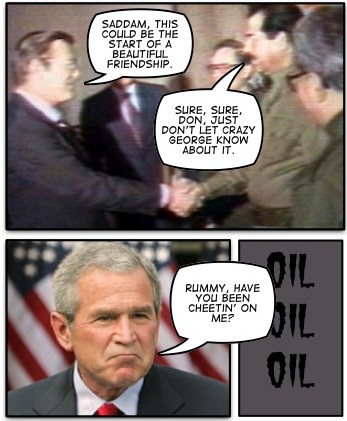 Source: W. George
This photo was taken about a year after the "Dujail massacre" for which Saddam Hussein has been "tried" and sentenced to death. Do you really think the US didn't know about it back then?
November 9, 2006
Democratic Plan
It rolls off the tounge so easily: "... but the Democrats have no plan." It sounds good, and believable. I'm sure Rush is hammering on the theme. But he'd be wrong.... again. They do have near-term plans.
Democratic Goals
Quickly adopt legislation to enact recommendations of the 9/11 Commission,
Reduce dependence on foreign oil, creating a new domestic industry in conservation technologies (read "jobs"),
Expand stem cell research in an ethical way, creating cures (hopefully in my lifetime) and a new domesic industry (read "jobs"), and
Reduce the price of drugs offered through Medicare. (read "Robin Hood: Taking from the rich and giving to the poor.")
I would add "take affirmative action to preserve network neutrality for the Internet," otherwise the rules will default to new charges for the fast-lane of the Internet.
Democratic Goals
Quickly adopt legislation to enact recommendations of the 9/11 Commission,
Reduce dependence on foreign oil, creating a new domestic industry in conservation technologies (read "jobs"),
Expand stem cell research in an ethical way, creating cures (hopefully in my lifetime) and a new domesic industry (read "jobs"), and
Reduce the price of drugs offered through Medicare. (read "Robin Hood: Taking from the rich and giving to the poor.")
I would add "take affirmative action to preserve network neutrality for the Internet," otherwise the rules will default to new charges for the fast-lane of the Internet.
November 8, 2006
Do the Democrats Have Cajones?
If the news is correct on Democratic control of both the House and Senate, we will soon learn whether or not the Democrats have the cajones to "get the job done." If they cannot, then the public should look long and hard at third-party candidates, and I'll tell you why.
The little secret is out. The corporate form of business charter has become a human-created monster that must be brought back under control. Like witches spells, which work only on people who believe in witches, the powerful spell of corporations will wither when people stop believing in them. So, where does this leave us with the Democratic Party?
The Democratic party must slay to "corporate beast." It must form a new type of commercial charter that requires more responsibility to protect the rights of humans. These new commercial beasties (smaller beasts) must protect our global life support system (the environment). They must have fewer constitutional rights [1]. It is a bold thing to do, but must be done. The question is by who?
The Democratic Party has been handed a golden opportunity. By shifting to an authentic populist position, they will be able to ride the power of democracy for decades. What are some specifics?
By addressing the basic power of corporations, we will regain control of our election process so that it reflects the interests of the people. Similarly, the public airwaves and right-of-ways will come back under public control thereby improving the integrity of mass media outlets. Disparity in wealth will be moderated with the social benefits inherent in that type of balance.
If the Democrates don't have the cajones, and the Republicans are discredited, the Green Party is standing in the wings.
Notes:
[1] In the the late 1980s, a National science advisory board chartered by the US Environmental Protection Agency (EPA) ranked the most important enviromental issues. Despite public opinion identifying hazardous waste sites as a top concern, the the advisory board's greatest concern was global-scale collapses of our environmental integrity. While improbable, the consequences would be catostrophic, with the possability of human extinction.
The little secret is out. The corporate form of business charter has become a human-created monster that must be brought back under control. Like witches spells, which work only on people who believe in witches, the powerful spell of corporations will wither when people stop believing in them. So, where does this leave us with the Democratic Party?
The Democratic party must slay to "corporate beast." It must form a new type of commercial charter that requires more responsibility to protect the rights of humans. These new commercial beasties (smaller beasts) must protect our global life support system (the environment). They must have fewer constitutional rights [1]. It is a bold thing to do, but must be done. The question is by who?
The Democratic Party has been handed a golden opportunity. By shifting to an authentic populist position, they will be able to ride the power of democracy for decades. What are some specifics?
By addressing the basic power of corporations, we will regain control of our election process so that it reflects the interests of the people. Similarly, the public airwaves and right-of-ways will come back under public control thereby improving the integrity of mass media outlets. Disparity in wealth will be moderated with the social benefits inherent in that type of balance.
If the Democrates don't have the cajones, and the Republicans are discredited, the Green Party is standing in the wings.
Notes:
[1] In the the late 1980s, a National science advisory board chartered by the US Environmental Protection Agency (EPA) ranked the most important enviromental issues. Despite public opinion identifying hazardous waste sites as a top concern, the the advisory board's greatest concern was global-scale collapses of our environmental integrity. While improbable, the consequences would be catostrophic, with the possability of human extinction.
November 5, 2006
Fallujah is Bush's Dujail
Saddam Hussein and his seven co-defendants have been on trial for executing 148 men from the town of Dujail following a 1982 assassination attempt on him. The case is the first of several that could be brought against Hussein (See list below).
Some believe the specific choice of trying Hussein for the assault on the people of Dujail is a setup of President George Bush for similar charges related to the US assults on Fallujah.
Consider the following: In 1982, Hussein's Iraq was in a cross-boarder war with Iran, a far greater national security threat for Iraq than what the US currently faces. The town of Dujail (Ad Dujayl), forty miles north of Iraq's capital of Baghdad, was dominiated by the Dawa Party, which was sympathetic to Iran. Al-Maliki's Islamic Dawa party, then an underground opposition, has claimed responsibility for organizing the attempt on Saddam's life, which was reported to have involved a three-hour gun battle. [1] "The Americans even claimed that the Shiite Daawa people were agents of the Iranian intelligence, and accused them of bombing the U.S. Embassy in Kuwait a year after the Dujail massacre." [4] At the time, the US supported Hussein.
Hussein had a reasonable case for identifying 148 men as "unlawful enemy combatants," according to Bush's way of thinking. Iraq held trials and executed them. Consider these trials in light of the new US Military Commissions for trying "unlawful enemy combatants". According to the new Military Commissions law, "unlawful enemy combatants" can be held indefinitely without charge, may face evidence obtained through torture including their owne, may face the use classified information as evidence and witheld from them, etc. The Military Commission trial procedures are so unjust that active duty Lt. Col. Colby Vokey, who represents a detainee at the U.S. naval base in Guantanamo, is speaking out against them. Web LINK
Hussein used the death penalty, and the US remains one of the few industrialized nations that use the death penalty.
Bush's Crime in Fallujah
Flash forward to April 2004, and Fallujah. After Hussein was nearly assassinated in Dujail, he crushed the resistance, and the town. Bush has done the same in Fallujah.
Some background is warranted. According to Wikipedia, "Fallujah was one of the most peaceful areas of the country just after the fall of Saddam. There was very little looting and the new mayor of the city — Taha Bidaywi Hamed, selected by local tribal leaders — was staunchly pro-American." However, on April 28, 2003, a crowd of Iraqi civilians gathered outside a school in Fallujah that had been taken over by US troops. The protesters wanted the Americans to leave and allow the building to re-open as a school. US troops opened fire on the crowed killing 13 people. Two days later, two more people were killed by US troops during a protest of the earlier incident. By March 2004, Darrin Mortenson, North County Times reporter, noted that U.S. Army troops had occupied Fallujah for 11 months, and that Marines attacked the town killing 18 Iraqis, including civilians. The Town was outraged. [5] In addition, the US was increasing its use of "coercive detention" [2] and this became "official" with the news of Abu Ghraib. Resentment of the US had built up in Fallujah.
Within this context, in late March 2004, four US contractors were killed in Fallujah. In response, U.S. administrator of Iraq, Paul Bremer III, vowed that this incident "will not go unpunished." [3]
In April 2004, soon after this highly publicized event, the US laid siege to Fallujah in an what appeared to be an act of collective punishment of the Town. The US failed to fully gain control of the town. Under orders from Washington the US military withdrew. Wikipedia cites 615 Iraqi deaths including civilians. According to independent journalist Dahr Jamail, reporting for The New Standard, after the US sent a small convoy through the town, “Spontaneous celebrations erupted as crowds of residents gathered in the street and began chanting and waving banners. Members of both the Iraqi Police and Iraqi Civil Defense Corps joined in the celebration, waving their guns in the air and flashing the two-fingered ‘Victory’ sign". [5] The US military involved in Fallujah was angry with Washington, and felt humiliated. Brig. General Mark Kimmitt said, "We will be back in Fallujah," "we will pacify Fallujah."
Now, the military wanted a re-match, and Washingon felt it owed it to them. In November 2004 the US regrouped for a decisive assault on Fallujah. The US called for all civilians to leave (200,000-350,000 people), and considered anyone remaining to be hostile targets, according to troops involved. [5] The assault was expected to be very destructive, surely requiring White House authorization. Another indication of White House involvement was that troops reported the assault was timed to occur after the 2004 elections.
One basic principle of urban warfare was described to New York Times reporter Dexter Filkins by a U.S. commander: “the new strategy must punish not only the guerrillas, but also make clear to ordinary Iraqis the cost of not cooperating.” According to Brigadier General Michael A. Vane, “We recently traveled to Israel to glean lessons learned from their counterterrorist operations in urban areas.” In the words of Michael Schwartz, collectively "punish the families and neighbors of guerrillas until they decide to reveal their identity and location." This tactic had been used in the village of Abu Hishma, and was going to be used in Fallujah. [5]
The US began the assault by capturing and closing the main hospital in Fallujah, a likely contravention of the Fourth Geneva Convention. According to Wikipedia, Fallujah "suffered extensive damage. Before the war, it was estimated that the city had 200 mosques. Some claim 60 of these had been destroyed in the fighting. Perhaps half the homes suffered at least some damage. About 7,000 to 10,000 of the roughly 50,000 buildings in the town are estimated to have been destroyed in the offensive and half to two-thirds of the buildings have suffered notable damage." In addition, the US used white phosphorus in its chemical mode to flush out insurgents to be killed with high explosives, a technique referred to as "shake 'n bake" in military slang. Because of the indiscriminant nature of white phosphorus in an area that the military knew had civilians, and the mode of use, this likely constitutes a war crime.
However, the war crime at issue is the assault on Fallujah in general. True, the US didn't hold a trial, like Saddam did before executing 148 people in Dujail. Instead, the US killed at least 148 civilians in Fallujah without a trial, destroyed the town, and sent a clear message to its inhabitants. In the end, Fallujah is Bush's Dujail.
Sources:
[1] Associated Press, Noveber 5, 2006, HAMZA HENDAWI Web LINK
[2] Seymour Hersh, New Yorker, The Gray Zone, 5/24/04. Web LINK
[3] Hindu Times, Atul Aneja, April 2, 2004 Web LINK
[4] Ynet News, October 18, 2005 Web LINK
[5] The Causes and Consequences of the April Uprising in Fallujah, Michael Schwartz, http://zmagsite.zmag.org/JulAug2004/schwartz0804.html
[6] Fallujah: The Hidden Massacre, RAI TV, Italian State Broadcasting.
Saddam's Alleged Crimes
• DISPLACING KURDS
• KIRKUK BOMBING
• SURPRESSING 1991 UPRISINGS
• DUJAIL MASSACRE
• FORCED EMIGRATION
• GASSING KURDS
• KILLING BARZANI CLAN
• INVADING KUWAIT
• CRIMES & EXECUTIONS: RELIGIOUS FIGURES
• CRIMES & EXECUTIONS: POLITICAL RIVALS
• DRYING OF MARSHES
Source: CBS News
http://www.cbsnews.com/elements/2004/07/01/iraq/whoswho627022_0_5_person.shtml
Some believe the specific choice of trying Hussein for the assault on the people of Dujail is a setup of President George Bush for similar charges related to the US assults on Fallujah.
Consider the following: In 1982, Hussein's Iraq was in a cross-boarder war with Iran, a far greater national security threat for Iraq than what the US currently faces. The town of Dujail (Ad Dujayl), forty miles north of Iraq's capital of Baghdad, was dominiated by the Dawa Party, which was sympathetic to Iran. Al-Maliki's Islamic Dawa party, then an underground opposition, has claimed responsibility for organizing the attempt on Saddam's life, which was reported to have involved a three-hour gun battle. [1] "The Americans even claimed that the Shiite Daawa people were agents of the Iranian intelligence, and accused them of bombing the U.S. Embassy in Kuwait a year after the Dujail massacre." [4] At the time, the US supported Hussein.
Hussein had a reasonable case for identifying 148 men as "unlawful enemy combatants," according to Bush's way of thinking. Iraq held trials and executed them. Consider these trials in light of the new US Military Commissions for trying "unlawful enemy combatants". According to the new Military Commissions law, "unlawful enemy combatants" can be held indefinitely without charge, may face evidence obtained through torture including their owne, may face the use classified information as evidence and witheld from them, etc. The Military Commission trial procedures are so unjust that active duty Lt. Col. Colby Vokey, who represents a detainee at the U.S. naval base in Guantanamo, is speaking out against them. Web LINK
Hussein used the death penalty, and the US remains one of the few industrialized nations that use the death penalty.
Bush's Crime in Fallujah
Flash forward to April 2004, and Fallujah. After Hussein was nearly assassinated in Dujail, he crushed the resistance, and the town. Bush has done the same in Fallujah.
Some background is warranted. According to Wikipedia, "Fallujah was one of the most peaceful areas of the country just after the fall of Saddam. There was very little looting and the new mayor of the city — Taha Bidaywi Hamed, selected by local tribal leaders — was staunchly pro-American." However, on April 28, 2003, a crowd of Iraqi civilians gathered outside a school in Fallujah that had been taken over by US troops. The protesters wanted the Americans to leave and allow the building to re-open as a school. US troops opened fire on the crowed killing 13 people. Two days later, two more people were killed by US troops during a protest of the earlier incident. By March 2004, Darrin Mortenson, North County Times reporter, noted that U.S. Army troops had occupied Fallujah for 11 months, and that Marines attacked the town killing 18 Iraqis, including civilians. The Town was outraged. [5] In addition, the US was increasing its use of "coercive detention" [2] and this became "official" with the news of Abu Ghraib. Resentment of the US had built up in Fallujah.
Within this context, in late March 2004, four US contractors were killed in Fallujah. In response, U.S. administrator of Iraq, Paul Bremer III, vowed that this incident "will not go unpunished." [3]
In April 2004, soon after this highly publicized event, the US laid siege to Fallujah in an what appeared to be an act of collective punishment of the Town. The US failed to fully gain control of the town. Under orders from Washington the US military withdrew. Wikipedia cites 615 Iraqi deaths including civilians. According to independent journalist Dahr Jamail, reporting for The New Standard, after the US sent a small convoy through the town, “Spontaneous celebrations erupted as crowds of residents gathered in the street and began chanting and waving banners. Members of both the Iraqi Police and Iraqi Civil Defense Corps joined in the celebration, waving their guns in the air and flashing the two-fingered ‘Victory’ sign". [5] The US military involved in Fallujah was angry with Washington, and felt humiliated. Brig. General Mark Kimmitt said, "We will be back in Fallujah," "we will pacify Fallujah."
Now, the military wanted a re-match, and Washingon felt it owed it to them. In November 2004 the US regrouped for a decisive assault on Fallujah. The US called for all civilians to leave (200,000-350,000 people), and considered anyone remaining to be hostile targets, according to troops involved. [5] The assault was expected to be very destructive, surely requiring White House authorization. Another indication of White House involvement was that troops reported the assault was timed to occur after the 2004 elections.
One basic principle of urban warfare was described to New York Times reporter Dexter Filkins by a U.S. commander: “the new strategy must punish not only the guerrillas, but also make clear to ordinary Iraqis the cost of not cooperating.” According to Brigadier General Michael A. Vane, “We recently traveled to Israel to glean lessons learned from their counterterrorist operations in urban areas.” In the words of Michael Schwartz, collectively "punish the families and neighbors of guerrillas until they decide to reveal their identity and location." This tactic had been used in the village of Abu Hishma, and was going to be used in Fallujah. [5]
The US began the assault by capturing and closing the main hospital in Fallujah, a likely contravention of the Fourth Geneva Convention. According to Wikipedia, Fallujah "suffered extensive damage. Before the war, it was estimated that the city had 200 mosques. Some claim 60 of these had been destroyed in the fighting. Perhaps half the homes suffered at least some damage. About 7,000 to 10,000 of the roughly 50,000 buildings in the town are estimated to have been destroyed in the offensive and half to two-thirds of the buildings have suffered notable damage." In addition, the US used white phosphorus in its chemical mode to flush out insurgents to be killed with high explosives, a technique referred to as "shake 'n bake" in military slang. Because of the indiscriminant nature of white phosphorus in an area that the military knew had civilians, and the mode of use, this likely constitutes a war crime.
However, the war crime at issue is the assault on Fallujah in general. True, the US didn't hold a trial, like Saddam did before executing 148 people in Dujail. Instead, the US killed at least 148 civilians in Fallujah without a trial, destroyed the town, and sent a clear message to its inhabitants. In the end, Fallujah is Bush's Dujail.
Sources:
[1] Associated Press, Noveber 5, 2006, HAMZA HENDAWI Web LINK
[2] Seymour Hersh, New Yorker, The Gray Zone, 5/24/04. Web LINK
[3] Hindu Times, Atul Aneja, April 2, 2004 Web LINK
[4] Ynet News, October 18, 2005 Web LINK
[5] The Causes and Consequences of the April Uprising in Fallujah, Michael Schwartz, http://zmagsite.zmag.org/JulAug2004/schwartz0804.html
[6] Fallujah: The Hidden Massacre, RAI TV, Italian State Broadcasting.
Saddam's Alleged Crimes
• DISPLACING KURDS
• KIRKUK BOMBING
• SURPRESSING 1991 UPRISINGS
• DUJAIL MASSACRE
• FORCED EMIGRATION
• GASSING KURDS
• KILLING BARZANI CLAN
• INVADING KUWAIT
• CRIMES & EXECUTIONS: RELIGIOUS FIGURES
• CRIMES & EXECUTIONS: POLITICAL RIVALS
• DRYING OF MARSHES
Source: CBS News
http://www.cbsnews.com/elements/2004/07/01/iraq/whoswho627022_0_5_person.shtml
November 4, 2006
Lebanese Children Orphaned by Isreali Attack in 2006
I don't have complete records, but the following report entry by USAID gives a hint:
Mercy Corps provided food kits to 3,500 families in Baalbek District, as well as textbooks and clothing to 598 orphaned children. [1] This doesn't account for Southern Lebanon where the most sever damage was inflicted by the US/Israli assault.
It's a sad sign of the times, or a reflection of superficial corporate media, that when searching the web for "orphaned Lebanese" the first eight entries are about orphaned pets.
Sources:
[1] USAID October 27, 2006 Situation Report on Lebanon Humanitarian Emergency.
Mercy Corps provided food kits to 3,500 families in Baalbek District, as well as textbooks and clothing to 598 orphaned children. [1] This doesn't account for Southern Lebanon where the most sever damage was inflicted by the US/Israli assault.
It's a sad sign of the times, or a reflection of superficial corporate media, that when searching the web for "orphaned Lebanese" the first eight entries are about orphaned pets.
Sources:
[1] USAID October 27, 2006 Situation Report on Lebanon Humanitarian Emergency.
November 1, 2006
Brad Will: Rest in Justice
They say that the flutter of a butterfly's wings in one far off land can cause a landslide in another place across the world. The killing of Brad Will in oaxaca Mexico by paramilitary people is the fluttering of wings. They might be felt in Israeli-occupied Gaza.
There's more to be said...
There's more to be said...
Subscribe to:
Posts (Atom)


