Showing posts with label debt. Show all posts

August 30, 2011

The Game in a Nutshell

Bailouts put the private debts onto the public (tax payer) balance sheet. Now Congress and the White House are poised to finish the job by putting that debt onto the backs of America's most vulnerable people.

For Your Convenience:Sources:

gdaeman_scroll_small

August 16, 2011

Talking Point: US Government Debt and Jobs

Job, Jobs, Where are the Jobs?

The talking point is simple. Average Americans are not spending money, and the economy is stalled, because they don't have much money. It's no use giving tax breaks and low interest rates to product manufacturers, because the people who would normally buy their products don't have money. People need jobs.

It is debatable whether the American public is responsible for 70% of domestic spending on goods and services, but by sheer number their spending potential is huge. They might make up 70% of domestic spending if they had money to spend, but they don't have good jobs.

Why not? Government policies over the past several decades, supply-side (trickle-down) tax policies and corporate globalization policies, have created a record wealth gap. A study by three Citigroup analysts indicates that the top 1% of Americans earn as much annual income as the bottom 60% and the top 1% possess as much wealth as the bottom 90% of Americans. The analysts concluded “economic growth [in the US] is powered by and largely consumed by the wealthy few.” [1] This is borne out by recent statistics showing that growth in domestic product sales have declined at discount stores and have grown in high-end stores and luxury products.

The Solution:

The government needs to set policies to put money in the pockets of average Americans, and I'm not talking about a $600 check; it needs to be tens of thousands per year, which simply put means temporarily creating jobs. The money for these jobs needs to come from the places that it is being hoarded: The richest 1% of Americans and transnational corporations who have benefited greatly from government policies over the past few decades.

After people have had government-sponsored jobs for several years, they will have the money to buy more products and services they need. This will create a market for private sector products and, in turn, support more jobs in the private sector. Eventually, the government can get out of business of job creation.

And yes, these jobs will require more government revenue in the near-term, but will also generate new revenues. In the long run, we'll be more likely able to pay down the US Government debt.

Agree? Let policy makers know:

Update: Listen to a professional, Bill Gross, founder and co-chief investment officer of the investment management firm Pimco. "America’s debt is not its biggest problem", Washington Post, August 10, 2011.

Sources:

1. Can the Middle Class be Saved? Atlantic Monthly, September, 2011.

gdaeman_scroll_small

August 13, 2011

Talking Point: Debt and Medicare

Are Medicare & Medicade the Problem?

First, Medicare is not part of the general budget deficit & associated debt problem. That's because Medicare, like Social Security, has a dedicated fund separate from the general fund. It should be managed as a separate dedicated fund, not lumped into the general budget debate.

Second, if we spent per capita what every other industrial nation spends on health care, we would not have a long-term Medicare solvency problem. If we simply focus on cutting Medicare and Medicaid, we’re just shifting the rising costs to those least able to pay them: the elderly, the disabled and the poor, or people on their death bed. Is that the American way?

Solutions: First, we need to cut health care costs (not services). Second, in the next few decades, we all need to pay a little more out of our FICA payroll deductions to cover the fact that the baby boomers are reaching old age (maybe from 1.45% to 1.75% or something). After the wave of baby boomers passes, the deductions could decrease. Finally, if Congress insists on mixing the dedicated fund of Medicare with the general fund, then we should insist on cutting corporate welfare and increasing revenue from corporate profits to help meet Medicare's needs.

Wanna take Action? Start by calling Senator Kerry's office and tell him to get better control of his message (He is one of the super committee members). Here's a recent statement of his:

... the real problem for our country is not the short-term debt. We can deal with that. It’s the long-term debt. It’s the structural debt of Social Security, Medicare and Medicaid, measured against the demographics of our nation.

Unfortunately, his statements are playing into the hysteria that is enveloping the mentality that these safety nets should be cut. We need to re-frame the debate.

For Your Convenience:Sources:

DemocracyNow! August, 12, 2011.

gdaeman_scroll_small

July 31, 2011

GDAE Podcast Episode 49

  • Economist James Galbraith: Reality check on the Washington "Debt Crisis".
  • Journalist, media critic and political analyst John Nichols: The Unraveling Murdoch News Corp media empire. Were crimes also committed in the United States?

  • Ralph Nader: Common Ground with the Tea Party? This might be true for the principled libertarians within the Tea Party.


Play Episode 49 (32 min):


gdaeman_scroll_small

January 5, 2009

Cartoon Economics

Four minutes worth watching for a humorous refresher on how we got into this economic mess, and a prediction for the future.


Psssst... Do Something

Sources:

Thanks Martha!

gdaeman_scroll_small

October 22, 2008

The Economic Meltdown: Seven Key Factors

There are seven key factors that underlie the current economic tectonic shift.

1. Financialized Economy

2. Debt (which relates to #1)

3. Real Estate Boom/Bust

4. Global commodity inflation

5. Dishonest Economic Statistics

6. Price of Oil

7. Demise of the US Dollar

Read More

gdaeman_scroll_small

September 18, 2008

Debt Absorption Entity: Your Grandchildren

Oh boy! The banks on Wall Street are so happy. The Dow Jones stock index shot up 400 points on news that the Republicrats might create an entity to absorb banks' bad debt. The name of that entit? "Your Unborn Grandchildren."

This is another abuse of the US Constitution, the preamble of which is supposed to provide for "ourselves and our posterity."

A friend of mine is suggesting that we use this financial crisis to call for a restructuring of the Constitution... to shift more of the power from the elite, who have benefited greatly from the bubble economy, to the ordinary people. My guess is the elite would coopt the process and even if we got a better constitution it would also be ignored.

gdaeman_scroll_small

August 14, 2007

The Chain in the Real Estate Reaction

The simple domestic chain reaction in the current financial crisis is outlined below. We're facing a systemic financial crisis; failure in one sector of the economy is spreading to the larger economy threatening a substantial reduction in aggregate economic activity.

Before outlining the chain reaction, some background. It didn't take an economist to know that this was coming. We've known that pronouncements about a robust economy were hollow, and reflect a phony Wall Street economy that has little in common with the Main Street economy.

First, we knew the dot-com phenomenon was a bubble built on hype, and it burst. In the run up to the burst, dot-com seminars devolved to lessons on how to hype a product concept and cash out to a big firm.

Next, we watched the dot-com bubble-wealth run to stocks on Wall Street in a transparent irrational exuberance. That new bubble burst as the fraudulent practices of the corporate sector were exposed. All of the corporate sectors were in on it: Banks were financing bogus business activities, the consulting divisions of accounting firms were helping cook the same books being certified by their audit divisions, legal firms were helping corrupt clients wiggle out of the illegalities, the corporate media was singing the praises of the robber barons, and the good will of various civic organizations was being purchased with philanthropy from the corrupt corporations. This is all continues.

Third, after the Wall Street bubble burst, the accumulated wealth ran to real estate, triggering an upward series of self-fulfilling cycles of price increases. Laws to prevent predatory lending practices were gone and boundaries on who could finance real estate were lifted. The bubble inflated as people bought multiple properties on the back of cash from refinanced properties. Some of that activity was legitimate, and the profits were somewhat real... "somewhat" real, as long as the Federal Reserves' current struggle to bail out the financial institutions doesn't cause inflation that decreases the "real" value of those profits. You know you have a bubble when practically everyone is saying, "You know, I couldn't even afford to buy the house I'm now living in." That bubble is deflating. Where will the money run to create the next bubble?

So, what makes up the the chain in the real estate reaction?

  • Home Buyer (Borrowers)
  • Lenders to Home Buyers
  • Mortgage Brokers (not always the lender themselves)
  • Mortgage Buyers/Bundlers (Create Mortgage-backed Securities (MBS - bonds))
  • MBS (Bond) Buyers (e.g, Pension Funds, University Endowments, Hedge Funds, Banks use them as reserves)*
  • Primary Dealers (21 large commercial banks that interact directly with the Federal Reserve and with whom large lenders deal)
  • Federal Reserve
How does the chain reaction work?

First, the prices on homes are artificially inflated by excessive accumulated wealth and rules rigged to help an elite minority make more wealth off of the real estate market as described above. This is a failure of the capitalist system, which makes homes unaffordable even to middle income people, setting them up as scapegoats.

Second, mortgage brokers scam buyers into accepting exotic loans, such as interest-only adjustable rate mortgages (ARMs), assuring them that "This is common these days. It's just the way things work." The mortgage broker has no risk. He just takes a fee and never holds the mortgage. The lender only holds the mortgage briefly, usually selling it to the secondary market, experiencing no risk. The secondary market buys bundles of mortgages that are used as collateral on bonds known as mortgage backed securities (MBSs). These are sold to pension funds, endowments, and others, including banks that use them to meet their reserve obligations.

The risk associated with the mortgage is passed on so far from the the point of initiation that the system seemed designed for failure. Actually, it was designed by votes in Congress paid for by lobbyists whose clients knew they could make money off the system before they knew it would fail. An insider's game. Yes, we could see what was coming, and we knew "the economy" was a house of cards, despite what well-paid business pundits were saying on phony TV.

If you think this type of game is limited to real estate sector, think again. This same game has become the American way, according the a recent report by the US Comptroller General comparing the United States to failing Rome.

But I digress...

Third, the buyer who, was scammed by mortgage brokers into taking a very risky mortgage, can't meet the payment; maybe the rate has finally adjusted on the ARM, or a health problem is limiting income and creating additional costs. They buyer becomes the scapegoat. The financial industry saw this coming and worked with both Republicans and Democrats in 2005 to toughen the US personal bankruptcy law, contributing to the creation of what Warren Buffet calls a "debt peonage" society.

Fourth, as the "debt peons" fail to pay their artificially inflated mortgages, the owners of the mortgage backed bonds don't receive their regular dividends. Many large banks to own such bonds as part of their mandatory reserve. Not only are their reserves losing value, but in many cases, banks and others take out low interest loans to buy such bonds (a carry trade: low interest loan pays for higher interest investment and the difference is taken as profit). Without the income from the mortgage backed bonds, these banks and others can't pay their loans. It's a classic carry trade trap that has caused the failure financial institutions in the past.

In many cases, the lender who provided the loan for the mortgage bonds also has debt payments to make, or has loaned out the same dollar 5 times as part of the leveraging that is implicit in fractional reserve banking (banks only hold a small fraction of hard money, or bonds, in reserve to back up their loans. They assume it is very unlikely for everyone to demand their cash at the same time. Note that some of that "hard money" is in the form of mortgage backed bonds...).

If the institutions caught in this kind of bind are big enough, there is a risk of a domino effect affecting the entire economy. It's already expected to happen, given layoffs of failed mortgage companies like American Home Mortgage, and First Magnus Financial Corp., and reduced purchases of hardware and home products associated with the exchange of home purchases, a large sector of the US economy. You know you have a crisis when the Federal Reserve steps in to give short-term loans in the hope that these chain reaction liquidity problems can be resolved. They buy bonds from primary dealers, who in turn make credit available to banks facing a liquidity crisis.

Macro-scale Liquidity Crisis

This is an example of a direct chain of liquidity crises at the micro economic scale among individual institutions. But there's also a macro economic liquidity crisis, which takes the form of less money available for loans. Recall above we mentioned that some banks use mortgage backed bonds as their reserves. The logic follows:

1. Much of the world's investments are in real estate and related financial instruments (MBSs), because of the historic real estate boom over the last six years. This means a lot of mortgage backed bonds are sitting in vaults out there, including as reserves (collateral to support loans).

2. As the value of these mortgage backed bonds declines, bank's reserves shrink. They can loan out less money, that is, credit liquidity shrinks on a macro scale.

Going International

That's the domestic story for the US. The macro-scale story continues as the financial problems jumped the Atlantic and Pacific Oceans . That's a separate story.

November 11, 2006

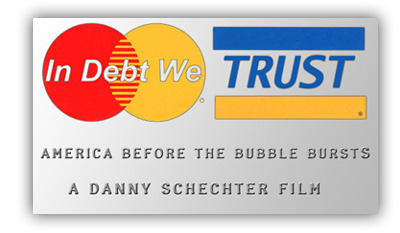
In Debt We Trust

Subtitled, "America Before the Bubble Bursts," the documentary In Debt We Trust Web Site
by Danny Schechter can be approached at two levels. On the surface, it offers a rallying point that cuts across party lines. Just as newly-elected Senator Bernie Sanders of Vermont has discovered, both conservative and liberal working people have serious economic concerns. He recently observed, "conservative Republicans don’t have healthcare, conservative Republicans can't afford to send their kids to college, conservative Republicans are being thrown out of their jobs as our good-paying jobs move to China. And if you talk about those issues, you know what people say? “I need somebody to stand up to protect my economic well-being.” [1] Full Interview

On a deeper level, Schechter is joining a growing chorus questioning the very basis of our economic system. He is in good company, which includes former chief economist of the World Bank, Joseph Stiglitz. Stiglitz, Nobel Award winner in economics has said, "[corporate] globalization inherently increases the inequalities in developing countries." He'd probably say that it increases inequalities in developed countries too if asked.

True, the Democratic Party hasn't caught on to this new trend... OK, we know they're slow to catch on. Efforts are being made to push the Democrats in this direction, but some research indicates change isn't likely to come from within the USA [2], and if it does, it will come from the grassroots.

A final parting word. People who founded The Program on Corporations, Law and Democracy (POCLAD) have given a lot of thought to the deeper perspective. They make a very persuasive argument that "It's Exessive Corporate Power Stupid." Well, they don't say it that way, but they are quick to point out, it's not about the bad behavior of corporations, it's about raw power of the corporate form of business, which has been "legitimized" in Supreme Court decisons over the decades.

Bottom line: Going back to Schechter, society's great problems won't be solved by small fixes, we need to revamp the system.

Sources:

[1] DemocracyNow! November 8, 2006, Inteview with Bernie Sanders (I-VT)

[2] Foreign Affairs, Journal of the Council on Foreign Relations. (trying to track down the article).

[3] Flashpoints Interview with Danny Schechter

Danny Scheckter
.