Showing posts with label Joseph Stiglitz. Show all posts

June 11, 2009

Stiglitz on Breaking the Bank's Grip

Former World Bank Chief Economist and Nobel Prize winner Joseph Stiglitz is trying to rally public to check the power of the banks. Stiglitz is featured in Episode 14 of GDAE Podcast if you want to hear him in his own words.

Here are some of Joseph Stiglitz's words:

It has long been recognized that the US banks that are too big to fail are also too big to be managed.

The rigged system:

If they take big bets and win, they walk away with the proceeds, if they fail, the Government picks up the tab.

It's not the Banks that are being bailed out:

The Obama Administration has succumbed to political pressure and scare-mongering by the big banks and, as a result, has confused bailing out the bankers and their shareholders with bailing out the banks.

Justice and Anger:

Rewriting the rules of the market economy — in a way that has benefited those that have caused so much pain to the entire global economy — is worse than financially costly. Most Americans view it as grossly unjust, especially after they saw the banks divert the billions intended to enable them to revive lending, to payments of outsized bonuses and dividends

A Prediction:

This ersatz capitalism, where losses are socialized and profits privatized, is doomed to failure.

Sources:

Business, Day, Break the banks, for the good of the people, Joseph Stiglitz, June 10, 2009.

gdaeman_scroll_small

June 10, 2009

GDAE Podcast Episode 14

Incentives and Einstein's Relativity III
  • Joseph Stigiltz and Bethany McLean on "Stopping Corrupt Capitalism in the Financial Services Industry: Regulations vs Incentives"
  • Humor: American Corporate Style
  • GDAE Podcast 15-Min of Fame?
  • Impeach Judge Jay Bybee for Torture Memos
  • Music by Dam, Palestinian rap group
  • Who are the Pirates of Somalia?
  • Einstein's Relativity: Part 3, Time Dilation and Length Contraction

You can take ACTION:

Urge your member of the House of Representatives to support impeachment hearings for judge Jay Bybee, signer of the torture memos. Write Your Rep Today. Or reach them by phone via the Capitol Switchboard (202) 224-3121.

Play GDAE Podcast Episode 14 from this page.

Previous Episodes & 60-Sec Promo:
GDAE Podcast 60-Second Promo

GDAE Podcast Episode 13 May 22, 2009
GDAE Podcast Episode 12 May 5, 2009
GDAE Podcast Episode 11 April 24, 2009
GDAE Podcast Episode 10 April 9, 2009
GDAE Podcast Episode 9 March 28, 2009
GDAE Podcast Episode 8 March 15, 2009
GDAE Podcast Episode 7 March 1, 2009
GDAE Podcast Episode 6 February 17, 2009
GDAE Podcast Episode 5 February 6, 2009
GDAE Podcast Episode 4 January 24, 2009


gdaeman_scroll_small

March 28, 2009

US Dollar Glory Days are Waning

Well, we knew it was coming

Economics Nobel laureate Dr Joseph Stiglitz called for a fundamental change of the world economic order by creating a new global reserve system and new multilateral institutions to restore the global economy.

The system is broken, evidenced by an elephant in the room:

“It's clearly a very strange global economic phenomenon that the global economic system requires the richest country to consume beyond its means to keep the global economy growing.”

Stiglitz points out additional evidence of the failed corporate free market economic system:

“Growing economic inequality means that we are moving money and assets from those who can spend it at the bottom to those who cannot spend it at the top. We told the people in the bottom to consume and kept lending to them.”

He went on to emphasize that the growing inequality “is not just in the US but in most of the countries in the world.” The abundance of empty houses and homeless people in the US and the problem of poverty and massive unemployment in developing countries show “the system of bringing together supply and demand is not working”, which is “a fundamental problem [that] needs to be addressed.”

Stiglitz is not alone in his call. He led a United Nations Commission of Experts to study the world financial crisis, which issued it's draft recommendations on March 26, 2009. A final report is due in May, 2009, which will serve as an input for the United Nations conference on the financial crisis in June.

The Commission's central recommendation, according to Stiglitz is....

The central idea is that the current system of depending on a single currency and the political and economic management of that currency is volatile.... It’s a matter of moving to multiple currencies. Over time you would replace the dollar as a reserve currency. No one thinks it would happen overnight.

The international decision making body on economic policy would also change. It has been the Group of Seven (G7) nations, but recently that has shifted to the G20 nations, recognizing the reality of a shift in the wealth. But that may be short lived if the Stiglitz Commission's ideas prevail, as described in this interview exchange:

Q – You are also proposing replacing the G20 with a United Nations body. What’s this all about?

A – We are calling for a Global Economic Coordination Council. There is no rhyme or reason to the current system other than who President Bush invited to it. The new body would have more political legitimacy and a broader mandate. It could demand, for instance, that the World Bank and the IMF report to it and evaluate how they are performing.

Q – Why not fix the G20 rather than creating a new body? Is what you propose likely to happen?

A – Yes. [German Chancellor] Angela Merkel is strongly pushing the idea. People in the G20 are saying this is how we need to go.

There would also be a move to break-up and prevent "too-big-to-fail" corporations.

Further, a financial regulatory board and competition authority – which would both answer to the Coordination Council – could prevent the expansion of multi-national firms that threaten competition or become problematic when they become too big to fail, the experts said.

Get ready for the value of the dollar to drop. Inflation is on the way.

Psssst... Do Something

Sources:

Stiglitz Calls for a Change of the World Economic Order and China's Vital Role, Leanne Wang, March 17, 2009.

Business Week, The Oil and Glory interview: Joseph Stiglitz, March 25, 2009.

United Nations, Global finance structures must be revamped, says UN expert panel, March 26, 2009.

gdaeman_scroll_small

UN Expert Commission on Global Financial Crisis Releases Draft Recommendations, March 26, 2009.

November 11, 2006

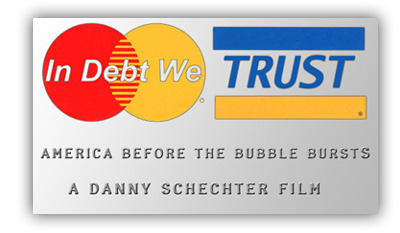
In Debt We Trust

Subtitled, "America Before the Bubble Bursts," the documentary In Debt We Trust Web Site
by Danny Schechter can be approached at two levels. On the surface, it offers a rallying point that cuts across party lines. Just as newly-elected Senator Bernie Sanders of Vermont has discovered, both conservative and liberal working people have serious economic concerns. He recently observed, "conservative Republicans don’t have healthcare, conservative Republicans can't afford to send their kids to college, conservative Republicans are being thrown out of their jobs as our good-paying jobs move to China. And if you talk about those issues, you know what people say? “I need somebody to stand up to protect my economic well-being.” [1] Full Interview

On a deeper level, Schechter is joining a growing chorus questioning the very basis of our economic system. He is in good company, which includes former chief economist of the World Bank, Joseph Stiglitz. Stiglitz, Nobel Award winner in economics has said, "[corporate] globalization inherently increases the inequalities in developing countries." He'd probably say that it increases inequalities in developed countries too if asked.

True, the Democratic Party hasn't caught on to this new trend... OK, we know they're slow to catch on. Efforts are being made to push the Democrats in this direction, but some research indicates change isn't likely to come from within the USA [2], and if it does, it will come from the grassroots.

A final parting word. People who founded The Program on Corporations, Law and Democracy (POCLAD) have given a lot of thought to the deeper perspective. They make a very persuasive argument that "It's Exessive Corporate Power Stupid." Well, they don't say it that way, but they are quick to point out, it's not about the bad behavior of corporations, it's about raw power of the corporate form of business, which has been "legitimized" in Supreme Court decisons over the decades.

Bottom line: Going back to Schechter, society's great problems won't be solved by small fixes, we need to revamp the system.

Sources:

[1] DemocracyNow! November 8, 2006, Inteview with Bernie Sanders (I-VT)

[2] Foreign Affairs, Journal of the Council on Foreign Relations. (trying to track down the article).

[3] Flashpoints Interview with Danny Schechter

Danny Scheckter
.