Showing posts with label POCLAD. Show all posts

February 11, 2010

Challenging Conventional Wisdom

As you might have noticed, I've been taking on the sanctity of the US Constitution on my "other" blog, Challenge the Establishment.

I remember, just within the past 4-5 years, that my initial reaction to hearing criticism of the US Constitution was one of discomfort ... Intellectually I could understand the critiques, but I was emotionally socialized to think of the Constitution as being ... exceptional and immutable.

It takes time to come to grips with challenges to one's bedrock beliefs. But, through repeated exposure to the critiques, through alternative critiques that accumulate into a body of evidence, through dialogue with other humans who are exploring the same path of inquiry, the bedrock can loosen into soil. Over time, as the weight of evidence becomes irrefutable, the soil becomes fertile ground for advancing positive social change.

The discomfort of challenging deeply held, socialized beliefs never goes away completely, in part because they are so deeply ingrained. But, in addition, by challenging conventional wisdom, you become a minority; facing reactions ranging from apathy to rejection to ridicule to outright hostility.

Facing the discomfort with the company of others helps. The Program on Corporations, Law and Democracy (POCLAD) Challenging has been bringing humans together on such issues for over a decade. The conventional wisdom about the role of corporations in our society goes hand in hand with challenging myths about the sanctity of the US Constitution.

I'll be revisiting these topics on this blog, the Challenge the Establishment blog, and on GDAE Podcast in 2010. I invite you to probe these bedrock issues with me.

Sources:

gdaeman_scroll_small

June 25, 2009

Strategic Framework for Challenging Establishment Power

It's difficult to ponder changing the status quo... the powerful establishment seeks, in general, to maintain the staus quo. Where does one start? Having a strategy helps. Here's a strategy shared with me by a college friend who has committed his life to promoting deep social change.

A Three-Element Strategy for Personal Activism:

It's certain that many of us share the sense that we need to move "beyond" the status quo, but we don't know how to do that. This sentiment is, in part, a reflection of the fact that our social construct is strongly defined by corporate power. An example of this might be that a corporation commits clear abuse, yet it is practically impossible to challenge that abuse because the channels to do so are filled with barriers that have been accumulated over decades of insider corporate tinkering with our judicial and legal systems. Add to that a pervasive control of mass media, and hence public awareness, that effectively isolates progressive activists from the rest of society.

So, how do we go forward? Here are three broad strategic elements by which to invest your activist energies:

Element 1: Invest part of your time in the multi-generational struggle to retract corporate constitutional rights that have been accumulated over decades. This sounds abstract, but think of it as being similar to ending slavery, which was once a legal business practice until the 13th, 14th and 15th amendments to the constitution were adopted. (Ironically, corporations have abused these amendments by getting the US Supreme Court to recognize them as "persons" within this Constitutional context.)

Element 2: Invest part of your time on time-sensitive issues, like saving that 700-year-old tree in your neighborhood that "needs to be chopped down" to widen a road. It's easy to become solely devoted to urgent issues of the day, so making linkages between this element and the other two is a helpful way to integrate your activism into this holistic strategy.

Element 3: Invest part of your time in identifying and promoting alternatives to status quo systems. It's easy to expose the flaws in the current "system," but difficult to develope and implement workable alternatives. Concrete steps in this regard include educating yourself and others about alternatives models of social interaction, supporting fledgling experiments into alternative models, like worker-owned businesses and so on.

By working within this construct on our own, we will be working together in a distributed way. It is a low-cost way to be organized, in the broad sense of the word.

Sources:

Dave Henson, one of the founders of the Program on Corporations, Law and Democracy (POCLAD).

gdaeman_scroll_small

May 17, 2009

Thoughts Turn to Corporate Power

I'll confess to posting without a concept in mind. I do this on rare occasion when I feel behind on my blogging and remember it IS a web log originally intended to be an on-line diary of sorts.

What's on my mind that anyone else would care about? Getting arrested in the Senate hearing chambers to further expose the elephant in the room on Health Care; Congress has literally been taken over (captured) by corporate power... the corporations have become more powerful than our legislative and executive branches.

Some folks believe the judicial branch is similarly corrupted, for instance many of the people engaging with the Program on Corporations, Law and Democracy (POCLAD). They have researched, organized and documented strong historical evidence, mostly since the US Civil War (1860s), explaining how the corporations have accumulated powerful constitutional rights that undermine human rights... literally "undermine," as in land subsidence.

In Pennsylvania Coal Co. v. Mahon, 260 U.S. 393 (1922), the US Supreme Court ruled that coal corporations must be compensated for property value lost [mineral rightst profits] due to laws protecting homes from mine subsidence. [43]

The list of Supreme Court decisions granting incremental increases in corporate power have accumulated over 100 years, amounting in what we have today. This potential state of affiars was summed up well by former US president Franklin Roosevelt.

"The liberty of a democracy is not safe if the people tolerate the growth of private power to a point where it becomes stronger than their democratic state itself. That, in its essence, is fascism - ownership of government by an individual, by a group, or any controlling private power." -- Franklin D. Roosevelt

Psssst... Do Something

gdaeman_scroll_small

December 3, 2008

Thoughts of a People's Democracy

Thoughts on a morning off. Frances Moore Lappe and the Program on Corporations, Law and Democracy (POCLAD) are on my mind, as is Democracy Unlimited of Humboldt County and Jim Hightower as Secretary of Agriculture.

In Spring 2008, Lappe participated in a discussion of the New Deal on Radio Nation, with Laura Flanders. Lappe observed the New Deal was about "rights and structure" and that "it's not just [about] particular program[s]." She gives as a tangible example for our times, "significant effort to get money out of our political system."

POCLAD invites people into a dialogue at the level of structural change in our society. For example, POCLAD points out the distinction between defining laws that establish the system itself and subordinate laws that operate in the context of the defined system. The federal and state constitutions are examples of defining laws.

Defining laws are often very dry, and go unnoticed, such as contract law or laws about who has the right to access the court system. A classic example is when a corporation is violating an environmental regulation under some environmental law. You want to stop it. Then you discover you can't because you don't have "standing" to bring a law suit. The environmental law is one of those subordinate administrative laws that rest upon the groundwork of defining law. In this case, the defining law says who has the right to challenge the violation of the environmental law.

Social change is doomed to failure unless people recognize this distinction in laws. We must devote some of our efforts to challenging the defining laws that are rigged in favor of the corporations and modern aristocracy.

I'll have say more about Jim Hightower for US Agriculture Secretary some other time.

Psssst... Do Something

Sources:

gdaeman_scroll_small

June 23, 2008

US Constitution Challenged

Open minded, thinking people will find the set of 3-minute videos, linked below, to be enlightening. Brought to you by the Program on Corporations, Law and Democracy (POCLAD), these brief presentations challenge the foundation of our current society.

Their constructive criticism was derived from years of asking why our so-called democracy is so disfunctional. Why does power remain in the hands of so few and how have corporations become so powerful that they dominate our legislative process, judicial system, educational institutions, popular media and the culture that reflects our individual personalities.

WARNING: The ideas raised in these videos will make some people uncomfortable, perhaps angry. Others will find it refreshing to hear people speaking honestly about "we the people" contrasted with the founding fathers.

Click Here for a list of the Videos: (You are leaving this page)

Sources:

Program on Corporations, Law and Democracy web site.

gdaeman_scroll_small

January 12, 2008

Nerdfigher Project: Remake of Hank Green's Explanation

There's a saying about "death by a hundred cuts".... I don't think it was written about video editing, but... it could have been.

The video below is a video animation of Hank Green's Project for Awesome: Explanation and Humane Society. He and his brother John were spending 2007 communicating only by YouTube videos, and Hank came up with this idea of promoting charities. You have to watch the video to see the charities I'm promoting. Comment PLEASE, and tell your friends.


Nerdfighter Project for Awrsome: Human Tennis Ball

If you haven't seen Hank Green's original, here's the link.

Spread the word. Thank You.

May 31, 2007

Cindy Sheehan: Moving on and Up

Cindy gets it. Our so-called "democracy" is corrupted by the corporate military industrial congressional complex. Yes. Eisenho original farewell address included the word "congressional" before it was removed. His words are worth repeating, and have been added at the end of this entry.

Cindy gets it, as did some researchers who published in Foreign Affairs. Their conclusion? The United States does not practice democracy. It is an imperial force in the world, driven by commercial and material goals at the expense of human needs. The transition is so deep, encompassing the vast majority of the mass communications media, that only external forces can correct the situation.

I posted several comments on other web sites, over the Memorial Day weekend, in response to reading Cindy Sheehan's "resignation letter." The gist? It seems that Cindy is moving on from the peace movement to the justice movement. My commentary is that we CAN wait for peace, because justice is a priority.

If anyone wants an answer to, "what's next?" it is provided by the Program on Corporations, Law and Democracy (POCLAD). If you're serious about change, then you should read through the POCLAD research, which is laid out to some degree in a 10-part self-study program compiled by the Women's International League for Peace and Freedom (it's a misnomer... they're all about Justice ;-) Their program is entitled "Challenge Corporate Power, Assert the People's Rights."

The three-part activist strategy is worth repeating (Dave Henson gets credit for this):

1) Devote some time to deep, multi-generational struggles, like freeing slaves, women's suffrage, and revoking corporate power.

2) Devote some time to fighting the immediate struggles, like humanitarian relief, saving historical artifacts from destruction, and key legislative battles.

3) Devote some time to developing alternative social structures (solutions to the problems), like alternative economic frameworks, alternative governance and electoral frameworks, and exploring means of positive cultural change.

Excerpt from Eisenhower's Farewell Address

Until the latest of our world conflicts, the United States had no armaments industry. American makers of plowshares could, with time and as required, make swords as well. But now we can no longer risk emergency improvisation of national defense; we have been compelled to create a permanent armaments industry of vast proportions. Added to this, three and a half million men and women are directly engaged in the defense establishment. We annually spend on military security more than the net income of all United States corporations.

This conjunction of an immense military establishment and a large arms industry is new in the American experience. The total influence – economic, political, even spiritual – is felt in every city, every Statehouse, every office of the Federal government. We recognize the imperative need for this development. Yet we must not fail to comprehend its grave implications. Our toil, resources and livelihood are all involved; so is the very structure of our society.

In the councils of government, we must guard against the acquisition of unwarranted influence, whether sought or unsought, by the military-industrial complex. The potential for the disastrous rise of misplaced power exists and will persist.

We must never let the weight of this combination endanger our liberties or democratic processes. We should take nothing for granted. Only an alert and knowledgeable citizenry can compel the proper meshing of the huge industrial and military machinery of defense with our peaceful methods and goals, so that security and liberty may prosper together.

November 11, 2006

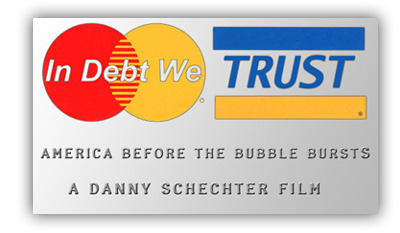
In Debt We Trust

Subtitled, "America Before the Bubble Bursts," the documentary In Debt We Trust Web Site
by Danny Schechter can be approached at two levels. On the surface, it offers a rallying point that cuts across party lines. Just as newly-elected Senator Bernie Sanders of Vermont has discovered, both conservative and liberal working people have serious economic concerns. He recently observed, "conservative Republicans don’t have healthcare, conservative Republicans can't afford to send their kids to college, conservative Republicans are being thrown out of their jobs as our good-paying jobs move to China. And if you talk about those issues, you know what people say? “I need somebody to stand up to protect my economic well-being.” [1] Full Interview

On a deeper level, Schechter is joining a growing chorus questioning the very basis of our economic system. He is in good company, which includes former chief economist of the World Bank, Joseph Stiglitz. Stiglitz, Nobel Award winner in economics has said, "[corporate] globalization inherently increases the inequalities in developing countries." He'd probably say that it increases inequalities in developed countries too if asked.

True, the Democratic Party hasn't caught on to this new trend... OK, we know they're slow to catch on. Efforts are being made to push the Democrats in this direction, but some research indicates change isn't likely to come from within the USA [2], and if it does, it will come from the grassroots.

A final parting word. People who founded The Program on Corporations, Law and Democracy (POCLAD) have given a lot of thought to the deeper perspective. They make a very persuasive argument that "It's Exessive Corporate Power Stupid." Well, they don't say it that way, but they are quick to point out, it's not about the bad behavior of corporations, it's about raw power of the corporate form of business, which has been "legitimized" in Supreme Court decisons over the decades.

Bottom line: Going back to Schechter, society's great problems won't be solved by small fixes, we need to revamp the system.

Sources:

[1] DemocracyNow! November 8, 2006, Inteview with Bernie Sanders (I-VT)

[2] Foreign Affairs, Journal of the Council on Foreign Relations. (trying to track down the article).

[3] Flashpoints Interview with Danny Schechter

Danny Scheckter
.