August 31, 2006

Senate Swing Votes on Network Neutrality

Updated December 17, 2006


If you're reading this you probably know about network neutrality* and are ready to take action "For" Network Neutrality. The following list identifies the US Senators who are are undecided, and thus whose votes will swing the final outcome on Net Neutrality.

What to Do: Contact their offices. Ask for the staff person who covers telecommunicaitons issues, and urge them to vote for Network Neutrality.
Senator Contact Information

What to Say: If asked, the basic reason to suupport Network Neutrality is to ensure everyone's information that travels on the Internet is handled the same way regardless of one's level of wealth (no fast lanes, no toll booths). Network Neutrality helps ensure everyone's speech is on a level playing field, which is critical to the health of our democracy:

Swing Voters on Net Neutrality in the Senate

Alexander, Lamar (R-TN) 202-224-4944
Allard, Wayne (R-CO) 202-224-5941
Baucus, Max (D-MT) 202-224-2651
Bennett, Robert F. (R-UT) 202-224-5444
Bond, Christopher S. (R-MO) 202-224-5721
Brown, Sherrod (D-OH) [New]
Bunning, Jim (R-KY) 202-224-4343
Burr, Richard (R-NC) 202 224-3154
Byrd, Robert C. (D-WV) 202-224-3954 CONTACT
Cardin, Ben (D-MD) [New]
Carper, Thomas (D-DE) 202-224-2441
Casey, Bob Jr. (D-PA) [New]
Chambliss, Saxby (R-GA) 202-224-3521
Coburn, Tom (R-OK) 202 224-5754
Cochran, Thad (R-MS) 202-224-5054
Collins, Susan (R-ME) 202-224-2523
Conrad, Kent (D-ND) 202-224-2043
Corker, Bob (R-TN) [New]
Cornyn, John (R-TX) 202-224-2934
Crapo, Mike (R-ID) 202-224-6142
Dole, Elizabeth (R-NC) 202-224-6342
Domenici, Pete V. (R-NM) 202-224-6621
Durbin, Richard J. (D-IL) 202-224-2152 CONTACT
Enzi, Michael (R-WY) 202-224-3424
Graham, Lindsey (R-SC) 202-224-5972
Grassley, Charles E. (R-IA) 202-224-3744
Gregg, Judd (R-NH) 202-224-3324
Hagel, Chuck (R-NE) 202-224-4224
Hatch, Orrin G. (R-UT) 202-224-5251
Inhofe, James M. (R-OK) 202-224-4721
Isakson, Johnny (R-GA) 202 224-3643
Johnson, Tim (D-SD) 202-224-5842
Klobuchar, Amy (D-MN) [New]
Kohl, Herb (D-WI) 202-224-5653
Kyl, Jon (R-AZ) 202-224-4521
Landrieu, Mary (D-LA) 202-224-5824
Levin, Carl (D-MI) 202-224-622 CONTACT
Lincoln, Blanche Lambert (D-AR) 202-224-4843
Lugar, Richard G. (R-IN) 202-224-4814
Martinez, Mel (R-FL) 202 224-3041
McCaskill, Claire (D-MO) [New]
McConnell, Mitch (R-KY) 202-224-2541
Menendez, Robert (D-NJ) 202-224-4744
Mikulski, Barbara A. (D-MD) 202-224-4654 CONTACT
Murkowski, Lisa (R-AK) 202-224-6665
Murray, Patty (D-WA) 202-224-2621
Reed, Jack (D-RI) 202-224-4642
Roberts, Pat (R-KS) 202-224-4774
Salazar, Ken (D-CO) 202 224-5852
Sessions, Jeff (R-AL) 202-224-4124
Shelby, Richard C. (R-AL) 202-224-5744
Specter, Arlen (R-PA) 202-224-4254 CONTACT
Stabenow, Debbie A. (D-MI) 202-224-4822
Tester, Jon (D-MT) [New]
Thune, John (R-SD) 202 224-2321
Voinovich, George (R-OH) 202-224-3353
Warner, John W. (R-VA) 202-224-2023
Webb, Jim (D-VA) [New]
Whitehouse, Sheldon (D-RI) [New]

Positions of Other Senators

Senator DC Phone Stance For or Against Net Nutrality

Akaka, Daniel K. (D-HI) 202-224-6361 For
Allen, George (R-VA) 202-224-4024 Against
Bayh, Evan (D-IN) 202-224-5623 For
Biden, Jr., Joseph R. (D-DE) 202-224-5042 For
Bingaman, Jeff (D-NM) 202-224-5521 For (Switched since Aug 06)
Boxer, Barbara (D-CA) 202-224-3553 For
Brownback, Sam (R-KS) 202-224-6521 Against
Cantwell, Maria (D-WA) 202-224-3441 For
Clinton, Hillary (D-NY) 202-224-4451 For
Coleman, Norm (R-MN) 202-224-5641 Against (Switched since Oct 06)
Craig, Larry E. (R-ID) 202-224-2752 Against
DeMint, Jim (R-SC) 202 224-6121 Against
Dodd, Christopher J. (D-CT) 202-224-2823 For
Dorgan, Byron L. (D-ND) 202-224-2551 For
Ensign, John (R-NV) 202-224-6244 Against
Feingold, Russell D. (D-WI) 202-224-5323 For
Feinstein, Dianne (D-CA) 202-224-3841 For
Harkin, Tom (D-IA) 202-224-3254 For
Hutchison, Kay Bailey (R-TX) 202-224-5922 Against
Inouye, Daniel K. (D-HI) 202-224-3934 For
Jeffords, James M. (I-VT) 202-224-5141 For
Kennedy, Edward M. (D-MA) 202-224-4543 For (Switched since Aug 06)
Kerry, John F. (D-MA) 202-224-2742 For
Lautenberg, Frank (D-NJ) 202-224-3224 For
Leahy, Patrick J. (D-VT) 202-224-4242 For
Lieberman, Joesph I. (D-CT) 202-224-4041 For (Switched since Oct 06) CONTACT
Lott, Trent (R-MS) 202-224-6253 Against
McCain, John (R-AZ) 202-224-2235 Against
Nelson, Bill (D-FL) 202-224-5274 For
Nelson, Ben (D-NE) 202-224-6551 For
Obama, Barack (D-IL) 202 224-2854 For
Pryor, Mark (D-AR) 202-224-2353 For
Reid, Harry (D-NV) 202-224-3542 For
Rockefeller, John D. (D-WV) 202-224-6472 For
Schumer, Charles (D-NY) 202-224-6542 For
Smith, Gordon (R-OR) 202-224-3753 Against
Snowe, Olympia (R-ME) 202-224-5344 For
Stevens, Ted (R-AK) 202-224-3004 Against
Sununu, John (R-NH) 202-224-2841 Against
Thomas, Craig (R-WY) 202-224-6441 Against
Vitter, David (R-LA) 202 224-4623 Against
Wyden, Ron (D-OR) 202-224-5244 For

Out of Office As of Jan. 2007:

Burns, Conrad R. (R-MT) 202-224-2644 Against
Chafee, Lincoln D. (R-RI) 202-224-2921
Dayton, Mark (D-MN) 202-224-3244 For
DeWine, Mike (R-OH) 202-224-2315
Frist, William H. (R-TN) 202-224-3344
Santorum, Rick (R-PA) 202-224-6324
Sarbanes, Paul S. (D-MD) 202-224-4524
Talent, Jim (R-MO) 202-224-6154

For More Information Visit "Save The Internet:"Web LINK

Notes:

* Network Neutrality is the fundamental principle that ensures I don't have to pay an extra fee for this web page to be as rapidly down-loaded as any other similarly designed web page on the Internet. Said another way, Net Neutrality ensures everyone has equal access to the Internet, rather than having to pay cable and phone compaines an added fee to ensure that your information flows over the Internet unimpeded.

Scott Ritter Quote: Citizen not Consumer

"Be a citizen, not a consumer." - Scott Ritter
Web Link, See page 10

Who Are the Payola Pundits?

August 29, 2006

Bush Leading the Nation into Another Trap: Iran

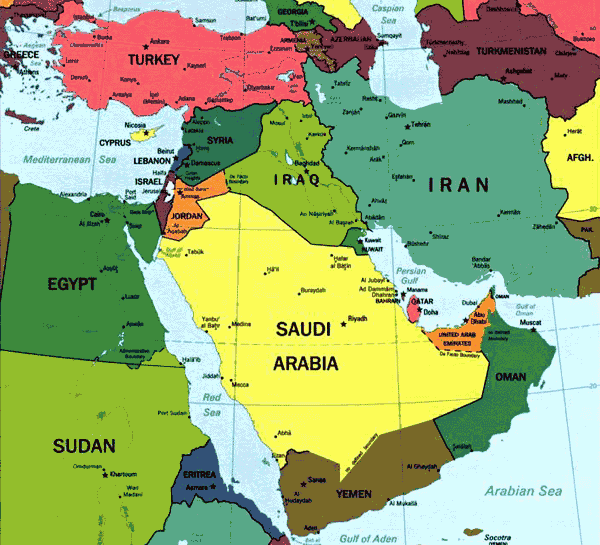
A picture is worth... a hell of a lot when you're contemplating a war-of-choice on Iran. See how big Iran is compared to Iraq, where Stratfor's George Friedman has proclaimed that the US military has lost the war? Web LINK

See tiny Lebanon, where Israel used Covert Commandos, a Navel Blockade, surgical airstrikes consisting of about 7,000 bombs, and boots on the ground? Israel failed, but not after sullying its reputation by managing to kill civilians at a ratio of about 75% with a child-kill ratio of about 33%. Israel has also placed itself at risk of war crimes and having to pay to rebuild the infrastructure of Lebanon. See: Hezbollah Clearly the Winner.


Read FauxNews' military experts and you would think that using a couple of the available military option on Iran is a good idea. Fox: Military Options The options sound familiar: Use Covert Commandos, a Naval Blockade, surgical strikes. Even the FauxNews military experts shy away from the "boots-on-the-ground" option, because, "The U.S. military is already stretched thin with its commitments in Afghanistan and Iraq."

In other words, the FauxNews proposal is to attack Iran using at most three of the four options used unsuccessfully by Israel in teeny weeny Lebanon, against an irregular militia of 2,500.

Remember during the first 2004 debate, Bush admitted we fell into a trap, "we thought we'd whip more of them going in. But because Tommy Franks did such a great job in planning the operation, we moved rapidly, and a lot of the Baathists and Saddam loyalists laid down their arms and disappeared. I thought they would stay and fight, but they didn't. And now we're fighting them now. And it's hard work."

Bush led the Nation into a trap in Iraq. Look at the map, and the size of Iran. Bush and FauxNews are leading the Nation into another trap in Iran.

August 26, 2006

Stratfor: US Has Lost Iraq War

"The US must now make an enormously difficult decision. If it simply withdraws from Iraq, it leaves the Arabian Peninsula open to Iran and loses all psychological advantage it gained with the invasion of Iraq.[1] If American forces stay in Iraq, it will be as a purely symbolic gesture, without any hope for imposing a solution." [2]

In other words, the US has lost the Iraq war. The grunts on the ground in Iraq will know that the risk they are taking, with shrapnel zining by their heads, is for no good cause.

In other words, the Bush administration has made a huge, predictable blunder... but I still ask, did they do this on purpose for some ulterior motive, such as, "Less Government" and thus more corporate power?

Notes:

[1] It could be argued that any psychological advantage is already lost. See:
James Galbraith Observation in the last paragraph of my post "Hezbollah is Clearly the Winner."

[2] George Friedman, Stratfor, "Breakpoint: What went wrong," reprinted in John Mauldin's August Issue of "Outside the Box."
Web LINK

[3] Implications for getting drawn into war with Iran. Analysis Suggesting Near-Insurmountable Pressures will pull the US into war in Iran

August 22, 2006

Mortgages and Real Estate Price Booms

Did you know.....

About 40-percent of the real estate price booms have resulted in a "bust"[1][2]. These usually have coincided with tightening fiscal policies, as we've just witnessed in repeated increases in interest rates by the Federal Reserve.

"Historically, if a boom cycle was followed by a bust, real housing prices contracted 25 to 30 percent from crest to trough, lasting on average from 3-5 years." [1]

The word "mortgage" is ranked 6th in the Top 100 searched phrases (Google). Musicians will be happy to note the work "lyrics" is 7th. Snes Roms is number 10.

Sources:

[1] 2006 World Economic Outlook report by the IMF.Web LINK

[2] A "bust" is defined in the 2006 WEO as the lowest 25% of price changes on record, which can be a negative change, or price drop.

August 21, 2006

Iraq and The Length of World War II


World War II: 1,248 Days (12/7/41 - 5/8/45)

Bush's Iraq War: 1,250 Days and Counting (3/19/2003 - ?)

Source: The Carpetbagger Report for more

Alternative Count: November 26, 2006 TOM RAUM, Associated Press

August 19, 2006

Freedom and Fear

Writer Alan Paton's "Cry, The Beloved Country," set in 1940s South Africa, includes a revealing passage that explores the fears whites had of the natives. In doing so, he touches on several forms of freedom and the conflicts between them: Freedom for the natives, freedom of white's conscience, freedom from fear of the known and unknown. A similar situation exists between so-called "terrorists" and people who accept President George Bush's framing of the World.

Yes, there are a hundred, and a thousand voices crying. But what does one do, when one cries for this thing, and one cries for another? Who knows how we shall fashion a land of peace where black outnumbers white so greatly? Some say that the earth has bounty enough for all, and that more for one does not mean less for another, that the advance of one does not mean the decline of another. They say that poor-paid labour means greater markets and greater scope for industry and manufacture. And others say that this is a danger, for better-paid labour will not only buy more but will also read more, think more, ask more, and will not be content to be forever voiceless and inferior.

Who knows how we shall fashion such a land? For we fear not only the loss of our possessions, but the loss of our superiority and the loss of our whiteness. Some say it is true that crime is bad, but would this not be worse? Is it not better to hold what we have, and to pay the price of it with fear? And others say, can such fear be endured? For is it not this fear that drives men to ponder these things at all?

We do not know, we do not know. We shall live from day to day, and put more locks on the doors, and get a fine fierce dog when the fine fierce bitch next door has pups, and hold on to our handbags more tenaciously; and the beauty of the trees by night, and the raptures of lovers under the stars, these things we shall forego. We shall forego the coming home drunken through the midnight streets, and the evening walk over the star-lit veld. We shall be careful, and knock this off, and knock that off our lives, and hedge ourselves about with safety and precaution. And our lives will shrink, but they shall be the lives of superior beings; and we shall live with fear, but at least it will not be a fear of the unknown. And the conscience shall be thrust down; the light of life shall not be extinguished, but be put under a bushel, to be preserved for a generation that will live by it again, in some day not yet come; and how it will come, and when it will come, we shall not think about at all.

August 18, 2006

Hezbollah is Clearly the Winner

According to the former CIA official who ran the US covert war in Afghanistan from 1986 - 1989,"Where it counts, Hezbollah is clearly the winner," Milt Bearden says. "For Israel ... not winning is losing. And for an irregular force like Hezbollah, not losing is winning."

The corporate media won't admit that the July-August 2006 war was a US-Israeli war on Hezbollah. George Bush has admitted it, Seymour Hersh has detailed it [1] and the fact the US resupplied Isreal with fuel, precision munitions and cluster bombs proves it beyond any doubt. Accordingly, the World now knows that the US also lost this 33-day war with Hezbollah.

Richard Armitage, who served as Deputy Secretary of State in Bush’s first term—and who, said that, “If the most dominant military force in the region—the Israel Defense Forces—can’t pacify a country like Lebanon, with a population of four million, you should think carefully about taking that template to Iran, with strategic depth and a population of seventy million.” “The only thing that the bombing has achieved so far is to unite the population against the Israelis” and the US.

This isn't really news. In the March-April 2006 issue of Mother Jones magazine, James K. Galbraith makes a profound observation. He says, "Bush and Cheney have done more than bungle a war and damage the Army. They have destroyed the foundation of the post-Cold War world security system, which was the accepted authority of American military power. That reputation is now gone." He goes on to note our alliances are now vulnerable, saying, "As these paper tigers start to blow in the wind, so too will America's economic security."

Notes:

[1] Seymour Hersh, New Yorker August 2006, "Watching Lebanon"
Web LINK
EXCERPT: “The Israelis told us it would be a cheap war with many benefits,” a U.S. government consultant with close ties to Israel said. “Why oppose it? We’ll be able to hunt down and bomb missiles, tunnels, and bunkers from the air. It would be a demo for Iran.”

August 17, 2006

Bush's Warrantless Surveillance Unconstitutional

DETROIT - July 17, 2006.

Federal U.S. District Judge Anna Diggs Taylor struck down President Bush's warrantless surveillance program, saying it violated the rights to free speech and privacy, as well as the separation of powers enshrined in the Constitution. Taylor is the judge to rule on the legality of the National Security Agency's program.

This puts a damper on the Congress writing a new law to make Bush's illigal program "legal." Not only does this surveillance program violate the law (Foreign Intelligence Surveillance Act - FISA), it violates the U.S. Constititution, which cannot be easily rewritten.

More Information:

AP Article, July 17, 2006

Taylor's ruling CLICK HERE

Informative analysis in an interview on DemocracyNow with constitutional law attorneyGlenn Greenwald August 18, 2006.
.

August 12, 2006

Lebanon Damage: Roads and Bridges

This assessment builds upon the Lebanon Damage Report 2006

Updated August 20, 2006.

Roads vs Bridges:

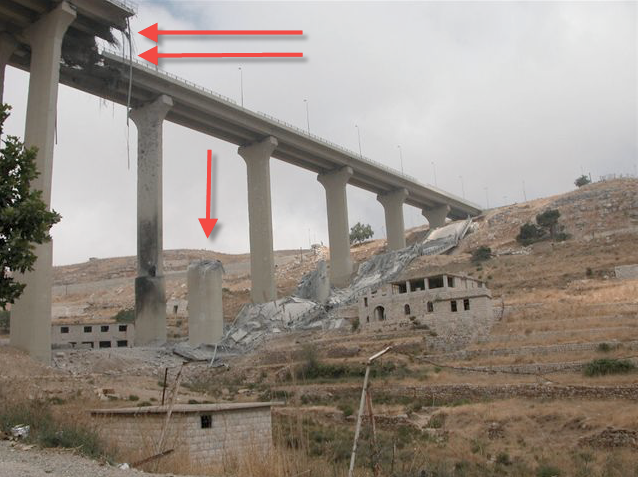
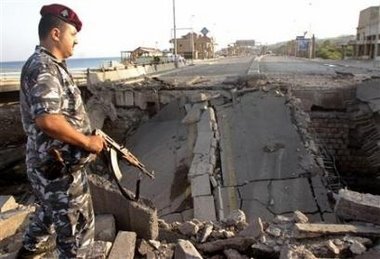
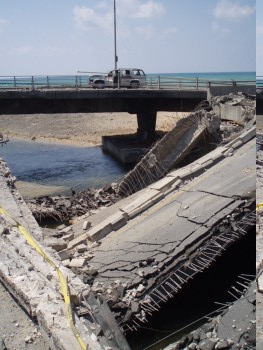
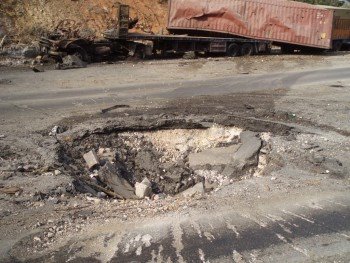
The destruction of roads and bridges to cutoff tranportation routes is the primary focus of this report. In this sense, road and bridge bombings are similar, except that the difficulty and cost of re-building bridges is often much greater.

Targeting Vehicles vs Targeting Roads:

Israel has targeted numerous vehicles on roads, which is different than targeting the road itself to cut off transportation routes. This report focuses on the later. A separate report is being developed on the topic of targetting civilian vehicles.

Israeli Rationale:

In the initial hours of Israel's assault on Lebanon, they claimed bridges were being destroyed to prevent Hezbullah from transporting the captured soldiers. Over time, this rational changed to preventing Hezbullah movement in general and to prevent the resupply of Hezbullah forces.

However, Isreali statements, and the facts on the ground, indicate that Israel had deeper motives. For example, Israel said it held the Lebanese government responsible for the soldier's kidnapping. In this context, the damage inflicted on Lebanon's infrastructure seems intended to pressure the Lebanese government and pupulace to turn against Hezbullah. This psychological warefare strategy is well documented throught history, including US bombing of civilians in Germany and Japan during World War II. In the present case, Israel's strategy appears to have backfired, and leaves Israel vulnerable to legitimate charges of war crimes (collective punishment, disproportionate use of force, and failing to distinguish between military targets and civilian population.

Report Methodology:


Road and bridge bombings are very common. Repairs and re-bombings make it difficult to provide numbers of disabled roads. This damage report is not intended to be perfect, but rather attempts provide a reasonable, well-sourced estimate of the damage.

Summary of Damage to Roads and Bridges:


94 roads as of August 11 [1].
71 bridges have been destroyed [2][3][1][32]
72 overpasses have been destroyed [2]

Detailed Cases


Initial Week, July 12 - 18:

In the first week of the US-Israeli assault, 38 main roads were cut off, and 48 bridges were destroyed [4]

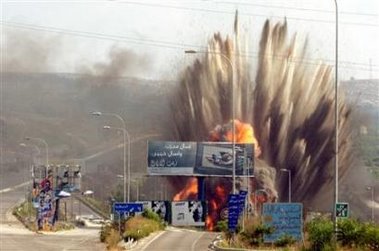
July 13, In the initial assault, the Israeli military said it attacked 40 targets to stop Hezbollah from moving their two soldiers. One strike by Israeli jets hit a major junction along the main north-south coastal highway, wrecking the road and wounding two people. [5]

July 14, Israeli planes struck the main highway linking Beirut to the Syrian capital Damascus, a Lebanese security source said. The jets struck at least five separate times along different points of the international route.[6]

July 14, A woman was killed and six other civilians, including three paramedics, wounded in a strike on a bridge over the river Zahrani near the main coastal city of Sidon. [8]

July 15, Security officials said three other civilians were killed in an air raid on a bridge on the Beirut-Damascus highway. [7]

July 15, Israeli planes fired rockets near a Lebanese-Syrian border crossing, heightening fears it could extend its campaign to Syria. [9]

July 17, Nine civilians were killed, including two children, when an afternoon strike hit a bridge at the entrance to the southern port city of Sidon (Saida), Lebanese security officials said. [30] This is consistent with a reporst circulating the internet referencing an attack on the Rmayleih bridge, near Saida (Sidon) on July 15 or July 17 (might be an error in the label of a photo) killing 8 civilians. The reports are submitted by, "Hanady," who reference a Dr. Bashir Sham, member of "French Association of Cardiovascular Surgeons" at the "Southern Medical Center," who describes the unusual condition of the corpses. The conditions were characterized as follows: they were burnt , but their colour is dark , they're inflated, and they have a terrible smell" All this , and the hair is not burnt nor do the bodies bleed. (Similar reports in Doueir).

July 16, Another seven people were killed in other raids against bridges and petrol stations in eastern and southern Lebanon, including a strike that blocked the main border crossing into Syria [?]

Continued Attacks on Roads & Bridges:


July 19, Two civilians were killed and two wounded in air strikes on roads in Kfarshuba, Bazuriyeh and the nearby entrance of Tyre. [11]

July 20, The BBC reported, "Bombed roads are hampering aid efforts, with the UN warning the humanitarian crisis is worsening by the hour." The United Nations' emergency relief co-ordinator, Jan Egeland, said the wounded could not be helped because roads and bridges had been cut by Israeli air strikes. [10]

July 21 A section of Lebanon's oldest bridge, which is part of the Beirut-Damascus highway in central Lebanon, collapsed after being hit with four Israeli missiles. [12]

July 22, Israel said its aircraft had hit 150 targets inside Lebanon in the 24 hours to Saturday morning, including a dozen roads linking Lebanon to neighbouring Syria. [13]

July 24, UN relief chief Jan Egeland said, "Hundreds of bridges and virtually all road networks have been systematically destroyed leaving entire communities in the south inaccessible." [14]

July 29, Lebanon's main international border crossing was closed on Sunday, July 30, a day after Israeli warplanes struck the road leading to Syria. Heavy bombs had gouged out large craters on the road leading to the Syrian border at Masnaa in eastern Lebanon, witnesses said. The closure left one route through northern Lebanon to Syria as the only relatively safe passage out of the country. [15]

July 31, Israeli warplanes launched raids on eastern Lebanon on Monday, Lebanese security sources said, hours after Isreel claimed to suspended aerial bombardment of south Lebanon for 48 hours. The sources said at least two air strikes hit roads near the border with Syria in the early hours. [16]

August 2, Israeli aircraft wrecked at least three bridges in the northern tip of the Bekaa and in northern Lebanon. [17]

August 4, Israel again cut off all roads into Beirut including the north-south coastal highway. [18] Israeli air strikes destroyed four bridges north of Beirut on the main coastal highway. The bombing of bridges in the Christian heartlands north of Beirut cut off the main coastal highway to Syria. A bridge in the Maameltein area near Jounieh was destroyed. Five people, including a Lebanese army soldier, were killed and 12 wounded in the bombing of the bridges, the Red Cross said. [19][20]
Video Report LINK

Also of concern is the fact that the Qasmieh Bridge and the makeshift bridge between Saida and Tyre in the south were destroyed a few days ago, leading to the isolation of the city of Tyre. [21]

August 6, Israeli warplanes early Sunday carried out a series of air raids bombing two roads linking Lebanon's eastern Bekaa plain with Beirut and north Lebanon, as well as two bridges in Akkar province north of the capital, Lebanese police said. [22] In Beirut, on Sunday afternoon (Aug 6), warplanes dropped six bombs on the sector, destroying a 10-storey building and cutting the main road that crosses the suburb. [23]

August 7, Israeli warplanes early Monday carried out a dozen raids in east Lebanon, hitting roads linking the region with Syria, Lebanese police said without reporting any victims. Two raids targeted the road leading to the Masnaa border post, knocked out by previous attacks and hit again each time residents fill in the craters so as to be able to drive around, the police said. The fighter-bombers pounded the road between Baalbek and Rayak, linking the Baalbek region with Zahle in the centre of Lebanon, they said. Two other raids hit the Aita al-Fukhar road linking villages in the Bekaa Valley with Syria. [24]

August 10, Israel struck the border crossing at Masnaa in the Bekaa Valley. Masnaa is the main border crossing with Syria used by evacuating foreigners, and has been closed after four previous strikes. Israeli warplanes struck roads and villages in mountainous areas in the southeastern part of the Bekaa Valley. [25]

August 11, Isralie jets struck twice at a busy bridge at the Abboudiyeh border crossing into Syria, killing at least 12 people and wounding 18 others, hospital and security officials said. [26]

August 12, An Israeli air strike destroyed a road leading to the only remaining border crossing to Syria at Arida about a mile from the Mediterranean coast. It's the last official border post open for humanitarian convoys and civilians fleeing the country. A separate raid destroyed a bridge linking Tyre and Nabatiyeh with Sidon. [27][28]

August 13, Israeli fighter-bombers destroyed two bridges in the northern Akkar plains that link Tripoli with the Syrian border, wounding six people. The air strike on the bridge at Halba destroyed a large number of homes, causing civilian casualties, said a hospital worker. A number of Lebanese Army soldiers stationed nearby were also wounded in the attacks. The bridge in adjoining village was also destroyed. Eight other bridges in the area have already been destroyed. [29]

August 15, Tens of thousands of Lebanese jammed bomb-cratered roads Monday as they returned to still-smoldering scenes of destruction after a tenuous cease-fire ended 34 days of vicious combat between Israel and Hezbollah. [31]

August 19, Israel raid after the cease fire: The security officials said the commandos flew in by helicopter to a hill outside the village of Boudai west of Baalbek in eastern Lebanon, about 17 miles from the Syrian border. Witnesses said Israeli missiles destroyed a bridge during the fighting. [32]

Images:


LINK to IDF video of bridge being destroyed

Video Report of 4 Bridges destroyed August 4, 2006


Bridge at Damour


Bridge at Al Owali, Sidon (Saida)

Photos from Dar Jamail


SEE Dar Jamail's Photo Album for More


Sources:


[1] Lebanese Government via map made available from www.lebanonmaps.org.

[2] BBC, "Lebanon Damage Report"
Web Link

[3] Reuters, Lin Noueihed, August 4, 2006
Web LINK

[4] Wikipedia referencing the Financial Times, July 19, 2006.
Web LINK

[5] The Sun UK
Web LINK

[6] YnetNews, July 14, 2006
Web LINK

[7] Naharnet News Desk, July 15, 2006.
Web LINK

[8] Beirut, July 14, 2006 AFP
Web LINK

[9] Reuters, July 15, 2006
Web LINK

[10] BBC, July 20, 2006
Web LINK

[11] Beirut, July 19, 2006 AFP
Web LINK

[12] Canadian Broadcast Corporation, July 21, 2006
Web LINK

[13] AFP, Beirut, July 22, 2006
Web LINK

[14] AFP, Beirut, July 24, 2006
Web LINK

[15] AFP, MASNAA, Lebanon, July 30, 2006
Web LINK

[16] Reuters, Beirut, July 31, 2006
Web LINK

[17] Reuters, August 2, 2006
Web LINK

[18] CNN, August 4, 2006
Web LINK

[19] Reuters, August 4, 2006
Web LINK

[20] Reuters, Lin Noueihed, August 4, 2006
Web LINK

[21] Action by Churches Together (ACT) - Switzerland
Elisabeth Gouel, August 6, 2006.
Web LINK

[22] Beirut, Lebanon Aug 7, (AFP)
Web LINK

[23] BAALBEK, Lebanon, Aug 6 (AFP)
Web LINK

[24] BAALBEK, Lebanon, Aug 7 (AFP)
Web LINK

[25] Associated Press, CHRISTOPHER TORCHIA, August 11, 2006
Web LINK

[26] August 11, 2006 (AFP)
Web LINK

[27] Beirut, Aug 12, 2006 (AFP)
Web LINK

[28] Associated Press, ZEINA KARAM, August 12, 2006.
Web LINK

[29] SIDON, Lebanon, Aug 13 (AFP)
Web LINK

[30] Associated Press, Ravi Nessman July 17, 2006.
Web LINK

[31] Associated Press, Steven R. Hurst, AP August 15, 2006
Web LINK

[32] Associated Press, SAM F. GHATTAS, August 20, 2006.
Web LINK

August 11, 2006

Bleeder Board

The term "bleeder board" appears to be military slang for an intelligence summary board. Updates of all the significant events in the area of military operation. The term also has an technical meaning associated with electronics (capacitor).

Source: Sergeant Ricky Clousing, US Army tactical interrogator, Interview with DemocracyNow! August 11, 2006 See Context

Sergeant Ricky Clousing Martin Luther King Quote


Sergeant Ricky Clousing, a tactical Army interrogator, who went AWOL from Ft. Bragg, NC in June 2005 left the following quote from Martin Luther King, which explains his rationle:


"Cowardice asks the question, 'Is it safe?' Expediency asks the question, 'Is it politic?' But conscience asks the question, 'Is it right?' And there comes a time when one must take a position that is neither safe, nor politic, nor popular but because conscience tells one it is right."

More Info:

Exclusive Interview with DemocracyNow! conducted on the morning of August 11, 2006 before Sgt. Clousing turned himself into the military

Associated press coverage of St. Clousing's press conference on the afternoon of August 11, 2006 before he turned himself into the military.,Web LINK

Interesting Exchange on DemocracyNow! Interview (Bleeder Board?):

JUAN GONZALEZ: And how prevalent, in your experience, were these kinds of incidents of innocent civilians being needlessly killed?

SGT. RICKY CLOUSING:
I, myself, only witnessed this particular incident where an innocent civilian was killed, although because I was an interrogator, my security clearance granted me access to the S-2 room, which is the intelligence briefing room. It’s where they have all the intelligence updates. There is a board called the daily intelligence summary, and that holds information on how many times in our area of operation that soldiers have received small arms fire, how many IEDs have gone off and also the number of local nationals or noncombatant Iraqi civilians that are killed. And as I said, I only saw this personally one time, but the number of innocent Iraqis killed on the bleeder board, or on the intelligence board, definitely climbed the whole time I was in Iraq. The number never -- it gradually increased day by day that we were there in the sector.

AMY GOODMAN: It’s called the “bleeder board”?

SGT. RICKY CLOUSING: It’s an intelligence summary board, basically of all the updates in the area of operation that we conduct in, all of the significant events.

August 10, 2006

Condoleezza Rice: Light Weight

On July 30, 2006, as Condoleezza Rice departed Israel she said, "As I head back to Washington, I take with me an emerging consensus on what is necessary for both an urgent ceasefire and a lasting settlement." "I am convinced we can achieve both this week."

In the face of the Qana Massacre committed by Israel earlier that morning, I thought, "She's out of touch to think she's close to an agreement."

Then, on PBS NewsHour August 1, 2006, Rice said, "I still believe that if we really put our minds to it and work that this week is entirely possible. Certainly, we're talking about days, not weeks, before we are able to get a cease-fire."

Who are her advisors? How do they let her make these statements that undermines her credibility?

As it has been said, Condoleezza Rice is a light-weight compared to past Secretaries of State.

August 3, 2006

The Buzz of Justice Served

This is an open letter to Thomas Friedman

Mr. Friedman,

On Meet the Press, July 30, 2006*, you spoke of the "buzz" that several Syrian writers displayedover seen Hezbullah confront Israel. That "buzz" is probably a sense of a form of justice served. Until Israel is held accountable for injustices of the past, this "buzz" is legitimate, and the violence will likely continue.

I urge you to write about the need to indict and convict certain Israelis for war crimes in order to induce the healthy "buzz" of justice served.


* Partial Text of "Meet the Press" Interview:


MR. FRIEDMAN: Well, it was, it was a dinner with a group of Syrian writers arranged by some friends of mine. Say, you know, one woman was saying how she’s just really—believes Israel should be, you know, eliminated, and another Arab journalist was saying how much pride—how much pride he gets by seeing Hezbollah fight the Israelis to a standstill and inflict these casualties. And a third, very interesting, was saying, “This Nasrallah, the head of Hezbollah, he’s a disaster for us.”

But there are too many people, Tim, outside of Lebanon, in the Arab world, getting their buzz, frankly, off seeing Hezbollah stand up to Israel while Lebanon gets decimated. Lebanon, the first Arab democracy. And I, I real—I have a real problem with that because it’s time for the Arab world to stop getting their buzz, OK, off fighting Israel and to overcome their humiliation that way. It’s time to start building something.

Full Transcript

August 2, 2006

Cuban Propaganda Campaign


Accorging to the Associated Press, Legislation sponsored by Senator Bill Nelson (R-FL), fellow Floridian Mel Martinez, Majority Leader Bill Frist and others would authorize as much as $80 million over two years to "dissidents" and non-governmental organizations on the island of Cuba to promote democracy.

The legislation says "dissidents" eligible for the money would include political prisoners, workers' rights organizations, independent libraries, journalists, doctors and economists.

Cuba has a population of about 11.4 million according to the CIA World Fact Book. The US has a population of about 300 million.

Imagine Fox News' reaction if Cuba announced a campaing to fund US "dissidents" at the same rate per capita that the US is proposing. That is, imagine if Cuba announced a $2.1 Billion-with-a-"B" campaign to promote democracy in the US.

We don't have a democracy, or republic, in this Great U-S-of-A. We have a Plutocracy; that is, we're governed by a wealthy, politically-connected aristocracy. Even our electoral process is seriously in question these days*. $2.1 Billion could be well spent to promote democracy in the US.

So, if Cuba comes up with $2.1 Billion in grant funding, I want a grant application form.


* It's not just electronic voting machines without paper verification, manufactured by Repulican-owned corporations funded by Congress; it's the purging of voter roles, placement of too few voting booths in certain precincts leading to hours-long lines, and many other tactics to supress votes.

AP, August 1, 2006, AP Article Link

July 31, 2006

Wealth Gap and Guillotines

I told a friend, "Did you know that the top 1% of wealthy Americans hold 33.4% of all US wealth?" She said, "It doesn't surprise me."

I continued, "And the bottom 90% hold less than one-third of the wealth. That means the top 10% hold over two-thirds of the wealth."

Her quip? "Makes ya think of guillotines doesn't it? I mean, we've just replaced the titles of nobility."

July 30, 2006

Remember Qana 1996 and 2006 - GRAPHIC

It was only a matter of time that the Israelis would do something to catch the World's attention. In April 1996, it was Qana. In July 2006, it appears to be Qana, again. 56 dead in one building, mostly women and children, who were too afraid to evacuate by roads that have been targeted by Isreal.

An AP reporter writes, "Heightening the anger were memories of a 1996 Israeli artillery bombardment that hit a U.N. base in Qana, killing more than 100 Lebanese who had taken refuge from fighting. That attack sparked an international outcry that forced a halt to an Israeli offensive."

Qana Video, 1996

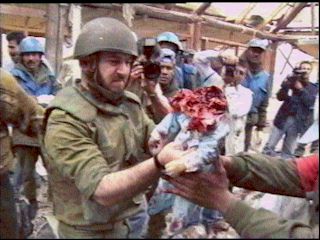
Right: Headless remains of an infant killed by the Israeli attack on the UN compound in Qana, 1996.

Excerpt of text by Robert Fisk associated with the 1996 Qana video:

"One of the UN soldiers who saw the video being made says that neither he nor his colleagues understood in the first few seconds what was happening at Qana. "We know the Israelis are perfect in their accuracy. The previous day, when Katyushas had been fired a couple of miles away, we saw the Israeli return fire come back on the launch site with complete accuracy. We felt so safe about the Israeli artillery that we never went indoors when shells flew over.

"They knew we were here and so they never hit us. So we didn't even wear flak jackets when there were shell warnings. The Israelis knew what they were doing. And then we saw Qana and by the end, none of us believed it was an accident. Yes, the Israelis knew what they were doing. What do you think the drone' was for?"

It is at times like these that poetry is the only way to speak:

Face of Qana

The face of Qana
Pale, like that of Jesus
and the sea breeze of April…
Rains of blood.. and tears..

They entered Qana stepping on our charred bodies
Raising a Nazi flag
in the lands of the South
and rehearsing its stormy chapters
Hitler cremated them in the gas chambers
and they came after him to burn us
Hitler kicked them out of Eastern Europe
and they kicked us out of our lands

They entered Qana
Like hungry wolves
Putting to fire the house of the Messiah
Stepping on the dress of Hussain
and the dear land of the South

Blasted Wheat, Olive-trees and Tobacco
and the melodies of the nightingale
Blasted Cadmus in his bark
Blasted sea and the gulls
Blasted even hospitals
even nursing moms
and schoolboys
Blasted the beauty of the Southern women
and murdered the gardens of the honeyed eyes

We saw the tears in Ali's eyes
We heard his voice as he prayed
under the rain of bloody skies

Who ever will write about the history of Qana
Will inscribe in his parchments
This was the second Karbala

Qana unveiled what was hidden
We saw America
Wearing the old coat of a Jewish Rabbi
Leading the slaughter
Blasting our children for no reason
Blasting our wives for no reason
Blasting our trees for no reason
Blasting our thoughts for no reason
Has it been decreed in her constitution,
She, America, mistress of the world,
In Hebrew .. that she should humble us al-Arab?

Has it been decreed that each time a ruler in America
wants to win the presidency that he should kill us ..
We al Arab?

We waited for one Arab to come
pull this thorny prick from our necks
We waited for single Qureishite
A single Hashemite
A single Don Quixote
A single local hero, for whom they did not shave the moustache
We waited for a Khalid .. Tariq .. or Antara
We were eaten chatter (while engaged in vain talk)
They sent a fax
We read its text
after paying tribute
and the end of the slaughter

What does Israel fear from our cries?
What does she fear from our faxes?
The Jihad of the fax is the weakest of Jihads
It is a single text we write
for all the martyrs who left
and all the martyrs those who will come

What does Israel fear from Ibn al-Muqaffa'?
Jarir and .. Farazdaq?
And Khansa throwing her poems at the gates of the cemetery
What does she fear if we burn tires
Sign communiqués
And destroy shops
And she knows that we have never been kings of war
But were kings of chatters

What does Israel fear
from the beating of the drums
the tearing of clothes
and the scratching of cheeks
What does she fear
when she hears
the stories of `Ad and Thamud?

We are in national comma
We did not receive
Since the times of conquest
a single mail

We are a people of made of dough
The more Israel increases in her killing and terrorism
the more we increase in idleness and coldness

A Smothering Dominion
A regional dialect that increases in ugliness
and a green union that grows in isolation
Summer trees, growing barren
And borders .. whenever the whim strikes
erase other borders

Israel should slaughter us, and why not?
She should erase Hisham, Ziyad and ar-Rashid, and why not?
[Why not?] and the Banu Taghlab lusting after their women
[Why not?] and Banu Mazen lusting after their slave boys
[Why not?] and Banu Adnan dropping their trousers to their knees
debating .. necking and .. the lips!

What should Israel fear from some of al-Arab
When they became Yehuda???

by Nizar Qabbani
1923-1998, written in 1996

425 and Selective Morality

Israel, and the World "ignored this earlier Security Council resolution [425] demanding that they [Israel] remove themselves from South Lebanon for 20 years, that’s called selective morality."

- Edward Peck: Former U.S. Chief of Mission in Iraq and ambassador to Mauritania. He served as deputy director of the White House Task Force on Terrorism in the Reagan Administration.

See transcript of inteview with Edward Peck, July 28, 2006

Brief Bio on E. Peck

July 23, 2006

Lebanon Damage Report 2006

Updated August 28, 2008

Expanded Reports: To minimize clutter on this page I've expanded several subject areas, listed and linked immediately below.

Damage to Villages by District (a work-in-progress)

Damage to Roads and Bridges

Impacts of Cluster Munitions (Includes a link to US Prohibitions on Israeli use of cluster munitions).

See Location Map of Lebanon below

The Number of Attacks:

Citing a variety of sources, the Amnesty International reports Israel’s air force carried out more than 7,000 air attacks, while the navy had fired 2,500 shells (known to be very inaccurate). (This does not count artillary, mortars, tank shells, grenades, and other munitions). [57]

Killed:

At least 1,191 Lebanese were killed, most are civilians, about a third were children according to the Lebanese government. More continue to die due to encounters with unexploded munitions. [57][39][66 10-27-06 Report] See "Special Concerns" and footnote [6] for specific cases.

Wounded:

4,409 civilians wounded, according to the Lebanese government. More continue to die due to encounters with unexploded munitions. [57][39][66 10-27-06 Report]

Displaced:

About 970,000 Lebanese fled their homes in the fighting, about one-quarter of the population.[57] About 200,000 remained displaced as of October 27, 2006[66].

Special Concerns:

Seige of an Entire Country: By cutting off all modes of transport into Lebanon, and thus life-supporting supplies, Israel is establishing a seige, which is a form of collective punishment. [45] The blockade continues after the cessation of major hostilities.

Phosphorus Weapons: On Saturday July 15, in their attack on villages in the Arqoub area in the South, Israel made use of phosphorus weapons. [9][15] (July 18, 24)

Cluster Bombs: Between the August 12 cease fire, and Sept. 9 the United Nations (UNICEF) reports that 14 civilians have been killed by unexploded ordinance (UXO), and 66 have been injured.[66] As of Sept. 9, 2006 the UN Mine Action Coordination Center had identified 450 cluster bomb sites. Nearly 15,000 unexploded bomblets had been destroyed. Some villages report being 90% inaccessible due to contamination with UXO. [66] As of December 29, 2006 the UN had received reports of at least 200 UXO incidents. [66] SEE Expanded Report

Update, August, 2008: Since the war ended, twenty-seven civilians and thirteen bomb disposal experts have been killed. Over 200 civilians have also been injured by the unexploded ordnance.

New Land Mines Laid by Israel:
The United Nations has reported that four deminers, two British and a Bosnian were seriously wounded, and a Lebanese expert slightly hurt, at the weekend when they stepped on mines. The incidents near the village of Deir Mimas were the "first evidence we have that the Israeli forces laid new mines in south Lebanon in 2006."

Attacks on relief and medical operations: “The International Committee of the Red Cross (ICRC) yesterday reiterated its 13 July appeal to both parties involved in the conflict in Lebanon to “respect humanitarian volunteers and workers and the Red Cross and Red Crescent symbols. This call follows an attack on Tuesday by the Israel Defense Forces (IDF) on a convoy of ambulances and trucks, sent by the United Arab Emirates Red Crescent (UAERC), on the road between Damascus and Beirut.” [10]

Attacks on Fleeing Refugees: Israel urges civilians to leave an area, but maintained a conflicting policy of attacking all moving vehicles. See: "Civilian Vehicles and Convoys" below. Also see notes [6]

UN Observer Post Attack July 26: The observer post has been manned by the UN for many years and is well marked. Israel shelled the post for several hours and is reported to have finally used targeted munitions. Israel commanders received direct communications from the observer post at least 10 times over several hours urging the shelling to stop. The UN Secretary General is on record indicating his belief that the attack was deliberate.

Qana Apartment Attack, July 30: 1am sustained attack killed up to 54 civilians, Lebanese officials say. Human Rights Watch says it has confirmed 28 dead in that attack and 13 people missing. [36]

Qaa Orchard Attack, August 4: Israeli air strike hit a farm near Qaa, close to the Syrian border in the Bekaa Valley where orchard workers, mostly Syrian Kurds, were taking lunch. 33 people were killed and 20 wounded. 23 of the killed were Syrian including 6 women. [36] ([42] updated after some died of their wounds).

Civilian Infrastructure:


“The top U.N. humanitarian official, touring Beirut, said billions of dollars will be needed to repair damage” [5] (July 23)

Homes & Residential Buildings:More than 130,000 private homes damaged or destroyed according to the Lebanese government. [64]

Roads & Bridges: Road & bridge bombings are very common, followed by repairs and re-bombings, making it difficult to inventory. A summary with a link to a more detailed assessment (See Also "Civilian Vehicles and Convoys").

More than 94 roads as of August 11 [48]. 38 main roads cut off within first week of the conflict.[2]
71 bridges have been destroyed [27][36][48][56]
72 overpasses [27]

SEE More Detailed Report & Images

Airports:
Beirut International Airport, runways, fuel depot (at least 4 separate strikes), radars, parking lot, access tunnel, two access bridges [2][12][8][28]
Qaleiat Airport in North Lebanon, runways [2][27]

“In an unusual deal that the United States helped broker, a runway at the Beirut airport was repaired long enough to enable six planes -- one carrying former Lebanese Prime Minister Najib Nakati -- to take off. Israeli forces soon after bombed the runway again.” [12] (July 15)

Ports:

The three main sea ports of Beirut, Tripoli and Jamil Gemayel, severly damaged [2] (July 18)

Utilities:
Widespread electricity outages across Southern Lebanon have disabled water pumps resulting in significant health risks.
Water-processing plant in Yurin
Fuel storage tank at the Jiyeh power plant, Beirut [11] (July 14)
Jiyeh power plant itself, Beirut [13] (July 16)
Zahrani power plant south of Beirut [12] (July 15)
Electricity generator in Sibline has been damaged [28] (July 21)
11 Reservoir dams were destroyed and 20 damaged [27][66 Sept. 12 report]
Sewage plant, Dair al-Zahrani [27]
6,800 water storage tanks destroyed in 40 villages in Majayoun and Bent Jbail districts affecting 45,000 people. [66 10-27-06 report]

August 11, Electricity was out in Tyre and Sidon, after Israeli warplanes struck transformers at power plants in both coastal cities. An official said it could be 10 days before power was restored [50]

Food Storage Facilities and Supermarkets:
Grain silo in Beirut Port [9] July 18
Detergent and foodstuffs warehouse for Procter & Gamble, Choueifat [28] (July 21)
Supermarkets in many villages were targeted, suggesting Israel's intent to drive civilians out of villages by destroying their food source [65]

Communications:
Antenna in Tripoli port belonging to the maritime operations room [2] (July 18)
Antenna owned by MTC mobile phone company in Dahr al-Baidar. [2] (July 18)
Lighthouse in Beirut near American University hit at least twice. [16][46] (7/15, 8/9)
Television transmitters at Terbol, north of Beirut, for Lebanese Broadcasting Company, and Future TV. [25] (July 22)
Cell Phone transmitters at Terbol, north of Beirut. [26] (July 26)

Commercial:
Textile factory in the border town of al-Manara [5] July 23
Factory producing prefabricated houses near the highway to Damascus [5] July 23
The country's largest dairy farm, Liban Lait [8] July 19
Paper mill [8] (July 19)
Packaging firm and [8] (July 19)
Pharmaceutical plant almost completely destroyed [8] (July 19)
Plastics factory in Tyre almost completely destroyed [8] (July 19)
Two plastics factories in the South and one in the Bekaa extensive damage [8] (July 19)
Tissue paper factory in Sidon almost completely destroyed [8][28] (July 19)
Tissue paper factory in Bekka [27]
Bottle factory in Bekka [17]
Medical supply company in Beirut's southern suburbs (might be same as Pharmaceutical plant)
Warehouse $10 million in consumer merchandise, Rafik Hariri International Airport [8] (July 19)
Warplanes struck a large construction materials factory south of Baalbek. [38]
About 150 businesses reported by the BBC [27]
See Gas Stations

Public Buildings:
Of 400 health facilities surveyed by the World Health Organization, 12 were totally damaged, 38 severly damaged with the most damage in Bent Jbail, followed by Marjayoun, Nabatiye, and the southern suburbs of Beirut. [66] Sept. 6

According to the UN Office for the Coordination of Humanitarian Affairs (OCHA), the conflict destroyed 50 to 90 percent of the government and public buildings in 39 villages in the Bent Jbail district. [66] Aug. 23, Report 26

Hospital destroyed, Mayss al-Jabal [2][28] (July 18)
Hospital hit, Nabatiyeh [28]
Hospital hit, southern suburbs of Beirut [28]
Air strikes destroyed the three-storey Dar al-Hikmah hospital in Baalbek [59][60] (Aug 2)
Several schools in Kounin destroyed [2] (July 18)
School for the deaf "leveled" [43] (Likely the Al-Hadi Institution for the blind and deaf in Ghobeiry, Beirut).

"Up to 50 schools in south Lebanon were completely destroyed as a result of the conflict. In addition there are as many as 300 other schools which suffered major damage," Simon Ingram, spokesman for UNICEF. [61]

According to the UN Office for the Coordination of Humanitarian Affairs (OCHA), the conflict destroyed 50 to 90 percent of the government and public buildings in 39 villages in the Bent Jbail district. (See August 23 United States Government Situation Report ref [66]).

Civilian Vehicles & Convoys:

There have been numerous reports. A few examples follow.

Israel hit a convoy of refugees, Associated Press reports on July 23. [14]
An Israeli missile also hit two [clearly marked] Red Cross ambulances late Sunday in the southern Lebanese town of Qana, killing one person and seriously wounding two others, a Red Cross official said. [15] (July 24)

Israeli missiles hit a convoy near the town of. Three trucks, clearly marked as a relief operation, containing supplies of medicines, vegetable oil, sugar and rice were damaged or destroyed, as well as four passenger vehicles. [28]

Two trucks with water drilling equipment destroyed in Ashrafiyeh, Beirut. [28]

The bodies of nine Lebanese civilians, including three children and their parents in a car hit by a missle, were found along Maarub-Dardghia road near Tyre July 28. [29]

Religious Buildings:
Church in Rmeish severely damaged [2] (July 18)
Mosque in Tiri severely damaged [2] (July 18)
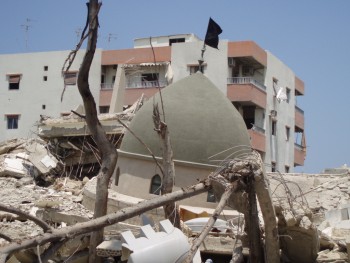
Mosque in Sidon destroyed (photo: Dahr Jamail)[51]

Gas Stations & Fuel Centers:
Fuel containers in Jiyye destroyed [2] (July 18)
Fuel depot at Beruit International Airport [8] (July 22)
Gas storage tank in the northern neighborhood of Dawra [19] (July 17)
12 service stations destroyed as of July 18 [4]
17 fuel stores reported as of July 21 [28]
4 gas stores reported as of July 21 [28]
Two petrol stations in Baalebeck were targeted and set on fire [34] Aug 1

Environmental:

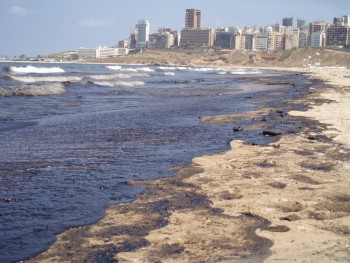
An oil slick caused by Israeli bombing of the Jiyyeh power station now covers 80km (50 miles) of coast. [33]See: United Nations Environmental Program (photo: Dahr Jamail)

Lebanese Military: (Not of Hizbullah)
Lebanese Army posts struck in Jounieh, Amsheet, Sidon, Batroun and Abdeh.
A Lebanese soldier was killed in another strike on an army post south of Beirut [41]
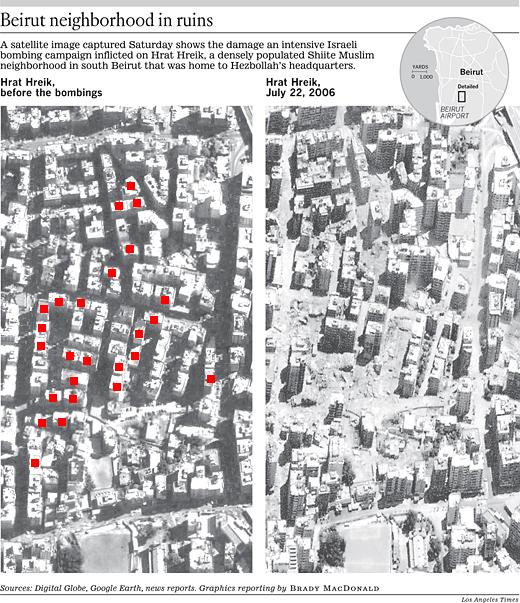
Military vehicles struck in Haret Hreik.
Israeli jets struck several radar targets in Lebanon over the weekend. [18] (July 17)
Eight Lebanese soldiers were killed when Israeli aircraft attacked a small fishing port at Abdeh in northern Lebanon near a highway leading to Syria. [19] (July 17)
Rayak military airport runways disabled
Radars at the Rayak airport
An air raid on a Lebanese army barracks in the Jamhour area east of Beirut killed 11 Lebanese soldiers, including four officers, and wounded 30. (July 18) [52]
Israel struck a military base at Kfarchima in southern Beirut. At least 11 soldiers were killed in an engineering unit and 35 were wounded. [21] (July 19)

Other:

Headquarters for the Popular Front for the Liberation of Palestine (PLO) in eastern Lebanon, which isn't responsible for Hizbullah [12] (July 15)

Economic Damage: Billions of dollars lost due to lost tourism, stock market closed, businesses loosing orders, capital flight from banks.

Detailed Daily Accounts:
Lebanon Updates
SAMIDOUN: See Day by Day

Images You Won't See in Western Corporate Media:
Indymedia Images


Israeli Bombs:
.
.
.


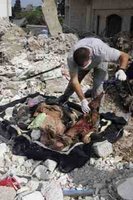
Israeli Target... what's left of a woman
.
.
.
.
.
.
.
Oil Spill Reaches Syria, August 8, 2006


Sources:

[1] Lebanon's Prime Minister Fuad Saniora, quoted in SF Chronicle
“ Civilian Toll Raises Questions: Israel, criticized for killing hundreds of Lebanese, says Hezbollah stores missiles in residences” by Anna Badkhen

[2] Internal Security Forces' directorate general, reported by the Daily Star of Lebanon
Web Link

[3] Same source as [2]
More than 100 homes and residential buildings destroyed in the areas of Tyre, Aita al-Shaab, Rmeish, Houla, Sarifa, Braachit, Shahour, Borayqeh, Shehabieh, Doueir, Aaba, Majadel, Dabaal, Jbeil, Ain Mezreb, Ghandourieh, Haret Hreik, Baalbek, Khiam, Dibbine, Marjayoun, Kfar Shuba, Bint Jbeil, Aitaroun, Tibnin, Maaroub, Kounin, Blida, Kfar Hammam, Meis al-Jabal, Jabal al-Batm, and Abbassieh.

[4]Same source as [2]
12 service stations in Bir Abed, Khiam, Ain Ibl, Moseileh, Rmeileh, Houla, Hesbe, Tyre, Kfar Kila, and Douris.

[5] Associated Press July 23, 2006, KATHY GANNON
Web Link

[6] Specific cases of injured and killed:
A member of the U.N. observer team in south Lebanon, Italian Capt. Roberto Punzo was wounded by guerrilla fire (the second observer injured). [5] July 23

Fleeing refugees, including women and children, were cut down on a road adjacent to the Lebanese-Israeli border in an airstrike as they left the village of Marwaheen. The bodies of several children, one headless, were sprawled on the ground. Police said 15 were killed in the afternoon attack and an Associated Press photographer counted 12 bodies in the two cars. [16] (July 15)

At least three civilians were killed when another Israeli airstrike hit a bridge near the Syrian border, cutting the last land link on the main road to Syria and its capital, Damascus. [16] (July 15)

Eight Canadians of Lebanese origin, all members of the same family, were killed by an Israeli strike on their village in the south where they'd come for a summer visit. [17] (July 16)

In the southern port of Tyre, an Israeli missile tore of the top of a 12-story building, killing at least nine. [17] (July 16)

A missile hit a minibus, killing 12 civilians as they were driving through the seaside town of Rmeileh, south of Beirut. [18] (July 17)

Nine members of the same family were killed when a bomb hit their house in the village of Aitaroun. [21] (July 19)

21 civilians were killed and 30 wounded in an air strike against the southern village of Srifa, 20 miles north of port of Tyre, when 10 houses were bombed. [22] (July 19)

A Lebanese photographer the magazine Al-Jaras, Layal Nejim, 23, became the first journalist to die in the fighting when an Israeli missile hit near her taxi in southern Lebanon. [5] (July 23)

An Israeli airstrike hit a United Nations post in southern Lebanon late Tuesday, killing at least two (make that 4) of the agency's observers. U.N. Secretary-General Kofi Annan said he was "deeply distressed" by the "apparently deliberate" strike. [20] (July 25)

An Israeli airstrike killed at least 56 people, including at least 34 children, in a southern Lebanese village Sunday, the Lebanese Red Cross said. It was the deadliest attack in 19 days of fighting. Lebanese security officials put the toll at 57 dead. Security officials said the toll rose dramatically after 18 people from two families were found in a single room of the building, where dozens of people had been taking refuge from the fighting. [30]

Warplanes returned to the capital midday and sent missiles into Chiah, a south Beirut neighborhood where at least 41 people were killed in a strike Monday (Aug 7). [44]

Israeli missiles slammed into the southern Lebanon village of Rachaf, about 10 miles from the Israeli border, killing at least 15 civilians, security officials said. [47]

The death toll continued to rise after the August 7 cease fire when, on August 16, rescue workers pulled 32 bodies from the rubble in the southern town of Srifa, target of some of Israel's heaviest bombardment in the 34-day conflict. [53]

[7] Associated Press, July 22, 2006. Among the civilian deaths are 8 Canadians, 2 Kuwaiti nationals, 1 Iraqi, 1 Sri Lankan, 1 Jordanian. Web Link

[8] Daily Star of Lebanon, July 19, 2006
Web Link

[9] Daily Star of Lebanon, July 18, 2006
Web Link

[10] IRIN, a UN humanitarian information unit.

[11] BBC, July 14, 2006
Web Link

[12] CNN, July 15, 2006
Web Link

[13] CNN, July 16, 2006
Web Link

[14] Associated Press, LEE KEATH July 24, 1006
Web Link

[15] CNN, July 25, 2006
Web Link

[16] Associated Press, July 15, 2006 SAM F. GHATTAS
Web Link

[17] Associated Press, July 16, 2006 Hamza Hendawi And Lee Keath Web Link

[18] New York Times, July 17, 2006 STEVEN ERLANGER and JAD MOUAWAD
Web Link

[19] ABC News (AP See Also [17]), July 17, 2006
Web Link

[20] CNN July 25, 2006
Web Link

[21] Associated Press, RAVI NESSMAN, via New York Sun, July 19, 2006
Web Link

[22] New York Times, July 19, 2006 JAD MOUAWAD and STEVEN ERLANGER
Web Link

[23] CNN July 27, 2006
Web Link

[24] Reuters, Nadim Ladki, July 27, 2006
Web Link

[25] ABC "World News Saturday," July 22.

[26] Associated Press, SAM F. GHATTAS, July 26.
Web Link

[27] BBC, "Lebanon Damage Report"
Web Link

[28] Guardian Unlimited, damage inventory, Brian Whitaker July 21, 2006
Web Link

[29] CNN, July 29, 2006
Web Link

[30] Associated Press, KATHY GANNON, July 30, 2006
Web Link

[31] Associated Press, KATHY GANNON, July 30, 2006
Web Link

[32] Reuters, Alaa Shahine, July 31, 2006
Web Link

[33] BBC, Richard Black, July 21, 2006
Web Link

[34] BBC, August 2, 2006
Web Link

[35] CNN, August 1, 2006
Web Link

[36] Reuters, Lin Noueihed, August 4, 2006
Web LINK

[37] Interview on DemocracyNow with Amy Goodman July 31, 2006. "Just a few days ago we documented an attack on the village of Blida, in which the Israelis used cluster munitions." Peter Bouckaert of Human Rights Watch in Beirut.
Web LINK

[38] Associated Press, SAM F. GHATTAS, August 7, 2006
Web LINK

[39] Wikipedia Casualties of 2006 Israel-Lebanon Conflict, which sources BBC, ITAR-TASS.
Web LINK

[40] Reuters, August 3, 2006.
Web LINK

[41] Reuters, August 4, 2006.
Web LINK

[42] Reuters, August 6, 2006.
Web LINK

[43] Flashpoints, WPFW, Dennis Burnstein interview of Bilal El-Amine, Aug 8.
Web LINK

[44] Associated Press, CHRISTOPHER TORCHIA, August 11, 2006
Web LINK

[45] CNN, August 4, 2006
Web LINK

[46] Flashpoints, WPFW, Dennis Burnstein interview of Bilal El-Amine, Aug 9.
Web LINK

[47] Associated Press, LAUREN FRAYER and SAM F. GHATTAS, August 12, 2006.
Web LINK

[48] Lebanese Government via map made available from www.lebanonmaps.org.

[49] Associated Press, Zeina Karam, August 14, 2006
Web LINK

[50] Associated Press, August 12, 2006
Web LINK

[51] Dahr Jamail, indpendent journalist.
Photo Gallery

[52] Reuters, July 18, 2006
Web LINK

[53] Associated Press, SAM F. GHATTAS, July 17, 2006. Web LINK

[54] Associated Press, Seven R. Hurst, August 15, 2006. Web LINK

[55] Reuters, August 18, 2006. Web LINK

[56] Associated Press, SAM F. GHATTAS, August 20, 2006. Web LINK

[57] New York Times, John Kifner, "Human Rights Group Accuses Israel of War Crimes," August 24, 2006.Web LINK

[58] DemocracyNow!, Ana Nogueira, August 23, 2006. web LINK

[60] Associated Press, August 2, 2006. Web LINK

[61] AFP, August 25, 2006. Web LINK

[62] DemocracyNow!, August 30, 2006. web LINK

[63] DemocracyNow!, August 25, 2006. Web LINK

[64] DemocracyNow!, September 1, 2006. Web LINK

[65] DemocracyNow!, Amnesty International interview, August 23, 2006. Web LINK

[66] United States Government Situation Report, Lebanon Humanitarian Emergency, USAID citing various source, Index of reports by date.
Web LINK to Index of All Situation Reports

[67] Reuters, "UN says Israel laid anti-personnel mines in Lebanon" November 28, 2006 Web LINK

[68] DemocracyNow! Headlines, "Shortage of Funding Halts Mine Sweeping in Lebanon"
August, 25, 2008.

Ignorance of the Law is no Excuse

We've all heard, or experienced, a similar story. Someone commits a traffic violation or other legal infraction. The person honestly didn't know that they were breaking a law. The police officer and court system says, "Sorry. You're guilty. Ignorance of the law is not a legitimate excuse."

Recently, Human Rights Watch released a report documenting the sanctioned torture of detainees by the US Military. AP Article According to the AP article, "A Pentagon spokesman, Cmdr. Greg Hicks, said the military is reviewing its procedures regarding detainees following a Supreme Court ruling that the Geneva Conventions should apply in the conflict with al-Qaida."

It sounds like the military and political establishment are gearing up to say, "Oh. We didn't know that the Geneva Conventions applied. Now that we know, we'll follow them, but you can't blame us for our past actions."

Sorry, "Ignorantia juris non excusat," latin for ignorance of law is no excuse, is a long standing maxum that applies in this case.

More Information:

Human Rights Watch Press Release

Human Rights Watch 53-page Report by John Sifton, “No Blood, No Foul: Soldiers’ Accounts of Detainee Abuse in Iraq”

Update:

Once we had laws that made it OK to own slaves. Now Congress has passed a law to make it OK, retrospectively, to violate the Geneva Conventions. (The Military Commissions Act signed into law October 17, 2006.)

I can't understand how they can legislate themselves out of this one. It's like a fox gets caught in the hen house. Then the fox puts on a chicken suit while the farmer is standing there and pretends he isn't a fox.