The world is being taken over by a segment of the corporate elite by using the The Shock Doctrine.
Sources:
Associated Press, Gates says Iran seeks to cause chaos, LOLITA C. BALDOR, December 8, 2007.

Tehran's decision to halt its nuclear weapons program suggests it is less determined to develop nuclear weapons than we have been judging since 2005.
The Basra palace had come under near daily rocket and mortar fire from Shiite militias until the British released about 30 gunmen a few months ago and spread the word that they would soon leave.
People on the streets of Basra cheered the departure of the British.
"We are pleased that the Iraqi army are now taking over the situation. We as an Iraqi people reject occupation. We reject colonialism. We want our freedom," resident Rudha Muter told AP Television News.
U.S. officials have been concerned about the prospect of British troops handing over control of a city where armed militias hold sway. Basra controls a key land supply line from Kuwait to Baghdad and farther north, and is also near important oil fields.
 The Associated Press reports that
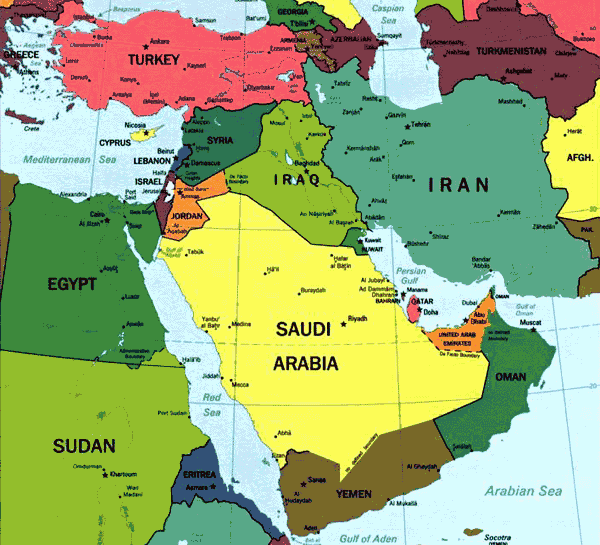
The U.S. is not preparing for war against Iran and Vice President Dick Cheney supports that policy, Secretary of State Condoleezza Rice says, taking a swipe at a U.N. official who says he's worried about "crazies" who want to start bombing.Actually, the US is already at war with Iran, as described below.
The president of the United States has made very clear what our policy is. That policy is supported by all the members of his Cabinet and by the vice president of the United States.
C reported on his recent talks in Washington. There was a perceptible shift in attitude. Military action was now seen as inevitable. Bush wanted to remove Saddam, through military action, justified by the conjunction of terrorism and WMD. But the intelligence and facts were being fixed around the policy. The NSC had no patience with the UN route, and no enthusiasm for publishing material on the Iraqi regime's record. There was little discussion in Washington of the aftermath after military action.Yet Bush regularly gave the American public the false impression that he was following a "diplomatic course" well aftr July 23, 2002, as documented in the Mother Jones Timeline. For example:
December 1, 2001: According to Bob Woodward, Rumsfeld orders [General] Franks to begin work on an Iraq war plan. Bush will meet with military leaders regarding the plan on a regular basis starting late December, despite public assurances that the administration is seeking a diplomatic solution to its showdown with Saddam.
This is not wild speculation. It's simply a fact that the planning has gone beyond the contingency stage, and it’s gone into what they call the operational stage, sort of an increment higher. And it's very serious planning, of course. And it's all being directed at the wish of the President of the United States.
The issue is not whether the military option would be used, but [rather] who approved the start of operations already?.... It's a very serious question about the constitutional framework under which we are now conducting military operations in Iran. [2]
The Central Intelligence Agency (CIA) has hired a Pakistani terrorist group that has carried out a series of deadly terrorist attacks inside Iran, ABC News has reported on Wednesday (April 3, 2007).
So, the establishment media story is that US Secretary of State, Condoleezza Rice, is assuring the World that the delusional Dick Cheney is on board with a "diplomatic" approach to Iran. However, this little smoke screen can't hide the fact that the US is already conducting military actions against Iran.
The [British] Defence Secretary said that the US had already begun "spikes of activity" to put pressure on the [Iraqi] regime. No decisions had been taken, but he thought the most likely timing in US minds for military action to begin was January, with the timeline beginning 30 days before the US Congressional elections.
Intelligence officials describe the CIA’s Iranian plan as non-lethal, involving a coordinated campaign of propaganda broadcasts, placement of negative newspaper articles, and the manipulation of Iran's currency and international banking transactions...
Central Intelligence Agency (CIA) has hired a Pakistani terrorist group that has carried out a series of deadly terrorist attacks inside Iran, ABC News has reported on Wednesday (April 3, 2007).
The group, called Jundullah, has carried out raids, resulting in the deaths or kidnapping of ordinary Iranian people as well as soldiers and officials.
The group claimed responsibility for an attack in February that killed at least 11 members of the Iranian Revolutionary Guard riding on a bus in the Iranian city of Zahedan.
ABC cited Pakistani government sources as saying the secret campaign against Iran was on the agenda when Vice President Dick Cheney met with Pakistani President Pervez Musharraf in February.

A plausible scenario for a military collision with Iran involves Iraqi failure to meet the benchmarks [that is, Bush's surge fails]; followed by accusations of Iranian responsibility for the failure; then by some provocation in Iraq or a terrorist act in the U.S. blamed on Iran; culminating in a “defensive” U.S. military action against Iran that plunges a lonely America into a spreading and deepening quagmire eventually ranging across Iraq, Iran, Afghanistan, and Pakistan.
In retrospect, the 2006 US/Israel assault on Lebanon's civilian infrastructure looks like a practice run for the pending attack on Iran. Will the world sit by and watch it done to Iran?
... the planned air strikes are by no means limited to Iran's nuclear facilities. Central Command Headquarters in Florida (CENTCOM) has already selected a comprehensive list of military and civilian targets. Industrial sites, civilian infrastructure including roads, water systems, bridges, electric power plants telecommunications towers, government buildings are part of the assumptions underlying the Blitzkrieg. "A single raid could result in 10,000 targets being hit with warplanes flying from the US and Diego Garcia."[2]
These war games, officially tagged as part of a counter terrorism program, are in direct response to US military threats in the region including the planned attacks against Iran. [4]
They must, pursuant to Section 5(c) of the War Powers Resolution, preclude any additional deployment of United States Armed Forces to the operations in Iran. Congress must explicitly refused to authorize or appropriate the use of funds for an operation on Iran. This is necessary to establish an actual confrontation between the legislative and executive branches sufficient to confer standing to Congress in the U.S. Supreme Court should the President disobey their directive and should they seek intervention of the judicial branch. (Campbell vs Clinton).So, in the end, we can expect protests in the US and other countries, an initial US military "success," dutifully portrayed by the corporate media, followed by a replay of the Iraq unraveling on a regional scale. Zbigniew Brzezinski recently told the Senate Foreign Relations Committee that, if Bush continues on his current path, we can anticipate
military action against Iran that plunges a lonely America into a spreading and deepening quagmire eventually ranging across Iraq, Iran, Afghanistan, and Pakistan.
The aggressively photogenic John Edwards was cruising along, detailing his litany of liberal causes last week until, during question time, he invoked the "I" word -- Israel. Perhaps the greatest short-term threat to world peace, Edwards remarked, was the possibility that Israel would bomb Iran's nuclear facilities. As a chill descended on the gathering, the Edwards event was brought to a polite close.
A plausible scenario for a military collision with Iran involves Iraqi failure to meet the benchmarks [that is, Bush's surge fails]; followed by accusations of Iranian responsibility for the failure; then by some provocation in Iraq or a terrorist act in the U.S. blamed on Iran; culminating in a “defensive” U.S. military action against Iran that plunges a lonely America into a spreading and deepening quagmire eventually ranging across Iraq, Iran, Afghanistan, and Pakistan.

Islam is not a religion, but a political ideology more akin to Fascism and totally in opposition to the ideals of freedom as described in the United States Constitution, especially the Bill of Rights.
The social/political/ideological system known around the world as Islam is not recognized in the United States as a religion.
The practice of Islam is therefore not protected under the 1st Amendment as to freedom of religion and speech.
A plausible scenario for a military collision with Iran involves Iraqi failure to meet the benchmarks [that is, Bush's surge fails]; followed by accusations of Iranian responsibility for the failure; then by some provocation in Iraq or a terrorist act in the U.S. blamed on Iran; culminating in a “defensive” U.S. military action against Iran that plunges a lonely America into a spreading and deepening quagmire eventually ranging across Iraq, Iran, Afghanistan, and Pakistan.
A mythical historical narrative to justify the case for such a protracted and potentially expanding war is already being articulated. Initially justified by false claims about WMD’s in Iraq, the war is now being redefined as the “decisive ideological struggle” of our time, reminiscent of the earlier collisions with Nazism and Stalinism. In that context, Islamist extremism and al Qaeda are presented as the equivalents of the threat posed by Nazi Germany and then Soviet Russia, and 9/11 as the equivalent of the Pearl Harbor attack which precipitated America’s involvement in World War II.
This simplistic and demagogic narrative overlooks the fact that Nazism was based on the military power of the industrially most advanced European state; and that Stalinism was able to mobilize not only the resources of the victorious and militarily powerful Soviet Union but also had worldwide appeal through its Marxist doctrine. In contrast, most Muslims are not embracing Islamic fundamentalism; al Qaeda is an isolated fundamentalist Islamist aberration; most Iraqis are engaged in strife because the American occupation of Iraq destroyed the Iraqi state; while Iran—though gaining in regional influence—is itself politically divided, economically and militarily weak. To argue that America is already at war in the region with a wider Islamic threat, of which Iran is the epicenter, is to promote a self-fulfilling prophecy.
Deplorably, the Administration’s foreign policy in the Middle East region has lately relied almost entirely on such sloganeering. Vague and inflammatory talk about “a new strategic context” which is based on “clarity” and which prompts “the birth pangs of a new Middle East” is breeding intensifying anti-Americanism and is increasing the danger of a long-term collision between the United States and the Islamic world. Those in charge of U.S. diplomacy have also adopted a posture of moralistic self-ostracism toward Iran strongly reminiscent of John Foster Dulles’s attitude of the early 1950’s toward Chinese Communist leaders (resulting among other things in the well-known episode of the refused handshake). It took some two decades and a half before another Republican president was finally able to undo that legacy.
 In his February 1, 2007 testimony to the Senate Foreign Relations Committee, Zbigniew Brzezinski laid out four steps in the "quest for a political solution for the growing chaos in Iraq." It's basically an excerpt of the diplomatic elements of the Iraq Study Group recommendations, including attention to the Palestinian-Israeli situation, and a recomendation for the US to state clear intentions of prompt military withdrawl from Iraq.
1.
The United States should reaffirm explicitly and unambiguously its determination to leave Iraq in a reasonably short period of time. Ambiguity regarding the duration of the occupation in fact encourages unwillingness to compromise and intensifies the on-going civil strife. Moreover, such a public declaration is needed to allay fears in the Middle East of a new and enduring American imperial hegemony.
Right or wrong, many view the establishment of such a hegemony as the primary reason for the American intervention in a region only recently free of colonial domination. That perception should be discredited from the highest U.S. level. Perhaps the U.S. Congress could do so by a joint resolution.
2.
The United States should announce that it is undertaking talks with the Iraqi leaders to jointly set with them a date by which U.S. military disengagement should be completed, and the resulting setting of such a date should be announced as a joint decision. In the meantime, the U.S. should avoid military escalation.
It is necessary to engage all Iraqi leaders—including those who do not reside within “the Green Zone”—in a serious discussion regarding the proposed and jointly defined date for U.S. military disengagement because the very dialogue itself will help identify the authentic Iraqi leaders with the self-confidence and capacity to stand on their own legs without U.S. military protection. Only Iraqi leaders who can exercise real power beyond “the Green Zone” can eventually reach a genuine Iraqi accommodation. The painful reality is that much of the current Iraqi regime, characterized by the Bush administration as “representative of the Iraqi people,” defines itself largely by its physical location: the 4 sq. miles-large U.S. fortress within Baghdad, protected by a wall in places 15 feet thick, manned by heavily armed U.S. military, popularly known as “the Green Zone.”
3.
The United States should issue jointly with appropriate Iraqi leaders, or perhaps let the Iraqi leaders issue, an invitation to all neighbors of Iraq (and perhaps some other Muslim countries such as Egypt, Morocco, Algeria, and Pakistan) to engage in a dialogue regarding how best to enhance stability in Iraq in conjunction with U.S. military disengagement and to participate eventually in a conference regarding
regional stability.
The United States and the Iraqi leadership need to engage Iraq’s neighbors in serious discussion regarding the region’s security problems, but such discussions cannot be undertaken while the U.S. is perceived as an occupier for an indefinite duration. Iran and Syria have no reason to help the United States consolidate a permanent regional hegemony. It is ironic, however, that both Iran and Syria
have lately called for a regional dialogue, exploiting thereby the self-defeating character of the largely passive – and mainly sloganeering – U.S. diplomacy.
A serious regional dialogue, promoted directly or indirectly by the U.S., could be buttressed at some point by a wider circle of consultations involving other powers with a stake in the region’sstability, such as the EU, China, Japan, India, and Russia. Members of this Committee might consider exploring informally with the states mentioned their potential interest in such a wider dialogue.
4.
Concurrently, the United States should activate a credible and energetic effort to finally reach an Israeli-Palestinian peace, making it clear in the process as to what the basic parameters of such a final accommodation ought to involve.
The United States needs to convince the region that the U.S. is committed both to Israel’s enduring security and to fairness for the Palestinians who have waited for more than forty years now for their own separate state. Only an external and activist intervention can promote the long-delayed settlement for the record shows that the Israelis and the Palestinians will never do so on their own. Without such a settlement, both nationalist and fundamentalist passions in the region will in the longer run doom any Arab regime which is perceived as supportive of U.S. regional hegemony.
The briefing was being carefully monitored by the White House -- which had postponed it twice previously. National security adviser Stephen Hadley told reporters on February 2: "The truth is, quite frankly, we thought the briefing overstated. And we sent it back to get it narrowed and focused on the facts."In short, the military has learned it cannot trust the White House. It's a frightening time when the stability of the United States depends on military coups because the civilian leaders are out of control.
The US can't continue to occupy Iraq, because US soldiers are getting chewed up, it's too costly, and the US public is getting restless.
The US can't leave Iraq, because Iraq is now run by Shia political parties that are friendly to Iran, and leaving now would yeild too much regional influence to Iran.
Solution? First attack and weaken Iran, THEN pull back from Iraq (leaving behind US military bases, of course). Call it "The Third Way" to resolving the Iraq problem.
There's also practical consideration of Iran's potential response to an attack that might give Bush pause: Iran has said they will retaliate around the world if attacked, and they have the assets to do it. Also, Iran could make life for US soldiers in Iraq even more dangerous if the US were to attack.
If the United States continues to be bogged down in a protracted bloody involvement in Iraq, the final destination on this downhill track is likely to be a head-on conflict with Iran and with much of the world of Islam at large. A plausible scenario for a military collision with Iran involves Iraqi failure to meet the benchmarks; followed by accusations of Iranian responsibility for the failure; then by some provocation in Iraq or a terrorist act in the U.S. blamed on Iran; culminating in a “defensive” U.S. military action against Iran that plunges a lonely America into a spreading and deepening quagmire eventually ranging across Iraq, Iran, Afghanistan, and Pakistan.
Your hearings come at a critical juncture in the U.S. war of choice in Iraq, and I commend you and Senator Lugar for scheduling them.Brzezinski and General Pace are doing their part to counter Bush's drive to war with Iran, and perhaps war with Islam. The other thing that could help keep Bush from attacking Iran is intense public pressure. To that end, we can begin by voicing our views with Congress and with the corporate mass media.
Seek out networks in Iran and Syria
Limited diplomacy surge with Jordan, Egypt, Saudi Arabia and the Gulf States, omitting Iran and Syria.Glen Greenwald was struck by the same point. He urges everyone to pay close attention to Bush's intentions toward Iran in the days and months ahead. Aside from Bush's argument of "disrupting networks" and pre-empting potential Iranian nuclear ambitions, there is pressure to attack Iran.
Bush committed 4,000 more troops to Anbar Province.My count was 20,000 in Baghdad and 4,000, but today's papers cited 21,500. I had expected Bush to focus solely on Baghdad, but he at least has the "sense" to recognize the troubles extend beyond Baghdad.
Capital investment funding for jobsBush been one step behind at every turn of this war. He commits more troops, when it's too late. He adopts a socialist job-creation policy, when it's too late. It's too late for reconstruction projects because it has become too dangerous to do the work. How long will it be until we hear "A bomb blast ripped through a line of people applying for jobs....." "The Iraqis were killed by small arms fire while working on a....." "A mini bus with eight Iraqi reconstruction workers was riddled with gun fire...." as if this isn't already happening.