Updated August 28, 2008Expanded Reports: To minimize clutter on this page I've expanded several subject areas, listed and linked immediately below.Damage to Villages by District
 (a work-in-progress)
Damage to Roads and BridgesImpacts of Cluster Munitions (Includes a link to US Prohibitions on Israeli use of cluster munitions).
See Location Map of Lebanon below The Number of Attacks:
Citing a variety of sources, the Amnesty International reports Israel’s air force carried out more than 7,000 air attacks, while the navy had fired 2,500 shells (known to be very inaccurate). (This does not count artillary, mortars, tank shells, grenades, and other munitions). [57]
Killed:
At least 1,191 Lebanese were killed, most are civilians, about a third were children according to the Lebanese government. More continue to die due to encounters with unexploded munitions. [57][39][66 10-27-06 Report] See "Special Concerns" and footnote [6] for specific cases.
Wounded:
4,409 civilians wounded, according to the Lebanese government. More continue to die due to encounters with unexploded munitions. [57][39][66 10-27-06 Report]
Displaced:
About 970,000 Lebanese fled their homes in the fighting, about one-quarter of the population.[57] About 200,000 remained displaced as of October 27, 2006[66].
Special Concerns:
Seige of an Entire Country: By cutting off all modes of transport into Lebanon, and thus life-supporting supplies, Israel is establishing a seige, which is a form of collective punishment. [45] The blockade continues after the cessation of major hostilities.
Phosphorus Weapons: On Saturday July 15, in their attack on villages in the Arqoub area in the South, Israel made use of phosphorus weapons. [9][15] (July 18, 24)
Cluster Bombs: Between the August 12 cease fire, and Sept. 9 the United Nations (UNICEF) reports that 14 civilians have been killed by unexploded ordinance (UXO), and 66 have been injured.[66] As of Sept. 9, 2006 the UN Mine Action Coordination Center had identified 450 cluster bomb sites. Nearly 15,000 unexploded bomblets had been destroyed. Some villages report being 90% inaccessible due to contamination with UXO. [66] As of December 29, 2006 the UN had received reports of at least 200 UXO incidents. [66]
SEE Expanded ReportUpdate, August, 2008: Since the war ended, twenty-seven civilians and thirteen bomb disposal experts have been killed. Over 200 civilians have also been injured by the unexploded ordnance.
New Land Mines Laid by Israel:The United Nations has reported that four deminers, two British and a Bosnian were seriously wounded, and a Lebanese expert slightly hurt, at the weekend when they stepped on mines. The incidents near the village of Deir Mimas were the "first evidence we have that the Israeli forces laid new mines in south Lebanon in 2006."
Attacks on relief and medical operations: “The International Committee of the Red Cross (ICRC) yesterday reiterated its 13 July appeal to both parties involved in the conflict in Lebanon to “respect humanitarian volunteers and workers and the Red Cross and Red Crescent symbols. This call follows an attack on Tuesday by the Israel Defense Forces (IDF) on a convoy of ambulances and trucks, sent by the United Arab Emirates Red Crescent (UAERC), on the road between Damascus and Beirut.” [10]
Attacks on Fleeing Refugees: Israel urges civilians to leave an area, but maintained a conflicting policy of attacking all moving vehicles. See: "Civilian Vehicles and Convoys" below. Also see notes [6]
UN Observer Post Attack July 26: The observer post has been manned by the UN for many years and is well marked. Israel shelled the post for several hours and is reported to have finally used targeted munitions. Israel commanders received direct communications from the observer post at least 10 times over several hours urging the shelling to stop. The UN Secretary General is on record indicating his belief that the attack was deliberate.
Qana Apartment Attack, July 30: 1am sustained attack killed up to 54 civilians, Lebanese officials say. Human Rights Watch says it has confirmed 28 dead in that attack and 13 people missing. [36]
Qaa Orchard Attack, August 4: Israeli air strike hit a farm near Qaa, close to the Syrian border in the Bekaa Valley where orchard workers, mostly Syrian Kurds, were taking lunch. 33 people were killed and 20 wounded. 23 of the killed were Syrian including 6 women. [36] ([42] updated after some died of their wounds).

Civilian Infrastructure:
“The top U.N. humanitarian official, touring Beirut, said billions of dollars will be needed to repair damage” [5] (July 23)
Homes & Residential Buildings:More than 130,000 private homes damaged or destroyed according to the Lebanese government. [64]
 Roads & Bridges:
 Road & bridge bombings are very common, followed by repairs and re-bombings, making it difficult to inventory. A summary with a link to a more detailed assessment (See Also "Civilian Vehicles and Convoys").
More than 94 roads as of August 11 [48]. 38 main roads cut off within first week of the conflict.[2]
71 bridges have been destroyed [27][36][48][56]
72 overpasses [27]
SEE More Detailed Report & ImagesAirports:Beirut International Airport, runways, fuel depot (at least 4 separate strikes), radars, parking lot, access tunnel, two access bridges [2][12][8][28]
Qaleiat Airport in North Lebanon, runways [2][27]
“In an unusual deal that the United States helped broker, a runway at the Beirut airport was repaired long enough to enable six planes -- one carrying former Lebanese Prime Minister Najib Nakati -- to take off. Israeli forces soon after bombed the runway again.” [12] (July 15)
Ports:The three main sea ports of Beirut, Tripoli and Jamil Gemayel, severly damaged [2] (July 18)
Utilities:Widespread electricity outages across Southern Lebanon have disabled water pumps resulting in significant health risks.
Water-processing plant in Yurin
Fuel storage tank at the Jiyeh power plant, Beirut [11] (July 14)
Jiyeh power plant itself, Beirut [13] (July 16)
Zahrani power plant south of Beirut [12] (July 15)
Electricity generator in Sibline has been damaged [28] (July 21)
11 Reservoir dams were destroyed and 20 damaged [27][66 Sept. 12 report]
Sewage plant, Dair al-Zahrani [27]
6,800 water storage tanks destroyed in 40 villages in Majayoun and Bent Jbail districts affecting 45,000 people. [66 10-27-06 report]
August 11, Electricity was out in Tyre and Sidon, after Israeli warplanes struck transformers at power plants in both coastal cities. An official said it could be 10 days before power was restored [50]
Food Storage Facilities and Supermarkets:Grain silo in Beirut Port [9] July 18
Detergent and foodstuffs warehouse for Procter & Gamble, Choueifat [28] (July 21)
Supermarkets in many villages were targeted, suggesting Israel's intent to drive civilians out of villages by destroying their food source [65]
Communications:Antenna in Tripoli port belonging to the maritime operations room [2] (July 18)
Antenna owned by MTC mobile phone company in Dahr al-Baidar. [2] (July 18)
Lighthouse in Beirut near American University hit at least twice. [16][46] (7/15, 8/9)
Television transmitters at Terbol, north of Beirut, for Lebanese Broadcasting Company, and Future TV. [25] (July 22)
Cell Phone transmitters at Terbol, north of Beirut. [26] (July 26)
Commercial:Textile factory in the border town of al-Manara [5] July 23
Factory producing prefabricated houses near the highway to Damascus [5] July 23
The country's largest dairy farm, Liban Lait [8] July 19
Paper mill [8] (July 19)
Packaging firm and [8] (July 19)
Pharmaceutical plant almost completely destroyed [8] (July 19)
Plastics factory in Tyre almost completely destroyed [8] (July 19)
Two plastics factories in the South and one in the Bekaa extensive damage [8] (July 19)
Tissue paper factory in Sidon almost completely destroyed [8][28] (July 19)
Tissue paper factory in Bekka [27]
Bottle factory in Bekka [17]
Medical supply company in Beirut's southern suburbs (might be same as Pharmaceutical plant)
Warehouse $10 million in consumer merchandise, Rafik Hariri International Airport [8] (July 19)
Warplanes struck a large construction materials factory south of Baalbek. [38]
About 150 businesses reported by the BBC [27]
See Gas Stations
Public Buildings:Of 400 health facilities surveyed by the World Health Organization, 12 were totally damaged, 38 severly damaged with the most damage in Bent Jbail, followed by Marjayoun, Nabatiye, and the southern suburbs of Beirut. [66] Sept. 6
According to the UN Office for the Coordination of Humanitarian Affairs (OCHA), the conflict destroyed 50 to 90 percent of the government and public buildings in 39 villages in the Bent Jbail district. [66] Aug. 23, Report 26
Hospital destroyed, Mayss al-Jabal [2][28] (July 18)
Hospital hit, Nabatiyeh [28]
Hospital hit, southern suburbs of Beirut [28]
Air strikes destroyed the three-storey Dar al-Hikmah hospital in Baalbek [59][60] (Aug 2)
Several schools in Kounin destroyed [2] (July 18)
School for the deaf "leveled" [43] (Likely the Al-Hadi Institution for the blind and deaf in Ghobeiry, Beirut).
"Up to 50 schools in south Lebanon were completely destroyed as a result of the conflict. In addition there are as many as 300 other schools which suffered major damage," Simon Ingram, spokesman for UNICEF. [61]
According to the UN Office for the Coordination of Humanitarian Affairs (OCHA), the conflict destroyed 50 to 90 percent of the government and public buildings in 39 villages in the Bent Jbail district. (See August 23 United States Government Situation Report ref [66]).
Civilian Vehicles & Convoys:There have been numerous reports. A few examples follow.
Israel hit a convoy of refugees, Associated Press reports on July 23. [14]
An Israeli missile also hit two [clearly marked] Red Cross ambulances late Sunday in the southern Lebanese town of Qana, killing one person and seriously wounding two others, a Red Cross official said. [15] (July 24)
Israeli missiles hit a convoy near the town of. Three trucks, clearly marked as a relief operation, containing supplies of medicines, vegetable oil, sugar and rice were damaged or destroyed, as well as four passenger vehicles. [28]
Two trucks with water drilling equipment destroyed in Ashrafiyeh, Beirut. [28]
The bodies of nine Lebanese civilians, including three children and their parents in a car hit by a missle, were found along Maarub-Dardghia road near Tyre July 28. [29]
 Religious Buildings:
Church in Rmeish severely damaged [2] (July 18)
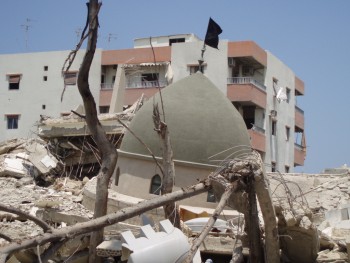
Mosque in Tiri severely damaged [2] (July 18)
Mosque in Sidon destroyed (photo: Dahr Jamail)[51]
Gas Stations & Fuel Centers:Fuel containers in Jiyye destroyed [2] (July 18)
Fuel depot at Beruit International Airport [8] (July 22)
Gas storage tank in the northern neighborhood of Dawra [19] (July 17)
12 service stations destroyed as of July 18 [4]
17 fuel stores reported as of July 21 [28]
4 gas stores reported as of July 21 [28]
Two petrol stations in Baalebeck were targeted and set on fire [34] Aug 1
 Environmental:
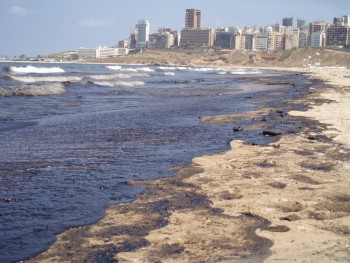
An oil slick caused by Israeli bombing of the Jiyyeh power station now covers 80km (50 miles) of coast. [33]
See: United Nations Environmental Program (photo:
Dahr Jamail)
Lebanese Military: (Not of Hizbullah)
Lebanese Army posts struck in Jounieh, Amsheet, Sidon, Batroun and Abdeh.
A Lebanese soldier was killed in another strike on an army post south of Beirut [41]
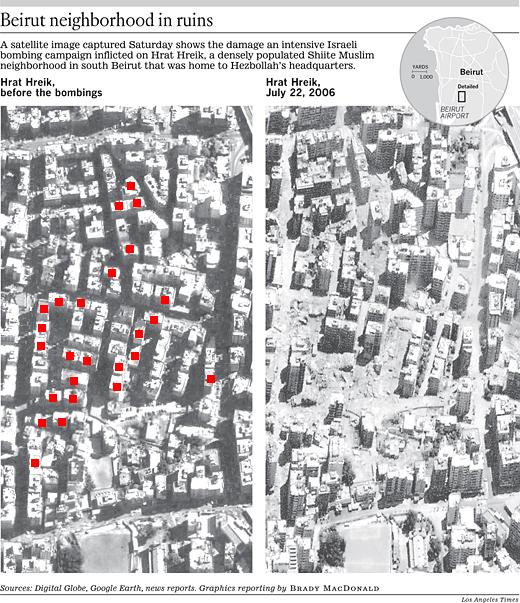
Military vehicles struck in Haret Hreik.
Israeli jets struck several radar targets in Lebanon over the weekend. [18] (July 17)
Eight Lebanese soldiers were killed when Israeli aircraft attacked a small fishing port at Abdeh in northern Lebanon near a highway leading to Syria. [19] (July 17)
Rayak military airport runways disabled
Radars at the Rayak airport
An air raid on a Lebanese army barracks in the Jamhour area east of Beirut killed 11 Lebanese soldiers, including four officers, and wounded 30. (July 18) [52]
Israel struck a military base at Kfarchima in southern Beirut. At least 11 soldiers were killed in an engineering unit and 35 were wounded. [21] (July 19)
Other:Headquarters for the Popular Front for the Liberation of Palestine (PLO) in eastern Lebanon, which isn't responsible for Hizbullah [12] (July 15)
Economic Damage: Billions of dollars lost due to lost tourism, stock market closed, businesses loosing orders, capital flight from banks.
Detailed Daily Accounts:Lebanon UpdatesSAMIDOUN: See Day by DayImages You Won't See in Western Corporate Media:Indymedia Images Israeli Bombs:
.
.
.
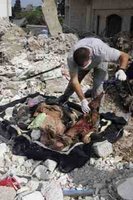 Israeli Target... what's left of a woman
.
.
.
.
.
.
.
Oil Spill Reaches Syria, August 8, 2006 Sources:
[1] Lebanon's Prime Minister Fuad Saniora, quoted in SF Chronicle
“ Civilian Toll Raises Questions: Israel, criticized for killing hundreds of Lebanese, says Hezbollah stores missiles in residences” by Anna Badkhen
[2] Internal Security Forces' directorate general, reported by the Daily Star of Lebanon
Web Link[3] Same source as [2]
More than 100 homes and residential buildings destroyed in the areas of Tyre, Aita al-Shaab, Rmeish, Houla, Sarifa, Braachit, Shahour, Borayqeh, Shehabieh, Doueir, Aaba, Majadel, Dabaal, Jbeil, Ain Mezreb, Ghandourieh, Haret Hreik, Baalbek, Khiam, Dibbine, Marjayoun, Kfar Shuba, Bint Jbeil, Aitaroun, Tibnin, Maaroub, Kounin, Blida, Kfar Hammam, Meis al-Jabal, Jabal al-Batm, and Abbassieh.
[4]Same source as [2]
12 service stations in Bir Abed, Khiam, Ain Ibl, Moseileh, Rmeileh, Houla, Hesbe, Tyre, Kfar Kila, and Douris.
[5] Associated Press July 23, 2006, KATHY GANNON
Web Link[6] Specific cases of injured and killed:
A member of the U.N. observer team in south Lebanon, Italian Capt. Roberto Punzo was wounded by guerrilla fire (the second observer injured). [5] July 23
Fleeing refugees, including women and children, were cut down on a road adjacent to the Lebanese-Israeli border in an airstrike as they left the village of Marwaheen. The bodies of several children, one headless, were sprawled on the ground. Police said 15 were killed in the afternoon attack and an Associated Press photographer counted 12 bodies in the two cars. [16] (July 15)
At least three civilians were killed when another Israeli airstrike hit a bridge near the Syrian border, cutting the last land link on the main road to Syria and its capital, Damascus. [16] (July 15)
Eight Canadians of Lebanese origin, all members of the same family, were killed by an Israeli strike on their village in the south where they'd come for a summer visit. [17] (July 16)
In the southern port of Tyre, an Israeli missile tore of the top of a 12-story building, killing at least nine. [17] (July 16)
A missile hit a minibus, killing 12 civilians as they were driving through the seaside town of Rmeileh, south of Beirut. [18] (July 17)
Nine members of the same family were killed when a bomb hit their house in the village of Aitaroun. [21] (July 19)
21 civilians were killed and 30 wounded in an air strike against the southern village of Srifa, 20 miles north of port of Tyre, when 10 houses were bombed. [22] (July 19)
A Lebanese photographer the magazine Al-Jaras, Layal Nejim, 23, became the first journalist to die in the fighting when an Israeli missile hit near her taxi in southern Lebanon. [5] (July 23)
An Israeli airstrike hit a United Nations post in southern Lebanon late Tuesday, killing at least two (make that 4) of the agency's observers. U.N. Secretary-General Kofi Annan said he was "deeply distressed" by the "apparently deliberate" strike. [20] (July 25)
An Israeli airstrike killed at least 56 people, including at least 34 children, in a southern Lebanese village Sunday, the Lebanese Red Cross said. It was the deadliest attack in 19 days of fighting. Lebanese security officials put the toll at 57 dead. Security officials said the toll rose dramatically after 18 people from two families were found in a single room of the building, where dozens of people had been taking refuge from the fighting. [30]
Warplanes returned to the capital midday and sent missiles into Chiah, a south Beirut neighborhood where at least 41 people were killed in a strike Monday (Aug 7). [44]
Israeli missiles slammed into the southern Lebanon village of Rachaf, about 10 miles from the Israeli border, killing at least 15 civilians, security officials said. [47]
The death toll continued to rise after the August 7 cease fire when, on August 16, rescue workers pulled 32 bodies from the rubble in the southern town of Srifa, target of some of Israel's heaviest bombardment in the 34-day conflict. [53]
[7] Associated Press, July 22, 2006. Among the civilian deaths are 8 Canadians, 2 Kuwaiti nationals, 1 Iraqi, 1 Sri Lankan, 1 Jordanian.
Web Link[8] Daily Star of Lebanon, July 19, 2006
Web Link[9] Daily Star of Lebanon, July 18, 2006
Web Link[10] IRIN, a UN humanitarian information unit.
[11] BBC, July 14, 2006
Web Link[12] CNN, July 15, 2006
Web Link[13] CNN, July 16, 2006
Web Link[14] Associated Press, LEE KEATH July 24, 1006
Web Link[15] CNN, July 25, 2006
Web Link[16] Associated Press, July 15, 2006 SAM F. GHATTAS
Web Link[17] Associated Press, July 16, 2006 Hamza Hendawi And Lee Keath
Web Link[18] New York Times, July 17, 2006 STEVEN ERLANGER and JAD MOUAWAD
Web Link[19] ABC News (AP See Also [17]), July 17, 2006
Web Link[20] CNN July 25, 2006
Web Link[21] Associated Press, RAVI NESSMAN, via New York Sun, July 19, 2006
Web Link[22] New York Times, July 19, 2006 JAD MOUAWAD and STEVEN ERLANGER
Web Link[23] CNN July 27, 2006
Web Link[24] Reuters, Nadim Ladki, July 27, 2006
Web Link[25] ABC "World News Saturday," July 22.
[26] Associated Press, SAM F. GHATTAS, July 26.
Web Link[27] BBC, "Lebanon Damage Report"
Web Link[28] Guardian Unlimited, damage inventory, Brian Whitaker July 21, 2006
Web Link[29] CNN, July 29, 2006
Web Link[30] Associated Press, KATHY GANNON, July 30, 2006
Web Link[31] Associated Press, KATHY GANNON, July 30, 2006
Web Link[32] Reuters, Alaa Shahine, July 31, 2006
Web Link[33] BBC, Richard Black, July 21, 2006
Web Link[34] BBC, August 2, 2006
Web Link[35] CNN, August 1, 2006
Web Link[36] Reuters, Lin Noueihed, August 4, 2006
Web LINK[37] Interview on DemocracyNow with Amy Goodman July 31, 2006. "Just a few days ago we documented an attack on the village of Blida, in which the Israelis used cluster munitions." Peter Bouckaert of Human Rights Watch in Beirut.
Web LINK[38] Associated Press, SAM F. GHATTAS, August 7, 2006
Web LINK[39] Wikipedia Casualties of 2006 Israel-Lebanon Conflict, which sources BBC, ITAR-TASS.
Web LINK[40] Reuters, August 3, 2006.
Web LINK[41] Reuters, August 4, 2006.
Web LINK[42] Reuters, August 6, 2006.
Web LINK[43] Flashpoints, WPFW, Dennis Burnstein interview of Bilal El-Amine, Aug 8.
Web LINK[44] Associated Press, CHRISTOPHER TORCHIA, August 11, 2006
Web LINK[45] CNN, August 4, 2006
Web LINK[46] Flashpoints, WPFW, Dennis Burnstein interview of Bilal El-Amine, Aug 9.
Web LINK[47] Associated Press, LAUREN FRAYER and SAM F. GHATTAS, August 12, 2006.
Web LINK[48] Lebanese Government via map made available from www.lebanonmaps.org.
[49] Associated Press, Zeina Karam, August 14, 2006
Web LINK[50] Associated Press, August 12, 2006
Web LINK[51] Dahr Jamail, indpendent journalist.
Photo Gallery[52] Reuters, July 18, 2006
Web LINK[53] Associated Press, SAM F. GHATTAS, July 17, 2006.
Web LINK[54] Associated Press, Seven R. Hurst, August 15, 2006.
Web LINK[55] Reuters, August 18, 2006.
Web LINK[56] Associated Press, SAM F. GHATTAS, August 20, 2006.
Web LINK[57] New York Times, John Kifner, "Human Rights Group Accuses Israel of War Crimes," August 24, 2006.
Web LINK[58] DemocracyNow!, Ana Nogueira, August 23, 2006.
web LINK[60] Associated Press, August 2, 2006.
Web LINK[61] AFP, August 25, 2006.
Web LINK[62] DemocracyNow!, August 30, 2006.
web LINK[63] DemocracyNow!, August 25, 2006.
Web LINK[64] DemocracyNow!, September 1, 2006.
Web LINK[65] DemocracyNow!, Amnesty International interview, August 23, 2006.
Web LINK[66] United States Government Situation Report, Lebanon Humanitarian Emergency, USAID citing various source, Index of reports by date.
Web LINK to Index of All Situation Reports[67] Reuters, "UN says Israel laid anti-personnel mines in Lebanon" November 28, 2006
Web LINK[68] DemocracyNow! Headlines, "
Shortage of Funding Halts Mine Sweeping in Lebanon"
August, 25, 2008.