Showing posts with label UXO. Show all posts

May 17, 2007

Living in a Mine Field

It's a sick joke I made up: Did you know Cambdia is the only country with a base-five counting system? 1, 2, 3, 4, 10, 11, 12, 13, 14, 20. It was developed because they can only count on one hand.

When I visited Cambodia I entered the famous Ankor Wat ruins, not from the front as 99.9% of people do, but rather from a side entrance through the woods. As a travel note, I recommend it. You have the place to yourself and, upon emerging from the woods and seeing the ruins, you feel as if you've discovered the temple for the first time.

Travel log aside, I know what it feels like to be in a mine infested country. Even in areas that have been "cleaned" you're forced to think, "maybe they missed one." I stayed on well worn trails... ususally.

Reuters reports that an estimated 400 million people live in mine infested areas. I'll skip the debate about mine ban treaties.

The Reuters article focused on cluster bombs. These are bombs or missiles that disperse large numbers of smaller bomblets over their target, which each explode independently destroying everything in a wide area. They are effective at destroying small things that are difficult to target, like an advancing group of soldiers that is spread out, or small missile or gun emplacements. However, by their nature, they cause a lot of collateral damage, and conventions preclude their use in populated areas. Worse is the fact that they leave behind unexploded bomblets, often found by curious children and farmers after the conflict has ended.

The Handicap International report, cited in the AP report, said that 98 percent of the casualties of the weapons were civilians "killed and injured while returning home in the aftermath of conflict or while going about their daily tasks to survive."

In 2006, Israel committed what history will record was one of the greatest war crimes involving cluster munitions. Haaretz reported:
"In Lebanon, we covered entire villages with cluster bombs, what we did there was crazy and monstrous," testifies a commander in the Israel Defense Forces' MLRS (Multiple Launch Rocket System) unit.

It's estimated that as many as a million unexploded cluster bomblets were left, and the truly criminal aspect is that Israel launched the vast majority in the final day or two when a negotiated settlement was imminent. It is viewed by many to have been yet another case of Israel's use of collective punishment via indiscriminate use of excessive force (a trifecta war crime). Many of the munitions were provided to Israel by the United States.

As noted above, there are prohibitions on the use of cluster munitions. Israel ignored them, and as a result, we have statements like the following being expressed in the aftermath of Israel's hammering of Lebanon in 2006:
The US Disaster Assistance Response Team Reports that the presence of unexploded ordinance continues to be the most significant security concern in the conflict-affected areas of Lebanon.
- US Government Situation Report, Lebanon, 9/5/06

The term "unexploded ordinance" is so common in these Lebanon situation reports that they have an acronym, UXO. The acronym is widely included comments like the following: Regarding Majdel Silim: "UXO scattered through the village," or "UXO prevents access to homes and agricultural lands", or in Borj Qalaouiye "UNHCR reports contamination by UXO," or in Marjaba village, "UXO significant problem," or Zaoutar Ghariya, Zaoutar Shargiya and Yahmour "90% of the land is inaccessible due to UXO," or in the Tyre District, villages of Deir Qanoun, Qana, Ramadya, Knisse, Henniyeh, Zibquin, Srifa, Maarake "UXO concerns."

And that laundry list is based on my incomplete work developing a Lebanon Village Damage Report.

Sources:

Reuters: 400 million people live in "minefields": report, Robert Evans Wed May 16, 2007.

United States Government Situation Report, Lebanon Humanitarian Emergency, USAID citing various sources, Index of reports by date.
Web LINK to Index of All Situation Reports
October 7, 2006

Lebanon: Village Damage by District

This page is work in progress...

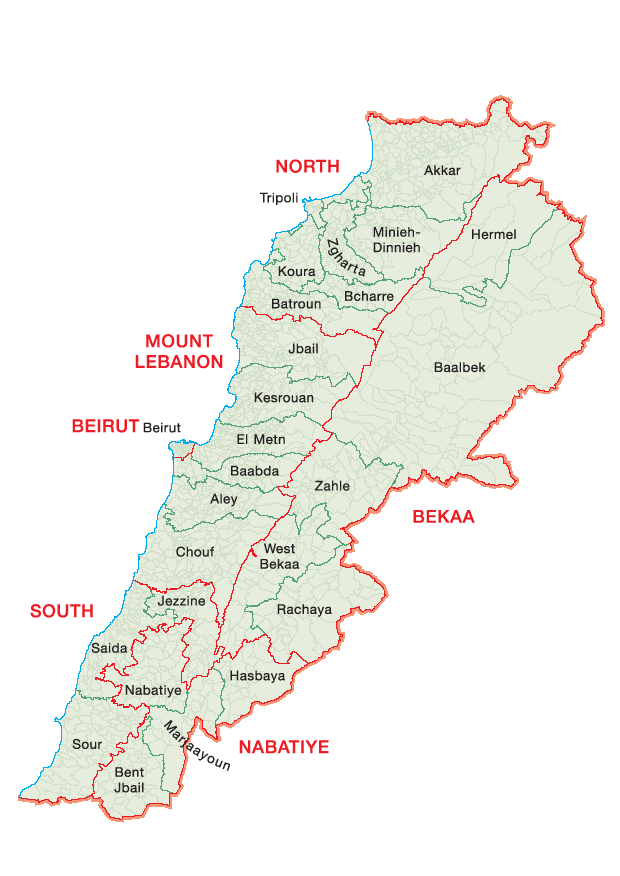
"Lebanon is divided into six governorates, which are further subdivided into 25 districts. The districts themselves are also divided into several municipalities, each enclosing a group of cities or villages." (Wikipedia) All the governorates and their respective districts are listed at the end of the report with a map.

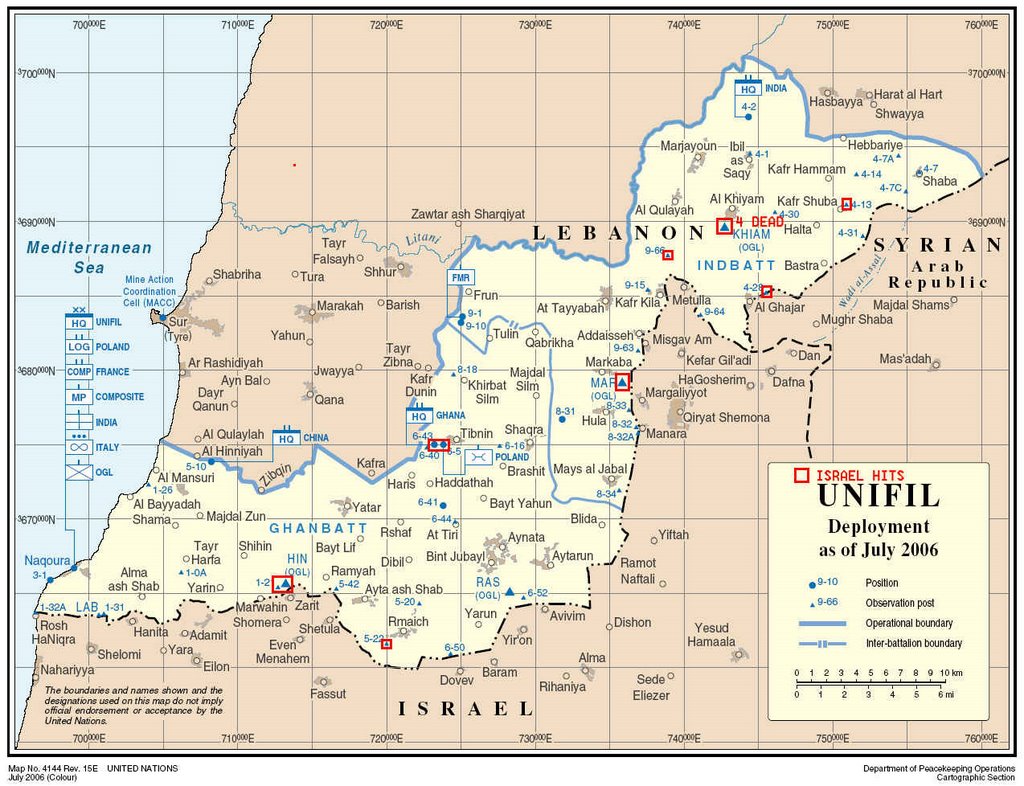
There are about 200 villages south of the Latani River (See Map of Southern Lebanon below, which includes Israeli attacks on UN compounds south of the Latani River).

The following is a summary of damage by governorate, district and village. The primary source is the USAID Lebanon Situation Reports (LSR), which often cite other sources. I've tried to provide report dates and Situation Report numbers.

Beirut Governorate

(There are no "districts" in Beirut. Only the city and neighorhoods).

HOUSING:
Of 120 damaged buildings surveyed that housed 2000 families, 40 need to be reconstructed. About 6,000 housing units were destroyed and 17,000 damaged. (Preliminary report. (LSR32 Sept. 1).

PUBLIC BUILDINGS:

UTILITIES:
Water and sewer piplines in major streets of Haret Hreik Municipality sustained significant damage (LSR38 Sept 12).

Nabatiyeh Governorate (Jabal Amel)

Al-Nabatiyé District

50 percent of all structures were destroyed in the villages of Yohmor and Western Zawtar. (LSR26, Aug. 23).

HOUSING:
Nabatiye Village: 50 percent of the homes destoryed, numerous unexploded ordinance remain.

PUBLIC BUILDINGS:

UTILITIES:
Drinking water sources and waste treatment capacity destroyed south of Nabatiye, Marjayoun including Qaliaiaa (often the collection and distribution pipeline systems are damaged). (LSR32 Sept. 1)
Water remains a concern: Villages of Zaoutar Ghariya, Zaoutar Shargiya and Yahmour. (LSR35 Sept. 6)

* Hasbyya

Marji'youn District

50 percent of all buildings destroyed in Markabe Village. (LSR24)

HOUSING:
Ghanduriyah village: 90 percent of the homes destroyed. (LSR30)
Houla village: 20 percent of the homes destroyed. (LSR20)
Markaba village: 50 percent of the homes destroyed. (LSR20)
Mays al Jabal village: 30 percent of the homes destroyed. (LSR20)
Qantarah (Cantarah): 50 percent of the homes destroyed. (LSR20)
Talusha village: 15 percent of the homes destroyed. (LSR20)
Tayyababh village: 80 percent of the homes destroyed. (LSR20)

PUBLIC BUILDINGS:

UTILITIES:
District affected by damage to three major pumping stations.
Khiam, water and sewer networks destroyed (LSR35 Sept. 6)
Marjaba village: Central water tank and pumps damaged, nonfunctinal.
Markaba and Taibe water needs remained as of Sept 8 (LSR38 Sept. 12)
Taibi, Adaisi, Deir Seryan, Kantara, Kfar Kila, Talousse, Rab Tlateen and Markaba, Mais Al Jabal, Blida and Houla water and waste piplines damaged (LSR32 Sept. 1)

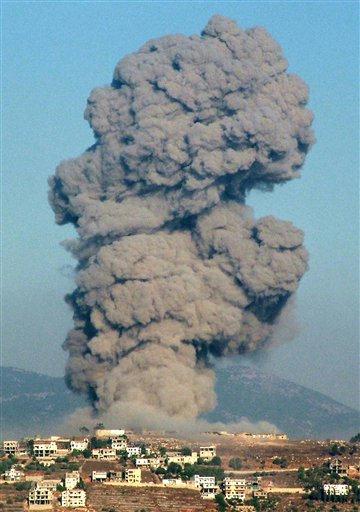
A large plume of smoke billows in the town of Khiam, in southern Lebanon, Tuesday, July 25, 2006, after Israeli air raids targeted it. For as sense of scale, note the size at the base of the plume, compared to the houses in front of the plume. An Israeli bombardment hit a UN observer post in the village of Khiam, killing four UN observers. (AP Photo/Lotfallah Daher).

Bint Jbeil District (Bent Jbail, Bint Jubayl)

HOUSING:
Ayta As Shaab: 70 percent of the homes and other properties were destroyed or badly damaged. (LSR24)
Bayt Leif: 30 percent of the homes destroyed (LSR21)
Bint Jbeil: 800 properties destroyed, 1,100 significantly damaged. (LSR36)
Borj Qalaouiye: 20 houses destroyed, 80 heavily damaged. (LSR38)
Kafra: 25 percent destroyed (LSR21)
Khiam village: 750 homes destroyed, 1,000 homes heavily damaged, 1,000 lightly damaged.
Majdel Silim: 200 homes destroyed, about 350 damaged out of 700. (LSR36)
Qabrikha: 100 homes destroyed, 75 damaged out of 480. (LSR36)
Soultaniye: Significant damage to houses. (LSR38)

PUBLIC BUILDINGS:
50 to 90 percent of the government and public buildings in 39 villages in the Bent Jbail district destroyed. (LSR 26 Aug. 29)

UTILITIES:
Affected by damage to three major pumping stations: Villages of Maroun er Ras, Aainata, Qabrikha and Kounine (LSR36 Sept 7)
Majdel Silim: Need water pumps (LSR36)
Soultaniye: Need for water tanks. (LSR38 Sept 12)

UXO:
Majdel Silim: UXO scattered through the village.

Beqaa Governorate (Bekaa)

Al-Hirmil District (Hermel)
Hermel village had the most significant structural damage in Bekaa.

HOUSING:

PUBLIC BUILDINGS:

UTILITIES:
North Bekaa water supply in need of urgent repairs.

Baalbeck District


HOUSING:
Baalbek: 2,000 homes destroyed. (LSR24)
Taibe: Significant damage to houses. (LSR38)

PUBLIC BUILDINGS:

UTILITIES:
North Bekaa: water supply in need of urgent repairs.
Taibe village: Need for water tanks (LSR38 Sept. 12)

South Governorate

(al-Janoub)
* Tyre (Sur, Sour)

HOMES:
Jabal al Butm village: 50 percent of the homes destroyed. (LSR21 Aug. 16)
Zibquin village: 60 percent destroyed. (LSR21 Aug. 16)

PUBLIC BUILDINGS:

UTILITIES:
Lack safe water and reliable power: Villages of Deir Qanoun, Qana, Ramadya, Knisse, Henniyeh, and Zibquin. (LSR35 Sept. 6)
Water and sanitation concerns: Villages of Srifa, Maarake (LSR37 Sept. 8)


Beirut Governorate

The Beirut Governorate is not divided into districts and is limited to the city of Beirut.

Nabatiyeh Governorate (Jabal Amel) - 4 districts

* Al-Nabatiyé
* Hasbyya
* Marji'youn
* Bint Jbeil

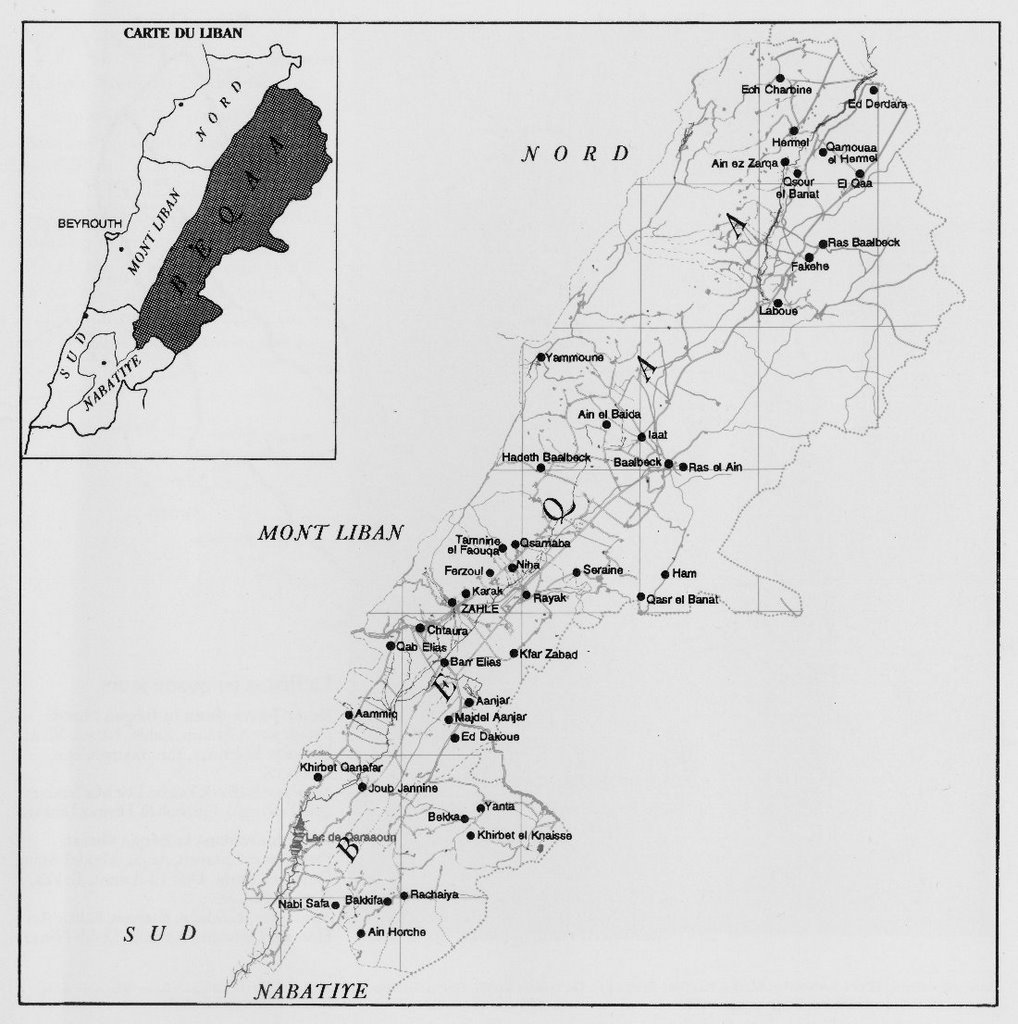
Beqaa Governorate - 5 districts

* Al-Hirmil (Hermel)
* Baalbeck
* Zahlé
* Western Beqaa (al-Beqaa al-Gharbi)
* Rashyya

North Governorate (al-Shamal) - 7 districts

* Akar
* Tripoli
* Zgharta
* Bshirri
* Batroun
* Koura
* Miniyeh-Danniyeh

Mount Lebanon Governorate (Jabal Lubnan) - 6 districts

* Jbeil
* Kisirwan
* Al-Matn
* Ba'abda
* Alay
* Al-Shouf

South Governorate (al-Janoub) - 3 districts

* Saida
* Tyre (Sur)
* Jezzine

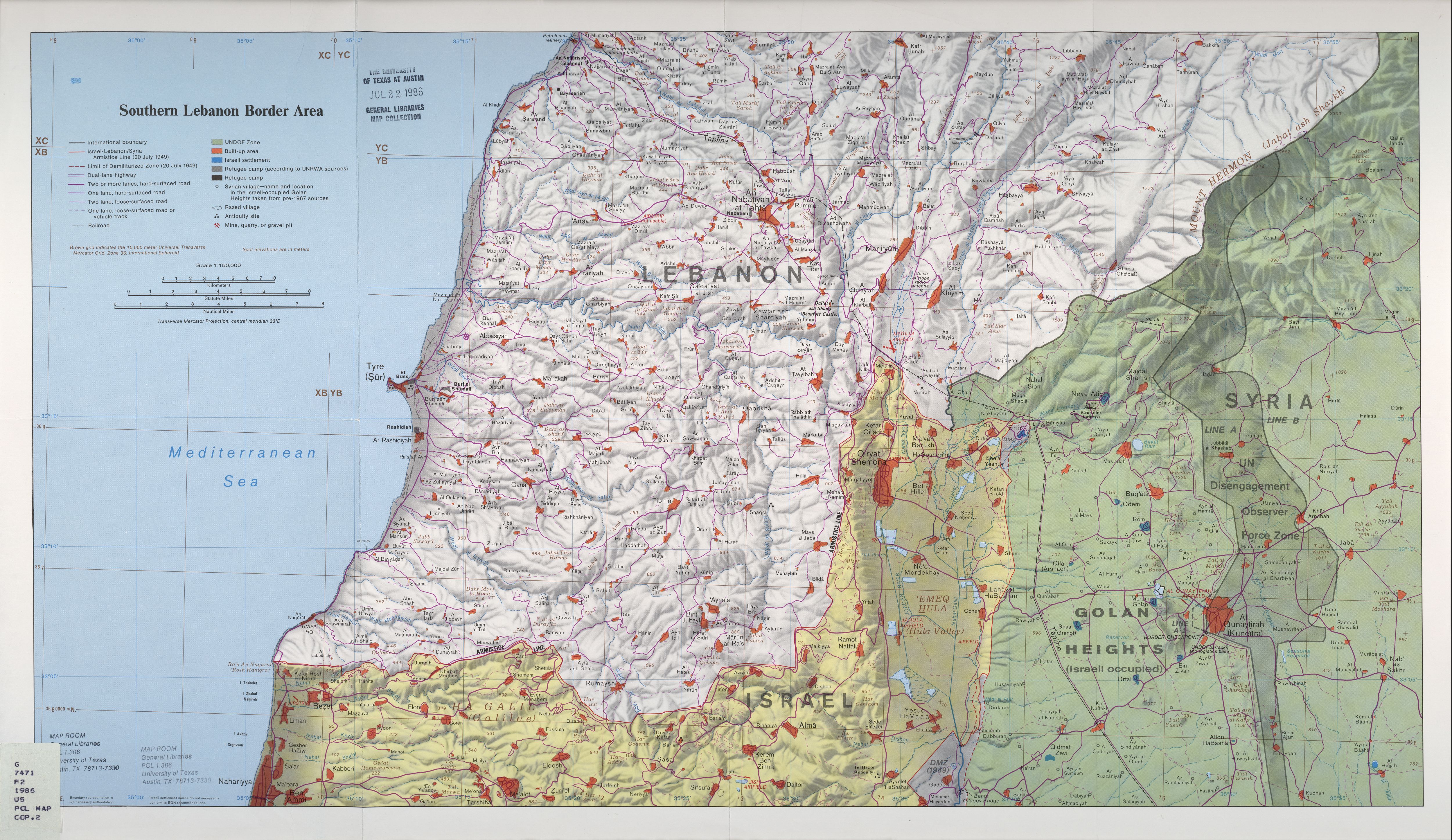
CLICK for Detailed Map of Southern Lebanon boarder area - 1986

Lebanon Village Districts, below


Source: USAID Disaster Assistance daily situation reports, which often cite other sources, like the Lebanese government and the United Nations.


Click for painting, "Lebanon Village 2006"