May 25, 2006

William Arkin: Apologist


Dear Laura Flanders,

I like your show, but on 5/23/06 Christy Harden-Smith displayed herself as a hack for praising William Arkin's work. Although he is trying to come off as "balanced," he has the effect of being an apologist, "There Is No Enemy's List"

In his effort to dissect the distinctions of three "programs," he misses the bigger picture. Arkin fails to acknowledge a serious erosion of the rule of law, replaced by the rule of brute power, to say nothing of civil liberties. The World is heading into dark times, and the Bush Administration is helping to push it that direction.

First, according to Brian Ross, chief investigative reporter at ABC News, the USA PATRIOT Act has been used by the FBI to obtain phone records without a warrant (this would not have been possible before the PATRIOT Act). These records are being obtained, not to fight terrorism or protect National security, but to suppress media efforts to expose excesses of the Bush administration that the American public has a right to know (secret CIA detention centers, kidnappings, extrajudicial executions (killing people with Predator vehicles), etc.). DemocracyNow! Link

Second, Arkin uses demeaning phrases to deminish those who question the motives of the Bush administration. Examples include, "a Hollywood trailer of government omniscience," "partisan posturing, narcissistic hand wringing, and Hollywood imagery," and asking, "So how is it that these three programs have turned into one?"

Some concern (hand wringing) is warranted, given our government's history of using secret surveilance and worse, and recent evidence of domestic surveillance, expanded on below. It's about time some "partisans" (AKA spineless Democrats) have taken a stand, though a bit late. Further, I've been tracking the three issues Arkin feels are being conflated, and I don't conflate them into one from a technical standpoint. I do, however, recognize that the Bush Administration is conducting domestic surveillance and intimidation to supress legitimate dissent. In other words, we have evidence that Bush's motives are not pure, leading one to legitimately conflate the "motive" and thereby conflate these surveillance activities into one broad and worrisome trend. This leads to my third point.

Third, the American Civil Liberties Union, and others, are uncovering widespread domestic surveillance activities by the Defense Department of Defense (DOD) and the FBI. The DOD admits it may not "collect" domestic intelligence, but it may posess it (If I have a beer bottle collection, but didn't drink any of the beers, have I collected beer bottles? According to the DOD, the answer is "no"). Peace groups, social justice groups, animal rights groups, the list is long, are being tracked by the federal government. Are we to have faith-based trust in the Bush government? Are we to believe that these NSA programs, and others yet to be exposed, are not currently or potentially useful in suppressing legitimate dissent by domestic groups and individuals? Remember, the Bush World is one in which might makes right. They have the might, the laws and the eavesdropping tools.

It would be fine if Arkin simply discussed the distinctions between the three programs. However, his, "be happy, don't worry, you're dumb hand wringning partisans who watch too many Hollywood productions," has no place being promoted on your show. For that matter, Christy Harden-Smith has no place on your show... she's a celebrity journalist. We need less of them.

May 21, 2006

Generals, Stop Making Political Speeches


It's inappropriate for active-duty military officers to make polictical speeches. In our democracy, civilians make policy, and generals follow civilian orders.

General Tommy Franks recently spoke at the National Rifle Association's annual banquet. Where, according to AP's Conlin Fly, he said, "Terrorism is a thing that threatens our way of life. It doesn't have anything to do with politics." AP Article on Franks

First, not to defend the technique, terrorism is a long-standing tactic used to gain political ends. A famous case-in-point was the 1946 zionist Irgun bombing of the King David Hotel, killing British, who used the hotel as a headquarters, as well as Arab and Jewish civilians. In otherwords, terrorism typically has a lot to do with politics.

Second, many arguments support the contention that US-led corporate globalization, and the violent methods used to opress foreign resistance to the US infringements, spawn terrorism.

While this second point can be debated, it is not the proper role of an active-duty military officer to propagandize on either side of the issue. That's the role of civilians in our society.

So, a message to General Franks, and others like General Bantz Craddock who has been propagandizing against Venezuelan President Chavez, Stop it. It is contrary to our democratic principles for active-duty military leaders to promote policy, particularly through propaganda speeches.

Editor's Note: General Craddock is responsible for overturning the military investigators' report that recommended punishment for the commanding officer of the Guantanamo Bay jail at the time, Army Major General Geoffrey Miller. Miller later went on to "Gitmoize" the interrogation operations at the Abu Ghraib prison in Iraq.ARTICLE

May 14, 2006

Time for Cheney to Resign


As of May 14, 2006, a Google search of the exact phrase "time for cheney to resign" finds about 26 posts. With Cheney the focus of a recent court filing by Special Counsel Patrick Fitzgerald in the CIA Leak case, we can expect that number rise.

COUNT CONTINUES:

26 posts as of May 14, 2006
32 posts as of May 21, 2006
791 posts as of September 18, 2006
85 posts as of December 31, 2006
43 posts as of January 23, 2007
1,310 posts as of April 28, 2007

I suppose that trend will give Cheney's heart some relief... for a while. Google it yourself.

AP's Pete Yost and Supposed Intelligence

An Open Letter to:

Jack Stokes
Director of Media Relations
Associated Press

Dear Mr. Stokes:

In an article of May 14, 2006, entitled "Cheney the Focus of CIA Leak Court Filing," AP writer PETE YOST wrote the following in regard to Bush administration claims that Iraq had made attempts to acquire uranium yellowcake from Niger:

"The Bush administration used the intelligence on supposed efforts by Iraq to acquire uranium from Africa to bolster its case for going to war."

I ask, to which "intelligence" is Mr. Yost referring? It has been established that, at the time, the Administration knew the documents regarding yellowcake were highly dubious. Many people suspect that the Administration had a hand in having the documents created by a third party.

I hope you will draw this critique to the attention of Mr. Yost. Perhaps the sentence should have more accurately read, "The Bush administration used the supposed intelligence on supposed efforts by Iraq to acquire uranium from Africa to bolster its case for going to war."

Thank you for your consideration.

May 13, 2006

AP's Jack Stokes and the Salvador Option in Iraq

An Open Letter to:

Jack Stokes
Director of Media Relations
Associated Press
info@ap.org

Dear Mr. Stokes:
In an article of May 13, 2006, entitled "Son of Top Iraqi Judge Killed in Baghdad," AP writer BUSHRA JUHI wrote the following:

"It could also be part of a series of killings by death squads and militias, who have kidnapped and killed hundreds of Sunnis and Shiites, often motivated by sectarian hatred."

I would appreciate receiving justification for the last phrase of that sentence, "often motivated by secarian hatred."

I'm of the understanding that Iraq does not have a history of sectarian division, or hatred. Marriages between Sunnis and Shiites are very common.

I would greatly appreciate the AP taking the time to determine if the phrase used by Bushra Juhi was included on the basis of supportable fact, or whether the phrase is simply a "throw-away" claim, which is potentially an echo of propaganda being generated by forces that seek to engender sectarian strife.

It is my understanding that a greater division exists between forces struggling to keep multinational corporate domination out of Iraq, and forces seeking to profit from enabling the country to be overtaken by foreign commercial power. That division might happen to fall along sectarian lines; however, I'd urge you to dig deeper into the fundamental rationales behind the death squad killings.

As a model, you might refresh AP's institutional memory of the death squads that were active in Central America in the 1980s. Is it coincidence that John Negroponte was deeply involved in those operations, and then served as Ambassador in Iraq during the period that Iraqi death squad activity arose? Many well-informed people speak of the "Salvador Option," including Newsweek among others.

I hope you will take the time to assess whether or not "momentum of habit," and article deadlines, are leading to phrases like "often motivated by sectarian hatred" being used in AP articles. I hope that you will caution your writers to resist potential over-simplifications, which can have a profound effect on the beliefs of readers. I do not believe the killings are primarily motivated by religious infighting. Unfortunately, the phrase used by Juhi would lead most readers to that conclusion.

Thank you for your consideration.

May 12, 2006

Open Letter: Georgetown and Feith

James O'Donnell
Provost
Georgetown University

Dear Professor O'Donnell:

I'm writing to register my dissapointment with your involvement in selecting Douglas J. Feith to serve on the Georgetown faculty. I understand the rationale of hiring a government practitioner; however, given the many alternative options and Mr. Feith's record, your unfortunate decision reflects poorly on Georgetown as an institution.

It would help place Georgetown University in better standing in my mind if you would conduct a retrospective poll of the faculty's views on the appointment of Mr. Feith.

Thank you for your consideration.

April 29, 2006

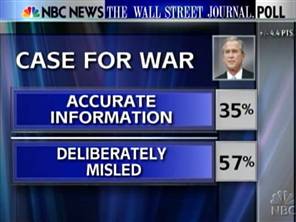
Deliberately Misled


Even the Corporate Media is saying it. This poll was taken way back in November 2005. Imagine what the numbers would say today.

Illiniois Resolution to Impeach Bush


Some in the Illinois legislature are attempting to force the House of Representatives to start impeachment proceedings. They are using little-known Section 603 of Jefferson's Manual of the Rules of the United States House of Representatives.

LINK For the Latest Update

Voice your Support To Push this Forward

Contact the Rules Commmittee Chair:

Representative Barbara Flynn Currie (D)
25th District
Majority Leader

Springfield Office:
300 Capitol Building
Springfield, IL 62706
(217) 782-8121
(217) 524-1794 FAX

April 19, 2006

General Miller Indicted


These are the words that many uniformed members of the military hope to see as headlines soon.

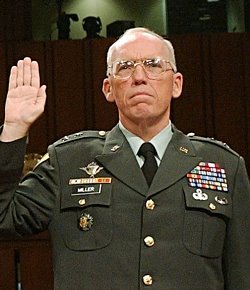
Maj. Gen. Geoffrey Miller is the architect of the Guantanamo torture procedures. He transferred those methods to Iraq. According to Brig. Gen. Janis Karpinski, former commander of the U.S. Army's 800th Military Police Brigade in Iraq, "he made reference several times to his plans to "Gitmo-ize" the interrogation operations." Famous Signal City Interview

Why do other military officials want Miller punished? Because Miller has helped give those who might toruture US soldiers in the future a cloak of legitimacy, "Well, the US torutures, so it's OK for us to torture."

Those who don't believe the US is using torture probably have not studied the subject. When Alfred McCoy, professor of history at the University of Wisconsin-Madison, heard the three methods of interrogation being used in Abu Ghraib, he knew it was a text-book case of torture.

He says, "by 2003, under General Miller, Guantanamo had perfected the C.I.A. paradigm, and it had a three-fold total assault on the human psyche: sensory receptors, self-inflicted pain, cultural sensitivity, and individual fears and phobia."

The self-inflicted pain often includes "stress positions." Some people think being forced to stand for long periods is not part of a torture regime. Secretary of Defense Rumsfeld is one of them. In a note on a 2002 memo about interrogation tactics, Defense Secretary Donald Rumsfeld indicated that making terrorism detainees stand for up to four hours was no biggie in the physical stress department. "I stand for 8-10 hours a day," Rummy scrawled. "Why is standing limited to four hours?" W Post article

So, what's the big deal about making people stand for long periods? According to McCoy, an expert on torture, "as they stand, what happens is the fluids flow down to the legs, the legs swell, lesions form, they erupt, they suppurate, hallucinations start, the kidneys shut down." Nice, self-inflicted pain.

What about sensory deprivation?

McCoy says, "Dr. Donald O. Hebb of McGill University, a brilliant psychologist, had a contract from the Canadian Defense Research Board, which was a partner with the C.I.A. in this research, and he found that he could induce a state of psychosis in an individual within 48 hours. It didn't take electroshock, truth serum, beating or pain. All he did was had student volunteers sit in a cubicle with goggles, gloves and headphones, earmuffs, so that they were cut off from their senses, and within 48 hours, denied sensory stimulation, they would suffer, first hallucinations, then ultimately breakdown."

Many people who have suffered torture say the mental torture is worse than the physical torture. This is, in part, because the mental damage is often irreversible.

The US is now using torture. Our reputation has been seriously damaged. General Miller must be indicted so our reputation can be cleansed.


See McCoy Interview on DemocracyNow!

April 4, 2006

Why is Tom Delay Resigning Now?


Election lawyers say one advantage of bowing out of the election now is that the campaign cash can be converted to pay legal bills immediately, instead of being drained in the course of a bid to stay in office.
- W. Post 4/4/06

March 31, 2006

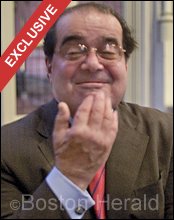
Scalia Not Impartial on Hamdan


Supreme Court justice Scalia's impartiality is reasonably questioned in the Hamdan v Rumsfeld case. He should recuse himself from the case.

The Hamdan case challenges legality of the military commission that seeks to try bin Ladin's former driver for war crimes. Newsweek reported that, before testimony on the Hamdan case was completed, Scalia gave a speech in Switzerland, where he dismissed the idea that the detainees have rights under the U.S. Constitution or international conventions. During the speech Scalia said he was "astounded" at the "hypocritical" reaction in Europe to Guantanamo. Scalia said "War is war, and it has never been the case that when you captured a combatant you have to give them a jury trial in your civil courts."

A chauffer is as much of a combatant in this "war on the tactic of terror" as a biased Supreme Court Justice is.

Voice your opinion:
Contact the Supreme Court

Note: This piece draws on text from:

March 27 DemocracyNow! headline

Washington Post

March 28, 2006

The Citizen Will Show

A funny thing happened on my way to Korea and back. Well, actually it was an article of mine that apparently made the trip. The punch line, as translated and retranslated, was "The Citizen Will Show." That pretty well sums it up.

One part of the translation does concern me, however. That is, "thuk Recalling the President with the sword and... the child wild world being horrible."

I want the Secret Service to know, that's not exactly what I said. I want him impeached, not recalled. The part about the sword is some korean's poetic license.

To clarify:
바른언론 빠른통신 인터넷 연합뉴스>자유토론 보기

Gary Hart Calls on "the people" to Check Bush "Tyranny"


Two-time presidential candidate Gary Hart has drawn on writings of the Founding Fathers to define Bush's consolidation of power as "tyrany," and calls on the people to check this constitutional crisis.

A Simple Sequence of Logic:

Bush is concentrating executive powers under the "war on terror," which are not granted by the Constitution and are prohibited by Congress.

James Madison defined tyranny as the concentration of powers in one branch of the government.

Madison's solution to tyranny relied upon either Congress or the Supreme Court checking the president. Presently, Congress will not check the president, and no legal case is working its way towards a Supreme Court judgment.

Facing the failure of our system of checks and balances, Hart proposes the question, "Can what Thomas Jefferson called the "common sense and good judgment of the American people" help us now?"

Hart argues that the people can and must check the president's tyranny, but first they must wake up to the present constitutional crisis.

Note: The text above draws heavily on the March 27, 2006 article by Joyce Appleby and Gary Hart

March 26, 2006

Si se Puede by the Hundreds of Thousands

Immigrants are facing the prospect of Congressional legislation that would build a fence along one-third of the US/Mexico boarder, criminalize undocumented immigrants and criminalize people who feed and house these immigrants by classifying them as human traffickers. Because the House legislation, HR 4437, has already been passed, immigrants' concern is palpable as the Senate considers the Sensenbrenner Bill.

This concern materialized in Los Angeles as 500,000- 1.5 million people took to the streets chanting "Si Se Puede" (Yes we can) on March 25, 2006 (Associated Press). Having some personal exeperience with peace protests, I know that's a huge number of people (a demonstration is considered very successful if 100,000 people participate).

According to the AP article, the "legislation ... would make it a felony to be in the U.S. illegally, impose new penalties on employers who hire illegal immigrants, require churches to check the legal status of people they help, and erect fences along one-third of the U.S.-Mexican border."

The massive LA protest isn't an isolated demonstration. On Friday March 10, to the suprise of many, Chicago police estimated over 100,000 protesters in the streets of that city (Coverage Link). Street protests have occured elsewhere, including 5,000 to 7,000 on March 25, 2006 in Charlotte, and tens of thousands in Washington, DC on Monday March 7, 2006 (Wash Post Link). Denver, CO had a demonstration of about 50,000 and Phoenix, AZ had a demonstration of about 20,000, which was its largest protest in history.

These protests, often on week days, demonstrate a massive base of human power for which this issue ressonates. A more humane approach to immigration reform would be wise in the face of the likely resentment the proposed legislation could engender in this huge constituency.

March 12, 2006

Censure Bush for Violating 4th Amendment

Senator Russ Feingold's call to censure bush for the illegal domestic spying program is an appropriate response. Failure to respond in some way would condone this type of behavior in future presidencies and erode the fabric of our self-governing system.

March 11, 2006

The Biggest Fear in Real Estate

The front page of today's Wall Street Journal reads, "Many mortgage borrowers may face financial problems or even foreclosure as adjustable-rate-mortgage payments are reset higher." Why has the WSJ used the prominent upper right-hand corner of it's front page for this message? Perhaps their aims are similar to those of the Federal Reserve, to stop the unhealthy speculative boom in the real estate market. That boom is slowing, but the question remains: Will the boom become a bust? More important, would such a bust spread to the entire economy?

The answer to the first question depends on the local market. Some markets might not see a bust, like Baltimore, Maryland, which will experience housing demand in response to recent military base realignment decisions. Others might be in for a shock, for reasons below.

First-year economics teaches us that prices drop when supply increases. It was with this in mind that David Seiders, cheif economist for the National Association of Home Builders recently said, "the biggest fear I have is investor-owned units coming back on the market in large numbers." [1] He has good reason to fear, because there's a record number of such units available to flood the market.

Second homes now comprise 38 percent of the nation's entire existing housing stock, according to the National Association of Realtors' "2005 National Association of Realtors Profile of Second-Home Buyers" released in March 2006.[2] Add to that the "millions" of borrowers who face foreclosure because they have exotic balloon-rate mortgages, and the "potential" for a downward bust in prices is undeniable.

That potential is a main ingredient for a bust. The other ingredient is self-reenforcing feedback. Lets look at a boom cycle as an example of such feedback. In the earl-1990s the Asian market was getting attention in the business press and many people pondered investing in foreign stocks. Early investors acted and the stocks rose. This rise gave confidence to a few more investors who entered the Asian market driving the stocks and other asset prices up further. This undeniable rise reenforced the justification for others to invest, which in turn drove up the prices. The feedback process continued, word got around to less informed investors who boosted the stocks further. There is often a "testing" period, when wise investors leave the market for fear of a downturn, and the rise slows or even dips, but this is often counter-balanced by late comers to the speculative boom. Eventually, the dip turns back up, fears of a downturn subside, and the self-reenforcing boom continues. This was the case in Asia until 1998 when the bottom fell out. The spread of this crash became known as "the Asian contagion."

What is clear is that this self-reenforcing feedback process works in both directions. Eventually, profit takers start to leave, and the stock price comes down a little. Those who got in late have little profit margin to loose, and they get must get out quickly, causing a clearly evident price decline. This undeniable decline reenforces the rationale for leaving, and others start to fear an actual loss on their investment. The same logic certainly applies in the case of the current real estate market, though the process is slower than for stocks; investor-owners don't want to get stuck holding a property they must maintain, particularly if the rigors of being a land lord is not their strong suit.

A third ingredient of boom-bust mechanics is summed up by the phrase, "the bigger the rise, the bigger the fall." For five years, real estate prices have witnessed dramatic annual rises. The annual percentage assessment increase in Maryland for at the end of 2005 was 20%. The range by county was 13%-26%. [3 Baltimore Sun] This followed five years of similar annual increases. But forget the numbers, who hasn't heard someone say, "I couldn't even afford to buy my own house today if I was in the market to buy." I've heard this statement a half-dozen times from people with well-paying jobs.

But, as convincing as that might be, that's all hypothetical. There is hard evidence of "the biggest fear" coming to pass. The Baltimore Sun article, referenced above, was accompanied by another article entitled, "slowdown poses new reality for buyers, sellers in region." The article includes a graph entitled, "listings soar" in which the number of homes for sale is shown to have more than doubled in a year. This is happening in the Baltimore market, which is supposed to be buffered by pending demand due to military base expansions. The 25% drop in San Diego housing prices from 1990 to 1996 also wasn't hypothetical. [4]

Now, to address the question of a potential spread of real estate woes to the rest of the economy. On August 8, 2005, economist and columnist Paul Krugman had a piece in the New York Times entitled "That Hissing Sound." He notes that the economic recovery since the 2001 stock market crash "wouldn't have happened at all without soaring spending on residential construction, plus a surge in consumer spending largely based on mortgage refinancing."

Will people run back into the stock market if the real estate market deflates? Major US auto manufacturers now make most of their profits on finance fees for car purchases, rather than on the product itself. The average US citizen has a negative savings, implying that the auto industry might have squeezed as much real money out of the public as it can for some time to come.

Then there are our financial institutions. They too have huge exposure to the real estate market. In February 2003, the Office of Federal Housing Enterprise Oversight released a REPORT that lost the OFHEO director his job. The director, Armando Falcon, had the nerve to explain that major commercial banks were heavily invested in risky real estate-based financial instruments crated by Fannie Mae and Freddie Mac. This meant that if the real estate market goes south some major banks will go with it, and with the banks go other parts of the economy in a chain reaction.

For example, the report indicates that major insurers are also at risk. So, imagine you run a business that has no relation to real estate, so you think, say import/export. One morning you read in the business section of the news paper that real estate is taking a beating. The next morning you read some banks are getting shaky, fortunately, not the bank with which you conduct business. The next week, you read that your insurer has gone belly up because it was invested in real estate. Suddenly, you realize that your business is related to real estate, and that the world is a very dangerous place. You pray nothing bad happens to your current import shipment, while you frantically seek another insurance company. Unfortunately, you learn that the four biggest insurers were heavily invested in real estate. Maybe the "biggest fear in real estate" isn't the possibility that gobs of "investor-owned units will come on the market in large numbers," but the fear that real estate is strongly coupled to the rest of the economy.

Notes:
1. "Housing Slowdown Ripples Through Economy," March 6, 2006, Associated Press, David Koenig.

2. Realty Times, March 10, 2006

3. Baltimore Sun, December 30, 2005 "Home assessments jump over 20 percent statewide."

4. Paul Krugman, "That Hissing Sound," New York Times Opinion section, August 8, 2005.

February 28, 2006

DP World Requests Second Review?

On February 27, 2006, AP's LIZ SIDOTI reported from Washington, "With the [port] deal under intense bipartisan criticism in Congress, the Bush administration agreed Sunday to DP World's request for a second review of the potential security risks related to its deal." Emphasis added.

I realize this is White House spin. The White House wants to avoid looking like it is caving in to pressure from Congress for a 45-day security review. But this White House spin puts it in the rediculous position of "agreeing" to a foreign corporation's request for a security review. Since when did the White House start entertaining such requests from foreign corporations, or is this request from a foreign government?

February 27, 2006

Bush Failures

Prescription Drugs,

Hurricane Katrina Response,

Port Security, lack of investment,

Port sales to United Arab Emirates (these are separate issues),

Growing Government debt,

International trade deals like CAFTA,

Iraq War...

... to name a few that are making Republicans nervous in an election year.

February 23, 2006

Haiti's Preval and the Rule of Law

Despite numerous delays of the Haitian election, engineered by foreign powers to prevent a popular candidate from being chosen, Rene Preval is now President-elect. He has proclaimed that Jean-Bertrand Aristide may return to Haiti, something the foreign powers insist should not be allowed. But Preval doesn't stop there. He says any Haitian citizen may live in Haiti, even those who are known to have been death squad leaders, even those who were part of the foreign-sponsored coup against Aristide.

Preval's argument? The Haitian constitution protects citizen's rights to live in Haiti. Are these just words or does Preval intend to live by these words? He is saying he intends to follow the supreme law of Haiti, its constitution, regardless of the difficulties that might result.

Elsewhere, adherence to law has eroded. Referring to international law, Shlomo Ben-Ami, former Israeli Foreign Minister, has said recently, "there are conditions where you cannot apply these lofty principles, which are very important, but you cannot apply them." [1] And in the U.S. we have Alberto Gonzales authoring a memo in January 2002 concluding that Article III of the Geneva Convention are obsolete as applied to captured Al Qaeda and Taliban fighters. [2] The Geneva Conventions are a treaty, adopted into US law by a ratification process. And the US President argues that he has the right to surveil US citizens as an unintended consequence of intercepting foreign electronic communications, despite the US constitution's fourth amendment requiring probable cause and a warrant. [3]

Is Haitian leader Preval serious about following the laws of his land? If so, he would be leading by example in a time when actions of US leaders demonstrate a distain for the rule of law, unless the laws are those written by corporate lobbyists to undermine the rights of the people.

NOTES:
1. DemoncracyNow! Interview 2/14/06

2. Gonzales authored a controversial memo in January of 2002 that explored whether Article III of the Geneva Convention even applied to Al Qaeda and Taliban fighters captured in Afghanistan and held in concentration facilities around the world, including Camp X-Ray in Guantanamo Bay, Cuba. The memo made several arguments both for and against providing Article III protection to Al Qaeda and Taliban fighters. He concluded that Article III was outdated and ill-suited for dealing with captured Al Qaeda and Taliban fighters. He described as "quaint" the provisions that require providing captured Al Qaeda and Taliban fighters "commissary privileges, scrip, athletic uniforms, and scientific instruments". He also argued that existing military regulations and instructions from the President were more than adequate to ensure that the principles of the Geneva Convention would be applied. He also argued that undefined language in the Geneva Convention, such as "outrages upon personal dignity" and "inhuman treatment", could make officials and military leaders subject to the War Crimes Act of 1996 if mistreatment was discovered. http://en.wikipedia.org/wiki/Alberto_Gonzales

3. Fourth Amendment: "The right of the people to be secure in their persons, houses, papers, and effects, against unreasonable searches and seizures, shall not be violated, and no Warrants shall issue, but upon probable cause, supported by Oath or affirmation, and particularly describing the place to be searched, and the persons or things to be seized."

February 21, 2006

Operation Northwoods

In 1962 senior US military officers proposed staging false pretexts for attacking Cuba. In addition to propaganda campaigns and staged attacks and incidents at US bases in Cuba, the proposed plans included terrorist attacks within the US, the sinking actual refugee boats, the attack of Cuban exiles intended to cause physical injury, the staged downing of a civilian chartered aircraft with college students going on vacation, and the staged downing of a military F101 with planted debris to be found by other unsuspecting members of the US Air Force.

This is must-read US history.

Wikipedia Summary

Declassified Memo PDF