March 31, 2006

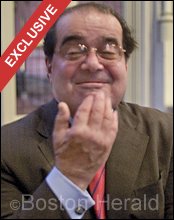
Scalia Not Impartial on Hamdan


Supreme Court justice Scalia's impartiality is reasonably questioned in the Hamdan v Rumsfeld case. He should recuse himself from the case.

The Hamdan case challenges legality of the military commission that seeks to try bin Ladin's former driver for war crimes. Newsweek reported that, before testimony on the Hamdan case was completed, Scalia gave a speech in Switzerland, where he dismissed the idea that the detainees have rights under the U.S. Constitution or international conventions. During the speech Scalia said he was "astounded" at the "hypocritical" reaction in Europe to Guantanamo. Scalia said "War is war, and it has never been the case that when you captured a combatant you have to give them a jury trial in your civil courts."

A chauffer is as much of a combatant in this "war on the tactic of terror" as a biased Supreme Court Justice is.

Voice your opinion:
Contact the Supreme Court

Note: This piece draws on text from:

March 27 DemocracyNow! headline

Washington Post

March 28, 2006

The Citizen Will Show

A funny thing happened on my way to Korea and back. Well, actually it was an article of mine that apparently made the trip. The punch line, as translated and retranslated, was "The Citizen Will Show." That pretty well sums it up.

One part of the translation does concern me, however. That is, "thuk Recalling the President with the sword and... the child wild world being horrible."

I want the Secret Service to know, that's not exactly what I said. I want him impeached, not recalled. The part about the sword is some korean's poetic license.

To clarify:
바른언론 빠른통신 인터넷 연합뉴스>자유토론 보기

Gary Hart Calls on "the people" to Check Bush "Tyranny"


Two-time presidential candidate Gary Hart has drawn on writings of the Founding Fathers to define Bush's consolidation of power as "tyrany," and calls on the people to check this constitutional crisis.

A Simple Sequence of Logic:

Bush is concentrating executive powers under the "war on terror," which are not granted by the Constitution and are prohibited by Congress.

James Madison defined tyranny as the concentration of powers in one branch of the government.

Madison's solution to tyranny relied upon either Congress or the Supreme Court checking the president. Presently, Congress will not check the president, and no legal case is working its way towards a Supreme Court judgment.

Facing the failure of our system of checks and balances, Hart proposes the question, "Can what Thomas Jefferson called the "common sense and good judgment of the American people" help us now?"

Hart argues that the people can and must check the president's tyranny, but first they must wake up to the present constitutional crisis.

Note: The text above draws heavily on the March 27, 2006 article by Joyce Appleby and Gary Hart

March 26, 2006

Si se Puede by the Hundreds of Thousands

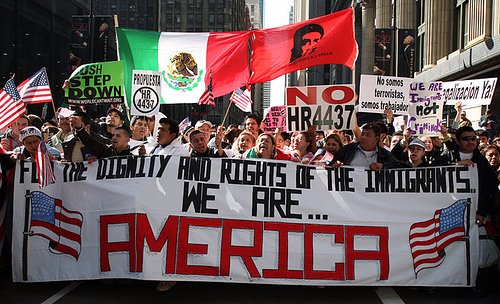
Immigrants are facing the prospect of Congressional legislation that would build a fence along one-third of the US/Mexico boarder, criminalize undocumented immigrants and criminalize people who feed and house these immigrants by classifying them as human traffickers. Because the House legislation, HR 4437, has already been passed, immigrants' concern is palpable as the Senate considers the Sensenbrenner Bill.

This concern materialized in Los Angeles as 500,000- 1.5 million people took to the streets chanting "Si Se Puede" (Yes we can) on March 25, 2006 (Associated Press). Having some personal exeperience with peace protests, I know that's a huge number of people (a demonstration is considered very successful if 100,000 people participate).

According to the AP article, the "legislation ... would make it a felony to be in the U.S. illegally, impose new penalties on employers who hire illegal immigrants, require churches to check the legal status of people they help, and erect fences along one-third of the U.S.-Mexican border."

The massive LA protest isn't an isolated demonstration. On Friday March 10, to the suprise of many, Chicago police estimated over 100,000 protesters in the streets of that city (Coverage Link). Street protests have occured elsewhere, including 5,000 to 7,000 on March 25, 2006 in Charlotte, and tens of thousands in Washington, DC on Monday March 7, 2006 (Wash Post Link). Denver, CO had a demonstration of about 50,000 and Phoenix, AZ had a demonstration of about 20,000, which was its largest protest in history.

These protests, often on week days, demonstrate a massive base of human power for which this issue ressonates. A more humane approach to immigration reform would be wise in the face of the likely resentment the proposed legislation could engender in this huge constituency.

March 12, 2006

Censure Bush for Violating 4th Amendment

Senator Russ Feingold's call to censure bush for the illegal domestic spying program is an appropriate response. Failure to respond in some way would condone this type of behavior in future presidencies and erode the fabric of our self-governing system.

March 11, 2006

The Biggest Fear in Real Estate

The front page of today's Wall Street Journal reads, "Many mortgage borrowers may face financial problems or even foreclosure as adjustable-rate-mortgage payments are reset higher." Why has the WSJ used the prominent upper right-hand corner of it's front page for this message? Perhaps their aims are similar to those of the Federal Reserve, to stop the unhealthy speculative boom in the real estate market. That boom is slowing, but the question remains: Will the boom become a bust? More important, would such a bust spread to the entire economy?

The answer to the first question depends on the local market. Some markets might not see a bust, like Baltimore, Maryland, which will experience housing demand in response to recent military base realignment decisions. Others might be in for a shock, for reasons below.

First-year economics teaches us that prices drop when supply increases. It was with this in mind that David Seiders, cheif economist for the National Association of Home Builders recently said, "the biggest fear I have is investor-owned units coming back on the market in large numbers." [1] He has good reason to fear, because there's a record number of such units available to flood the market.

Second homes now comprise 38 percent of the nation's entire existing housing stock, according to the National Association of Realtors' "2005 National Association of Realtors Profile of Second-Home Buyers" released in March 2006.[2] Add to that the "millions" of borrowers who face foreclosure because they have exotic balloon-rate mortgages, and the "potential" for a downward bust in prices is undeniable.

That potential is a main ingredient for a bust. The other ingredient is self-reenforcing feedback. Lets look at a boom cycle as an example of such feedback. In the earl-1990s the Asian market was getting attention in the business press and many people pondered investing in foreign stocks. Early investors acted and the stocks rose. This rise gave confidence to a few more investors who entered the Asian market driving the stocks and other asset prices up further. This undeniable rise reenforced the justification for others to invest, which in turn drove up the prices. The feedback process continued, word got around to less informed investors who boosted the stocks further. There is often a "testing" period, when wise investors leave the market for fear of a downturn, and the rise slows or even dips, but this is often counter-balanced by late comers to the speculative boom. Eventually, the dip turns back up, fears of a downturn subside, and the self-reenforcing boom continues. This was the case in Asia until 1998 when the bottom fell out. The spread of this crash became known as "the Asian contagion."

What is clear is that this self-reenforcing feedback process works in both directions. Eventually, profit takers start to leave, and the stock price comes down a little. Those who got in late have little profit margin to loose, and they get must get out quickly, causing a clearly evident price decline. This undeniable decline reenforces the rationale for leaving, and others start to fear an actual loss on their investment. The same logic certainly applies in the case of the current real estate market, though the process is slower than for stocks; investor-owners don't want to get stuck holding a property they must maintain, particularly if the rigors of being a land lord is not their strong suit.

A third ingredient of boom-bust mechanics is summed up by the phrase, "the bigger the rise, the bigger the fall." For five years, real estate prices have witnessed dramatic annual rises. The annual percentage assessment increase in Maryland for at the end of 2005 was 20%. The range by county was 13%-26%. [3 Baltimore Sun] This followed five years of similar annual increases. But forget the numbers, who hasn't heard someone say, "I couldn't even afford to buy my own house today if I was in the market to buy." I've heard this statement a half-dozen times from people with well-paying jobs.

But, as convincing as that might be, that's all hypothetical. There is hard evidence of "the biggest fear" coming to pass. The Baltimore Sun article, referenced above, was accompanied by another article entitled, "slowdown poses new reality for buyers, sellers in region." The article includes a graph entitled, "listings soar" in which the number of homes for sale is shown to have more than doubled in a year. This is happening in the Baltimore market, which is supposed to be buffered by pending demand due to military base expansions. The 25% drop in San Diego housing prices from 1990 to 1996 also wasn't hypothetical. [4]

Now, to address the question of a potential spread of real estate woes to the rest of the economy. On August 8, 2005, economist and columnist Paul Krugman had a piece in the New York Times entitled "That Hissing Sound." He notes that the economic recovery since the 2001 stock market crash "wouldn't have happened at all without soaring spending on residential construction, plus a surge in consumer spending largely based on mortgage refinancing."

Will people run back into the stock market if the real estate market deflates? Major US auto manufacturers now make most of their profits on finance fees for car purchases, rather than on the product itself. The average US citizen has a negative savings, implying that the auto industry might have squeezed as much real money out of the public as it can for some time to come.

Then there are our financial institutions. They too have huge exposure to the real estate market. In February 2003, the Office of Federal Housing Enterprise Oversight released a REPORT that lost the OFHEO director his job. The director, Armando Falcon, had the nerve to explain that major commercial banks were heavily invested in risky real estate-based financial instruments crated by Fannie Mae and Freddie Mac. This meant that if the real estate market goes south some major banks will go with it, and with the banks go other parts of the economy in a chain reaction.

For example, the report indicates that major insurers are also at risk. So, imagine you run a business that has no relation to real estate, so you think, say import/export. One morning you read in the business section of the news paper that real estate is taking a beating. The next morning you read some banks are getting shaky, fortunately, not the bank with which you conduct business. The next week, you read that your insurer has gone belly up because it was invested in real estate. Suddenly, you realize that your business is related to real estate, and that the world is a very dangerous place. You pray nothing bad happens to your current import shipment, while you frantically seek another insurance company. Unfortunately, you learn that the four biggest insurers were heavily invested in real estate. Maybe the "biggest fear in real estate" isn't the possibility that gobs of "investor-owned units will come on the market in large numbers," but the fear that real estate is strongly coupled to the rest of the economy.

Notes:
1. "Housing Slowdown Ripples Through Economy," March 6, 2006, Associated Press, David Koenig.

2. Realty Times, March 10, 2006

3. Baltimore Sun, December 30, 2005 "Home assessments jump over 20 percent statewide."

4. Paul Krugman, "That Hissing Sound," New York Times Opinion section, August 8, 2005.
February 28, 2006

DP World Requests Second Review?

On February 27, 2006, AP's LIZ SIDOTI reported from Washington, "With the [port] deal under intense bipartisan criticism in Congress, the Bush administration agreed Sunday to DP World's request for a second review of the potential security risks related to its deal." Emphasis added.

I realize this is White House spin. The White House wants to avoid looking like it is caving in to pressure from Congress for a 45-day security review. But this White House spin puts it in the rediculous position of "agreeing" to a foreign corporation's request for a security review. Since when did the White House start entertaining such requests from foreign corporations, or is this request from a foreign government?

February 27, 2006

Bush Failures

Prescription Drugs,

Hurricane Katrina Response,

Port Security, lack of investment,

Port sales to United Arab Emirates (these are separate issues),

Growing Government debt,

International trade deals like CAFTA,

Iraq War...

... to name a few that are making Republicans nervous in an election year.

February 23, 2006

Haiti's Preval and the Rule of Law

Despite numerous delays of the Haitian election, engineered by foreign powers to prevent a popular candidate from being chosen, Rene Preval is now President-elect. He has proclaimed that Jean-Bertrand Aristide may return to Haiti, something the foreign powers insist should not be allowed. But Preval doesn't stop there. He says any Haitian citizen may live in Haiti, even those who are known to have been death squad leaders, even those who were part of the foreign-sponsored coup against Aristide.

Preval's argument? The Haitian constitution protects citizen's rights to live in Haiti. Are these just words or does Preval intend to live by these words? He is saying he intends to follow the supreme law of Haiti, its constitution, regardless of the difficulties that might result.

Elsewhere, adherence to law has eroded. Referring to international law, Shlomo Ben-Ami, former Israeli Foreign Minister, has said recently, "there are conditions where you cannot apply these lofty principles, which are very important, but you cannot apply them." [1] And in the U.S. we have Alberto Gonzales authoring a memo in January 2002 concluding that Article III of the Geneva Convention are obsolete as applied to captured Al Qaeda and Taliban fighters. [2] The Geneva Conventions are a treaty, adopted into US law by a ratification process. And the US President argues that he has the right to surveil US citizens as an unintended consequence of intercepting foreign electronic communications, despite the US constitution's fourth amendment requiring probable cause and a warrant. [3]

Is Haitian leader Preval serious about following the laws of his land? If so, he would be leading by example in a time when actions of US leaders demonstrate a distain for the rule of law, unless the laws are those written by corporate lobbyists to undermine the rights of the people.

NOTES:
1. DemoncracyNow! Interview 2/14/06

2. Gonzales authored a controversial memo in January of 2002 that explored whether Article III of the Geneva Convention even applied to Al Qaeda and Taliban fighters captured in Afghanistan and held in concentration facilities around the world, including Camp X-Ray in Guantanamo Bay, Cuba. The memo made several arguments both for and against providing Article III protection to Al Qaeda and Taliban fighters. He concluded that Article III was outdated and ill-suited for dealing with captured Al Qaeda and Taliban fighters. He described as "quaint" the provisions that require providing captured Al Qaeda and Taliban fighters "commissary privileges, scrip, athletic uniforms, and scientific instruments". He also argued that existing military regulations and instructions from the President were more than adequate to ensure that the principles of the Geneva Convention would be applied. He also argued that undefined language in the Geneva Convention, such as "outrages upon personal dignity" and "inhuman treatment", could make officials and military leaders subject to the War Crimes Act of 1996 if mistreatment was discovered. http://en.wikipedia.org/wiki/Alberto_Gonzales

3. Fourth Amendment: "The right of the people to be secure in their persons, houses, papers, and effects, against unreasonable searches and seizures, shall not be violated, and no Warrants shall issue, but upon probable cause, supported by Oath or affirmation, and particularly describing the place to be searched, and the persons or things to be seized."

February 21, 2006

Operation Northwoods

In 1962 senior US military officers proposed staging false pretexts for attacking Cuba. In addition to propaganda campaigns and staged attacks and incidents at US bases in Cuba, the proposed plans included terrorist attacks within the US, the sinking actual refugee boats, the attack of Cuban exiles intended to cause physical injury, the staged downing of a civilian chartered aircraft with college students going on vacation, and the staged downing of a military F101 with planted debris to be found by other unsuspecting members of the US Air Force.

This is must-read US history.

Wikipedia Summary

Declassified Memo PDF

February 20, 2006

Immediate Phased Redeployment: Republican Lite?

The Democrats have a sound-bite to counter Bush's "Stay the Course" bumper sticker on the Iraq war. They call it, "Immediate Phased Redeployment".

According to the Boston Globe, Senator Jack Reed, "an Army veteran and former paratrooper, has been charged with developing a strategy on the war for the Democrats. The plan exposes the "false dichotomy" suggested by President Bush: The only options in Iraq are "stay the course" or "cut and run." Globe Article

For some time now, military analysts have observed that the presence of US troops helps fuel the insurgency. Their analyses have included the option of moving forces from urban areas to bases in the countryside. Secretary of Defense William Perry addressed this issue broadly in 1996 [1]. Now Democratic Party leaders are considering this option in the form of a "strategic redeployment" plan, which would relocate US troops elsewhere in the region from where they could respond to emergencies in Iraq. Will this include redeplyoments within Iraq? Is this actually a new plan, or something that is already in the works for which Democrats are attempting to take credit?

Adopting this plan could be considered "progress"; however, it might also fit into the grand strategy for a permanent US presence in Iraq. Given the construction of permanent US bases in Iraq [2], it looks like the two major US political parties are preparing to maintain indefinite US control over Iraq and its natural resources. Once again, this Democratic proposal smells a bit like Republican Lite.

Notes:

[1] Report to the President and the Congress, "The Protection of US Forces Deployed Abroad," September 15, 1996.
LINK

[2] "US military to build four giant new bases in Iraq", Michael Howard in Baghdad
Monday May 23, 2005 Gaurdian Article

Impeachment Articles: An Obligation

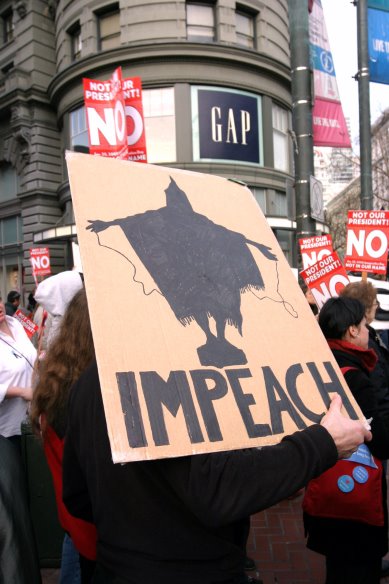
The opposition party is obligated to draw up articles of impeachment. It is not a matter of political strategy, nor does it depend on the probability of successful impeachment; it is a matter of defining American values for posterity.

If we can collectively answer "no" to any of the following, then we must draw up articles of impeachment.

Are we willing to accept torture as an American value, including sensory deprivation combined with painful stress positions?

Are we willing to accept abrogation of the Geneva Convention and other international norms as an American value?

Are we willing to accept an executive branch violation of the constitution to allow electronic surveillance of American citizens without a warrant from the judicial branch?

Are we willing to allow the executive branch to detain people indefinitely without charge and due process?

Are we willing to accept the practice of intentional deception of American citizens by the executive in order to sway public opinion in advance of a decision by the legislature? [1]

Are we willing to accept the practice of intentional deception of the US Congress by the executive branch in advance of a dicision by the legislature? [2]

Are we willing to accept cronyism in the form of creating opportunities for windfall profits and steering those profits to corporations that, in turn, provide financial backing to executive interests?

We need to draw a bright line on American values, and future expectations of the Office of the President. Articles of impeachment must be formally drawn up by the opposition party.


NOTES:

1. The executive branch paid African American commentator Armstrong Williams to surreptitiously promote the "No Child Left Behind Act" as a part of his talk shows and columns. The executive branch presented deceptive intelligence information to the public and Congress prior to invading Iraq.

2. The chief Medicare actuary, Richard S. Foster, said that Thomas A. Scully, administrator of the Medicare program, directed him to withhold the information from Congress on the true cost of Bush's proposed prescription drug program, citing orders from the White House in one instance. Congress was informed the cost would be about $400 billion over ten years. The more valid estimate was between $678 to $737 billion. Source

Acknowledgment: This blog entry was inspired by statements from Richard Dreyfuss. I've drawn heavily from his statements.

February 19, 2006

Michelle Malkin: Asian Anne Coulter

No thanks to a podcast of the Air America's "Best of Ring of Fire for 2005", today I learned about Michelle Malkin. Here's all you need to know about her:

In November of 2004, the Norfolk, Virginia-based Virginian-Pilot ceased running Malkin's nationally syndicated column. Fellow columnist Bronwyn Lance Chester explained, "I think [Malkin] habitually mistakes shrill for thought provoking and substitutes screaming for discussion… She's the worst of what's wrong with punditry today. She adds absolutely nothing to genuine political discourse."
Source: Wikipedia on Malkin


Photo Source: www.mlcsmith.com/graphics/warped/

January 24, 2006

Detect and Prevent

Lieutenant General Michael V. Hayden, USAF, former Director of the National Security Agency (NSA), argued that the warrantless spying was necessary to "detect and prevent" potential terrorist acts. He also explained that the NSA is executing a Presidential order deemed to be legal by the US Department of Justice.

The Foreign Intelligence Surveillance Act (FISA) Court has approved 18,742 applications and denied just four between 1979 and 2004. If the communications being intercepted by the NSA is "focused" and "targeted," why is it necessary for the NSA to sidestep obtaining a warrant from FISA for eavesdropping on US citizens?

The answer implied by Hayden, and US Attorney General Gonzales, is that they need to be expeditious. The President can order a search 72 hours prior to obtaining a FISA warrant if urgency is the issue. A more convincing answer seems to be that the President didn't believe he could obtain a warrant from the FISA court, because he could not prove "probable cause," and would thus violate the 4th amendment of the US Constitution.

This was exposed in an exchange between Jonathan Landay with Knight Ridder and General Hayden on January 23, 2006 at the National Press Club. Addressing General Hayden, Landay contended, "You used the terms just a few minutes ago, "We reasonably believe." And a FISA court, my understanding is, would not give you a warrant if you went before them and say "we reasonably believe"; you have to go to the FISA court, or the attorney general has to go to the FISA court and say, "we have probable cause."

Hayden insisted that the burden in the 4th amendment was not "probable cause," but rather a prohibition against "unreasonable search and seizure." Hayden stated, "... if there's any amendment to the Constitution that employees of the National Security Agency are familiar with, it's the Fourth. And it is a reasonableness standard in the Fourth Amendment. And... what you've raised to me is, in terms of quoting the Fourth Amendment, is an issue of the Constitution. The constitutional standard is "reasonable." See the Full Exchange

Fourth Amendment: "The right of the people to be secure in their persons, houses, papers, and effects, against unreasonable searches and seizures, shall not be violated, and no Warrants shall issue, but upon probable cause, supported by Oath or affirmation, and particularly describing the place to be searched, and the persons or things to be seized."

January 16, 2006

Baltimore Neighborhood Proposal to Limit Corporate Power

Residents of the Baltimore City neighborhood have proposed limiting the entry of large corporate franchises. According to the Baltimore Sun, this initiative has been led by Benn Ray, the owner of Atomic Books located on 36th Street in Hampden (The Avenue). Sun Article

Some people have interpreted this proposal to be "elitist," as reflected in a letter to the editor of the Baltimore Sun
Opposing Letter to the Sun They seem to envision chic towns, like Carmel California, which have passed similar laws. According to the Jan. 3, 2006 Sun article, the initiative is backed in concept by Mary Pat Clarke, in legislation regarding "formula businesses."

However, this desire to limit franchises has been championed in places around the country for reasons other than preserving the look and feel of trendy places like Carmel, California. This alternative motivation is that of resisting the growth of corporate power and influence on our culture. One of the leaders in this has been the community of Arcada California, led by a group called Democracy Unlimited of Humboldt County. Highly Recommended Link

Below is a letter to the Baltimore Sun on this subject, which expresses concerns about excessive corporate power.

I can understand how some might believe that the sole motivation for preventing franchises from locating to Hamden is "elitist" ("Hampden elitists unfairly limit trade," Jan. 9, and "Hampden strives to preserve its style," Jan. 3). However, there is another motivation for the legislation that would limit large corporate franchises in Hampden. That is the undeniable need to curtail the excessive power that has been amassed by corporate entities beginning in the mid 1800s.

This concern regarding corporate power might also sound "elitist." However, an honest appraisal reveals that, for generations, the true elite of society are those who have used corporations to amass wealth. This consolidated wealth has, in turn, been used to influence the creation of laws and judicial decisions that have conveyed even greater power to corporations. The classic example occurred in 1877, during the corrupt Robber Baron railroad era, when the corporate elite managed to have corporations recognized by the US Supreme Court as "persons" under the 14th Amendment of the Constitution.

After generations of repeating this cycle of using corporate-generated wealth to game the democratic system, corporate persons have accumulated far more power than persons of flesh and blood. The corporate "person" is immortal and amoral (profit motive is independent of moral choices). A single corporation can operate in multiple places on the globe at all times through legions of lawyers, lobbyists, researchers and truly elite executives. Corporations can hammer away tirelessly at their desired goals, which are often contrary to the desires of human goals, even when the humans are in the majority. This is because it has been found unconstitutional to "discriminate" against a corporate "person".

I support shifting the balance of power back in favor of the human person, away from the corporate person. To the tiny degree that the proposed legislation helps accomplish this, I view it as a positive step in the ongoing multi-generational struggle for humans to regain control over excessive corporate power.

END

January 15, 2006

Revolutionary Power


The Introduction to Paul Krugman's book, "The Great Unraveling" calls for a paradigm shift in how we look at today's World. That's because his reality has been shaken, and he shares his spine chilling revelation with us all.

Krugman, a Princeton economist, was offered a gig to write an opinion column in the New York Times. International financial crises were one of his specialties. When he took the Op-Ed job in 1999, he thought he would "write about the vagaries of the new economy, the impacts of globalization, and bad policies of other countries."

"But as events unfolded, politics inevitably intruded." Krugman eventually found himself "speaking very uncomfortable truth to power." "I began pointing out the outrageous dishonesty of the Bush administration." Krugman's book chronicles his commentaries on an unsettling pattern of abuse of power by the Bush administration.

As Krugman's book was about to go to press, someone brought Henry Kissinger's 1957 doctoral dissertation to his attention. Having the experience of critiquing the Bush administration in detail for several years, Krugman read a passage in Kissinger's dissertation "that sent chills down [his] spine, because they seemed all too relevant to current events." The passage describes how the general population responds to a "revolutionary power" that is taking over "a heretofore stable diplomatic system":

Kissinger wrote, "Lulled by a period of stability which had seemed permanent, they find it nearly impossible to take at face value the assertion of the revolutionary power that it means to smash the existing framework. The defenders of the status quo therefore tend to begin by treating the revolutionary power as if its protestations were merely tactical; as if it really accepted the existing legitimacy but overstated its case for bargaining purposes; as if it were motivated by specific grievances to be assuaged by limited concessions. Those who warn against the danger in time are considered alarmist; those who counsel adaptation to circumstances are considered balanced and sane.... But it is the essence of a revolutionary power that it possesses the courage of its convictions, that it is willing, indeed eager, to push its principles to their ultimate conclusion."

It's a case of "The Big Lie."

Krugman gives an example, of this "eager" "conviction," in a response that Supreme Court Justice Antonin Scalia gave to a "student who asked how he felt making the Supreme Court decision that threw the election to Bush. Was it agonizing? Did Scalia worry about the consequences? No: "It was a wonderful feeling," he declared."

Krugman used to be a fairly mainstream thinker until his epiphany that we are presently facing a revolutionary power that intends to undermine the principles and values of the United States. Krugman outlines his "rules for reporting" under these circumstances when the rulers are not playing by the rules:

1. Don't assume that policy proposals make sense in terms of their stated goals.

2. Do some homework to discover the real goals.

3. Don't assume that the usual rules of politics apply.

4. Expect a revolutionary power to respond to criticism by attacking.

5. Don't think that there's a limit to a revolutionary power's objectives (If they nominate a Supreme Court Justice who opposed Roe v Wade, they intend to overturn Roe v Wade).

With Bush in mind, a former director of the Brazilian mint once told me, "It's easier to prevent a dictatorship than it is to remove a dictatorship." He spoke from experience.

The Big Lie: Are We Living One?

The predictable response to this question that I might expect from you is, "One? We're living a whole slew of big lies."

That is true; however, I recently had one of those sinking-feeling moments that made me wonder if we're not living an even bigger lie than even the one that lead us into the Iraq war. I'm not talking about the "9/11 Truth" conspiracy, though *shrug* ya never know. I'm talking about rampant criminality being the norm rather than an accepted marginal reality.

True, the US Government has frequently worked with organized crime. When the Government needs information or a favor, and the criminals can provide it, the Government is often willing to "look the other way" in exchange for what it needs. This is routine. There's also the situation in which the Government itself becomes involved in criminal activity, such as transporting drugs to fund black operations. The implied rationale is that the national security benefits of the black operations out weigh the costs of US Government participation in the illegal drug trade. Then, there are even cases in which US officials, or even small units of government, engage in criminality simply for benefit. But it seems today that criminality of a nature that is deeper and more wide spread is going on... I'm not talking about Jack Abramoff, though you start to get an idea of what I'm talking about if you consider this a tip-of-the-arctic example.

Those familiar with organized crime know that "once you get in, you can never get out." The primary reason is that "you know too much" and the syndicate is so powerful, there's no place to hide... and if you can hide, they'll "get" your family. I have that "Invasion-of-the-body-snatchers" feeling, or "Rosemary's Baby" feeling, that things aren't what they seem to be. This hunch is more than a healthy, or unhealthy, dose of paranoia.

I'm getting the feeling that some people within US government are being forced to "choose sides," and that many are choosing the criminal side who they predict will come out winners. Many others are in denial, and simply staying quite. A few are speaking out. Unfortunately, because the few speaking out face "The Big Lie," their voices are going unheeded by the vast majority of the American public continue to slumber in denial.

According to Wikipedia, Hitler wrote in his 1925 autobiography Mein Kampf (James Murphy translation, page 134): "... in the big lie there is always a certain force of credibility; because the broad masses of a nation are always more easily corrupted in the deeper strata of their emotional nature than consciously or voluntarily; and thus in the primitive simplicity of their minds they more readily fall victims to the big lie than the small lie, since they themselves often tell small lies in little matters but would be ashamed to resort to large-scale falsehoods. It would never come into their heads to fabricate colossal untruths, and they would not believe that others could have the impudence to distort the truth so infamously. Even though the facts which prove this to be so may be brought clearly to their minds, they will still doubt and waver and will continue to think that there may be some other explanation."

So, "what," you ask, "is this big lie."? We see is a pattern of actions, all predicated on "protecting the National Security," that is more akin to a group of people seeking to accumulate wealth, control and power in the face of an oncoming global debacle. They believe that law of the jungle is creeping up upon World. They have a mentality like that of the survivalists who create a horde of canned goods and dig fallout shelters. They have access to "intelligence," so they "know more" than many of us mere mortals. They mouth words of "freedom" and "democracy," some even believing that they are being true to those ideals, while their actions expose them as frauds at best and more likely as fascists. Ironically, many would honestly not view themselves as fascists, in part, because they have not taken the time to learn much about fascism. In this case, the lie is so big, they themselves are living a delusion, not realizing they are wrapped in the lie. Many also wrap themselves in the American flag.

This must all sound very nebulous to you, the reader. If you want a better feel for this hunch, read the following:

1. The Introduction to "The Great Unraveling," by Princeton economist Paul Krugman. See my blog piece on "A Revolutionary Power" for the gist.

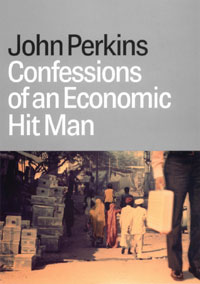
2. "Confessions of an Economic Hit Man," by John Perkins.
Interview Link

3. "Worse than Watergate: The Secret presidency of George W. Bush" by John Dean, former counsel to President Richard Nixon. My hunch is that it's worse than "worse than watergate".

4. "An Inconvenient Patriot," David Rose, Vanity Fair, September, 2005. Tells the strange tale of how former FBI translator Sibel Edmonds came to know "too much," and describes similar tales about BFI intelligence-operations specialist John Cole, FBI counter terrorism specialist Mike German, Russ Tice who worked for both the Defense Intelligence Agency and the National Security Agency. All of these people discovered "strange things" happening in their agencies, and when they tried to get to the bottom of it, they were set up and fired.

"She [Sibel Edmonds] is credible, and the reason I feel she's very credible is because people within the FBI have corroborated a lot of her story." US Senator Charles Grassley (R) Iowa.
Sibel Edmonds Article Link

January 2, 2006

Consolidation of Pentagon Power

2005 ended a year in which the Bush Administration continued to consolidate power. The cabinet was re-shuffled to move Bush loyalist Condoleezza Rice into the State Department. Alberto Gonzoles, brought by Bush from Texas, advances from the role of White House Counsel and architect of Bush's torture policies, to head of the Nation's Justice Department. The list goes on.


One name on the list of loyalists who are being brought into the tightening circle around Bush is not a household word. That is Defense Undersecretary for Intelligence Stephen A. Cambone. US Brigadier General Janis Karpinski, former Commander of the Abu Ghraib prison, believes he "orchestrated" the policies on US use of torture [1].

Cambone has been brought closer to Bush's political control by a Presidential Executive Order that changes the Pentagon chain of command in the event of an "emergency." This executive order moves the Pentagon intelligence chief into the No. 3 spot in the succession hierarchy; moved down the list are the heads of the Army, Navy, and Air Force.

The "plan moves to near the top three undersecretaries who are Rumsfeld loyalists and who previously worked for Vice President Dick Cheney when he was defense secretary" according to the Dec. 29, 2005 AP article.
Full Article Link

Even conservatives are unnerved by the consolidation of power represented by this move. According to the AP article, 'Thomas Donnelly, a defense expert with the American Enterprise Institute, said the changes make it easier for the administration to assert political control and could lead to more narrow-minded decisions.'

"It continues to devalue the services as institutions," said Donnelly, saying it will centralize power.'


[1] "The Signal" interview with Janis Karpinski, July 4, 2004.
Full Interview Link Interview Excerpt Below:

Signal: Who is — who are the responsible parties for the prisoner abuse at Abu Ghraib?

Karpinski: I don't know. I could tell you that — you want my opinion?

Signal: Yes.

Karpinski: General Miller. [architect of Guantanamo Bay interrogation program, which he transferred to Iraq]; General Fast. [responsible for intelligence in Iraq]; General Sanchez. (Defense Undersecretary Stephen A.) Cambone. I don't know if it stops at Cambone, but I believe that he was orchestrating it, he was directing.

She also took blame herself for not speaking out loudly enough.

December 21, 2005

Warrantless Domestic Spying: An Impeachable Offense

The Legislative Branch is a coequal branch of government relative the Executive Branch. By design, the House of Representatives is closest to the People, which is why the impeachment powers reside within the House. The People need to raise their voices to ensure that the Legislative Branch checks the excessive use of powers being exercised by the Executive Branch.


Even conservative legal scholars have admitted the severity of Bush's actions in using the NSA to spy on US citizens without a warrant. Norm Ornstein, a scholar at the American Enterprise Institute, said "I think if we're going to be intellectually honest here, this really is the kind of thing that Alexander Hamilton was referring to when impeachment was discussed."

Alone, this offense is impeachable. However, it is also another straw on the People's backs, which justifies impeachment. Add this violation of trust to the following:

+ Misrepresentation of Intelligence to Justify War in Iraq
+ Starting a War to Justify the Misuse of Various War Powers
+ Detaining People Indefinitely without Due Process
+ Advocating and Conducting Torture
+ Renditioning People to Secret CIA Prisons
+ Renditioning People to Countries to Conduct Torture
+ Retributions Against Countries & People that Oppose Bush Actions
+ Numerous Cover-ups

Many former government insiders are speaking out against the excesses of the Bush Administration. For a list, go to:
Those Who Told
Fallen Legion

December 20, 2005

"Show Me Your Papers"

"It brings us frighteningly close to a show me your papers society," said Carrie Davis of the ACLU, in regard to the Ohio Patriot Act that has made it to the Ohio Governor's desk for signature.

According to News 5, of Cleveland, the Ohio Patriot Act would let police arrest people in public places who will not give their names, address and birth dates, even if they are not doing anything wrong. One Ohio state representative said it resembles Gestapo-style tactics.

Combine this bit of news with the New York Times revelation last week that the Bush Administration has used the NSA to spy on US citizens and it is difficult to keep the word "fascism" from creeping into the back of one's mind.

Those who have an interest in understanding fascism are encouraged to read "Anatomy of Fascism" by Robert O. Paxton. Although I like the susinct quote by FDR, below, Paxton's take on fascism is a bit more chilling, in part because it fits the current situation so well.

Paxton argues that fascism isn't really an "ism." "isms" are defined by a core set of principles, which in turn tend to drive policies. Fascism, on the other hand, is hard to pin down; analyses of past fascist movements reveal what appears to be contradictory alliances and principles. Fascism tends to be defined by the way it grows in a society and its illusive principles. Paxton reveals that fascism has only one over-riding principle, securing and maintaining power. If it is necessary in the early stages of a fascist movement to have alliances with leftists, and then later switch alliances, so be it. If it is necessary to vocalize one set of principles early on, and change them later, so be it. If it is necessary to give one justification for a major government action, like starting a war, and then change the justification later, then so be it as long as it leads to the consolidation of power.

In short, fascism seems to be all about gaining and maintaining power. It stands to reason that, in a democratic society, the initial stage of a fascist consolidation would need to have popular support. Rush Limbaugh's ditto heads and the blind-faith evangelicals are well suited to serve in this capacity. In time, as power is consolidated, the laws can be changed, and civil liberties slowly eroded in order to further consolidate power. Imagine a situation in which the Congress, the Judicial System and the Executive Branch of the US were all in the hands of a fascist movement. Not hard to do these days. The fascists might not even realize that they are being fascist by Paxton's definition.

A more simple definition of fascism follows:

"The liberty of a democracy is not safe if the people tolerate the growth of private power to a point where it becomes stronger than their democratic state itself. That, in its essence, is fascism - ownership of government by an individual, by a group, or any controlling private power."
- Franklin D. Roosevelt